Reviews ›
12 Best Sublimation Printers for Heat Transfer 2026
by Rachel Kim · April 13, 2022
The global sublimation printing market surpassed $8.4 billion in 2025 and analysts project it will climb past $11 billion before 2030, driven by surging demand for custom apparel, personalized drinkware, and on-demand promotional products. For anyone looking to enter this space in 2026 — whether as a home crafter, small-business owner, or production shop operator — choosing the right sublimation printer is the single most consequential equipment decision they will make. The wrong machine produces washed-out colors, clogs at critical moments, and forces costly reprints; the right one delivers gallery-quality output, consistent batch after batch.

Sublimation printing works by converting solid dye into gas under heat and pressure, bonding color molecules directly into polyester fibers or polymer-coated hard substrates — a process explained in detail by Wikipedia's entry on dye-sublimation printing. Unlike inkjet printing on paper, sublimation transfers produce fade-resistant, wash-resistant results with no cracking or peeling. The technology spans a wide hardware range, from compact desktop units capable of printing a single mug transfer to wide-format professional machines handling 24-inch banners. Readers new to the process should start with this overview of what sublimation printing is before diving into hardware comparisons. Those already familiar with the basics and looking for project inspiration will find the top 20 sublimation ideas a useful companion to this guide.
This review covers seven of the most competitive sublimation printers available in 2026 — two purpose-built Sawgrass models and five Epson machines spanning entry-level, mid-range, and professional tiers. Each unit has been evaluated on print quality, media flexibility, maintenance demands, software ecosystem, and total cost of ownership. The goal is to give buyers the factual, specification-grounded comparison needed to match hardware to workflow, whether that workflow involves occasional hobby transfers or high-volume commercial runs. A full list of compatible substrates appears in the guide to 36 of the best sublimation blank products, which pairs naturally with the hardware selections below.
Contents
- Standout Models in 2026
- Detailed Product Reviews
- Sawgrass SG500 — Best for Home & Startup Businesses
- Sawgrass SG1000 — Best for Scaling Businesses
- Epson SureColor F170 — Best Compact Dedicated Sublimation Printer
- Epson SureColor F570 Pro — Best Wide-Format Professional
- Epson EcoTank ET-2800 — Best Budget-Friendly Conversion Printer
- Epson Workforce Pro WF-7310 — Best Wide-Format Conversion Option
- Epson EcoTank ET-4850 — Best All-in-One Conversion Printer
- What to Look For When Buying
- What People Ask
- Final Thoughts
Standout Models in 2026
- #PreviewProductRating
- Bestseller No. 1
 Rating:

- Bestseller No. 2
 Rating:
 - Bestseller No. 3
 Rating:
 - Bestseller No. 4
 Rating:
 - Bestseller No. 5
 Rating:
 - Bestseller No. 6
 Rating:
 - Bestseller No. 7
 Rating:
Detailed Product Reviews

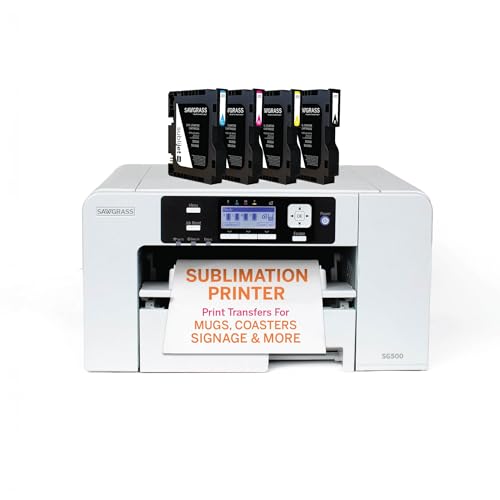
1. Sawgrass SG500 Sublimation Printer Starter Bundle — Best for Home & Startup Businesses
The Sawgrass SG500 is a purpose-built sublimation printer — not a converted inkjet — which distinguishes it immediately from most consumer-grade competitors. Sawgrass designed the SG500 exclusively for dye-sublimation output, and that focus shows in the precision of its color reproduction. The included 20mL SubliJet UHD cartridges are formulated in small batches to deliver exceptionally consistent CMYK gamut coverage, producing rich reds, saturated blues, and accurate skin tones across both polyester apparel and polymer-coated hard substrates such as mugs, phone cases, and aluminum panels.
The SG500 prints on media up to 8.5" x 14" through the standard paper path and extends to 8.5" x 51" via the bypass tray, accommodating banners and long-form transfers without requiring a wide-format machine. Wi-Fi connectivity and Sawgrass's CreativeStudio cloud software round out the ecosystem, giving operators browser-based template design alongside color profile management tuned specifically to the SG500's output characteristics. Setup is documented as genuinely straightforward, with most users reporting first successful transfers within 30 minutes of unboxing. For small businesses and home-based entrepreneurs who want professional-grade output without a steep learning curve, the SG500 represents a compelling entry point into dedicated sublimation hardware in 2026.
Pros:
- Purpose-built sublimation design eliminates conversion hassles and color-profile guesswork
- SubliJet UHD inks deliver vivid, consistent CMYK color on both hard and soft substrates
- Bypass tray extends print length to 51 inches for banners and panoramic transfers
- Wi-Fi connectivity pairs with CreativeStudio cloud software for streamlined workflow
- Compact desktop footprint suits home studios and small retail environments
Cons:
- Maximum standard media width of 8.5 inches limits output to smaller apparel and hard-good formats
- SubliJet UHD cartridge costs are higher per milliliter than third-party sublimation inks
- No automatic document feeder or duplex capability
2. Sawgrass SG1000 Sublimation Printer Bundle — Best for Scaling Businesses
The Sawgrass SG1000 occupies the next tier above the SG500 in Sawgrass's purpose-built sublimation lineup, extending maximum print width to 11" x 17" tabloid format straight from the factory. That jump from letter-size to tabloid output unlocks a substantially broader product catalog — full-front t-shirt transfers, 11-inch tumbler wraps, larger signage panels, and oversized promotional items that the SG500 simply cannot accommodate. The 31mL SubliJet UHD ink cartridges included in the bundle provide greater ink volume, reducing cartridge swap frequency during high-volume production runs and lowering effective per-print costs compared to the smaller 20mL units shipped with the SG500.
Automatic maintenance is the SG1000's headline operational advantage. The machine runs scheduled head-cleaning cycles autonomously, meaning operators can leave the unit idle for extended periods and return to find it ready for immediate production — without the manual purge routines that plague converted inkjet printers after periods of inactivity. Wi-Fi connectivity and integration with the CreativeStudio cloud platform mirrors the SG500 experience, so businesses upgrading from that model face no software learning curve. For growing operations that have outgrown 8.5-inch output and need tabloid-format capability with professional-grade color and near-zero maintenance overhead, the SG1000 is the logical and cost-effective step up in 2026.
Pros:
- Tabloid 11" x 17" printing opens full-front apparel transfers and larger hard-good substrates
- Automatic maintenance cycles eliminate manual head-cleaning after idle periods
- Larger 31mL ink cartridges reduce swap frequency and per-print cost versus the SG500
- Seamless upgrade path from SG500 — identical software ecosystem, no retraining required
- Business-ready build quality with commercial-grade reliability as a purpose-built sublimation unit
Cons:
- Higher upfront hardware investment compared to the SG500
- Still limited to 11 inches width for operators who eventually need 13- or 24-inch output
- Proprietary ink system restricts third-party ink options
3. Epson SureColor F170 Dye-Sublimation Printer — Best Compact Dedicated Sublimation Printer
The Epson SureColor F170 is Epson's entry-level dedicated dye-sublimation printer, designed to compete directly with the Sawgrass SG500 in the compact desktop segment. Like the SG500, the F170 is a purpose-built sublimation machine — not a modified general-purpose inkjet — which means its firmware, color management, and printhead specifications are factory-optimized for sublimation output from the outset. The PrecisionCore printhead, which Epson deploys across its professional SureColor line, delivers Precision Droplet Control that produces extremely fine detail reproduction and smooth tonal gradients, making it particularly well-suited for photorealistic transfers on hard substrates such as ceramic tiles, phone cases, and aluminum panels.
The F170 ships with a complete set of OEM Epson sublimation inks certified ECO PASSPORT by OEKO-TEX, confirming their safety for contact with textiles and apparel — a certification increasingly important for businesses selling products that meet EU or California textile safety standards. Epson's factory-sealed packaging and full manufacturer warranty provide purchasing confidence that aftermarket bundles cannot replicate. Print format is limited to 8.5" x 11" as the standard paper path, which places it squarely in the same market tier as the SG500, though the SG500 edges ahead with its extended bypass tray option. For buyers who prioritize Epson's established brand support infrastructure and OEKO-TEX certified inks, the F170 is a credible and well-supported dedicated sublimation entry in 2026.
Pros:
- PrecisionCore printhead delivers exceptional clarity and Precision Droplet Control for photorealistic output
- OEM Epson sublimation inks carry ECO PASSPORT by OEKO-TEX textile safety certification
- Full Epson manufacturer warranty and factory-sealed packaging provide reliable support coverage
- Purpose-built sublimation design eliminates conversion complexity
- Compact footprint suitable for limited studio or desk space
Cons:
- Standard paper path limited to 8.5" x 11" — no bypass tray for extended media lengths
- Epson OEM sublimation ink costs can be significant compared to third-party alternatives
- No tabloid-size output capability without stepping up to the F570 Pro

4. Epson SureColor F570 Pro 24" Desktop Sublimation Printer — Best Wide-Format Professional
The Epson SureColor F570 Pro sits at the professional end of this roundup, delivering 24-inch-wide sublimation output from a desktop form factor — a combination that distinguishes it from every other unit reviewed here. The PrecisionCore MicroTFP printhead represents Epson's most advanced consumer-facing printhead architecture, pairing Precision Droplet Control with Nozzle Verification Technology that actively monitors each nozzle during printing and compensates for any firing inconsistency in real time, producing commercial-grade reliability on demanding production schedules. The inclusion of two full ink sets in the bundle extends operational uptime between restocking events, and the integrated paper cutter eliminates manual trimming from the workflow.
Versatile media support is the F570 Pro's defining capability: the machine handles both roll media and cut sheets up to 24 inches wide, accommodating continuous banner output, full-width garment transfers for adult sizes, and wide-panel signage in a single production pass. A 50-sheet auto-feed tray manages cut-sheet production without operator attendance. The machine ships LTL freight only — buyers should factor in delivery lead time and receiving logistics, as standard parcel delivery is not available for this unit. For production shops, sign studios, and professional decorators who need wide-format sublimation output with commercial-grade reliability and are ready to invest in professional hardware, the F570 Pro is the clear selection in 2026.
Pros:
- 24-inch print width accommodates full-size banners, wide garment transfers, and large signage panels
- PrecisionCore MicroTFP printhead with Nozzle Verification Technology ensures commercial-grade output consistency
- Handles both roll and cut-sheet media with a built-in cutter for automated trimming
- 50-sheet auto-feed tray enables unattended cut-sheet production runs
- Two full ink sets included in the bundle for extended production uptime
Cons:
- Ships LTL freight only — delivery logistics are more complex than standard parcel shipping
- Higher hardware cost places it above the budget of home crafters and micro-businesses
- Larger physical footprint requires dedicated studio or production floor space
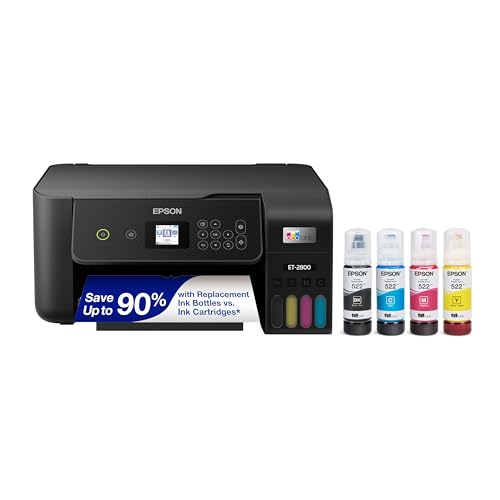
5. Epson EcoTank ET-2800 Wireless Color All-in-One — Best Budget-Friendly Conversion Printer
The Epson EcoTank ET-2800 is not a dedicated sublimation printer — it is a general-purpose inkjet that a substantial community of crafters and home-based decorators converts for sublimation use by refilling its EcoTank reservoirs with compatible third-party sublimation inks. The appeal is straightforward: the ET-2800's factory price is dramatically lower than any purpose-built sublimation machine, and its Micro Piezo Heat-Free Technology produces the type of consistent droplet formation that responds well to sublimation ink substitution. Print speeds of up to 10 pages per minute make it capable for light-production environments, and the EcoTank ink reservoir system — equivalent to approximately 80 individual cartridges per fill set — fundamentally changes the economics of high-volume printing.
Buyers considering the ET-2800 as a sublimation conversion platform should understand the trade-offs clearly: color profiles require manual calibration, ICC profiles must be sourced or built from scratch, warranty coverage from Epson does not extend to third-party ink use, and maximum paper width is limited to standard 8.5-inch letter format. The machine also lacks scan and copy functionality at this price point — those features appear in the ET-4850 reviewed below. The ET-2800 suits hobbyists, Cricut enthusiasts (see the guide on the best sublimation printers for context on compatible workflows), and low-volume operators who want the lowest possible hardware entry cost into sublimation printing in 2026, with the understanding that color management requires more hands-on attention than a dedicated sublimation unit.
Pros:
- Very low upfront hardware cost makes sublimation printing accessible to hobbyists and beginners
- EcoTank reservoirs hold ink equivalent to ~80 cartridges, dramatically lowering per-print ink cost
- Micro Piezo Heat-Free Technology responds well to sublimation ink conversion
- Wi-Fi connectivity and Epson Smart Panel app support mobile printing workflows
- Compact design fits small desks, dorm rooms, and home studios easily
Cons:
- Not a dedicated sublimation printer — ICC profile calibration requires additional setup effort
- Epson warranty void when third-party sublimation inks replace factory ink
- Maximum 8.5-inch paper width limits transfer size for larger apparel formats
- No scan or copy functionality at this tier

6. Epson Workforce Pro WF-7310 Wireless Wide-Format Printer — Best Wide-Format Conversion Option
The Epson Workforce Pro WF-7310 brings wide-format output capability to the conversion sublimation segment, printing up to 13" x 19" on standard media paths and up to 11" x 17" with automatic double-sided printing — a specification set that no EcoTank conversion model can match. For sublimation decorators who need full-size adult t-shirt transfers, large pillow panels, or oversized tote bag prints, the WF-7310's 13-inch width is a practical necessity that the ET-2800 and ET-4850 cannot accommodate. PrecisionCore Heat-Free Technology powers the printhead, delivering 25 ISO pages per minute in black and 12 in color — speeds that support modest commercial production rates when the machine is converted for sublimation use with compatible third-party inks.
The 500-sheet paper capacity, 2.4-inch color display, and Epson Smart Panel app integration position the WF-7310 as a serious production-support machine rather than a hobbyist tool, even before sublimation conversion is considered. Auto double-sided printing on media up to 11" x 17" adds operational flexibility for businesses printing two-sided promotional materials alongside sublimation transfers. As with all converted inkjet platforms, Epson's warranty does not cover third-party ink use, and buyers must source or calibrate ICC profiles independently. The WF-7310 suits mid-volume decorators who need wide-format sublimation output without the capital expenditure of the F570 Pro, accepting the color management trade-off inherent in any converted platform in 2026.
Pros:
- 13" x 19" maximum print width enables full-size adult apparel transfers and large promotional items
- 500-sheet paper capacity supports production volume without constant reloading
- 25 black / 12 color ISO ppm speeds facilitate higher-throughput conversion sublimation workflows
- Auto double-sided printing on 11" x 17" media adds operational versatility
- 2.4-inch color display provides intuitive on-device control without requiring a connected computer
Cons:
- Cartridge-based ink system (not EcoTank) increases per-cartridge ink cost relative to tank-based alternatives
- Epson warranty void with third-party sublimation ink conversion
- ICC profile calibration and color management require additional setup investment
- Larger physical footprint than EcoTank conversion options
7. Epson EcoTank ET-4850 Wireless All-in-One — Best All-in-One Conversion Printer
The Epson EcoTank ET-4850 upgrades the ET-2800's foundation with a full suite of all-in-one office functionality — scan, copy, fax, ADF, and Ethernet alongside Wi-Fi — while retaining the EcoTank reservoir system that makes conversion sublimation economically attractive. Print speed reaches 15.5 ppm in black and 8.5 ppm in color, meaningfully faster than the ET-2800, and resolution of 4800 x 1200 dpi produces fine image detail that benefits photorealistic sublimation transfers. The automatic document feeder streamlines multi-page scan workflows, which matters for home offices and small businesses using the machine for standard document handling alongside sublimation transfer production.
The ET-4850's dual-purpose nature is its primary strength and its primary limitation simultaneously. For operators who need a single device that handles everyday office printing, scanning, and sublimation transfer production without maintaining two separate machines, the ET-4850 represents a practical and space-efficient consolidation. However, sublimation ink permanently commits the EcoTank reservoirs to sublimation use — standard document printing on plain paper with sublimation inks produces heavily color-shifted, unusable output, meaning the machine cannot easily switch between use cases. Ethernet connectivity adds wired network integration for shared office environments, and the Epson Smart Panel app supports cloud scanning workflows via Epson Scan to Cloud. At 4800 x 1200 resolution with EcoTank economics, the ET-4850 delivers the strongest feature set among converted all-in-one sublimation platforms available in 2026.
Pros:
- All-in-one functionality (print, scan, copy, fax, ADF) consolidates office and sublimation equipment into one unit
- 4800 x 1200 dpi resolution produces fine photorealistic detail in sublimation transfers
- 15.5 ppm black / 8.5 ppm color print speeds support higher-throughput production than the ET-2800
- EcoTank reservoirs deliver dramatic per-print cost savings versus cartridge-based systems
- Ethernet and Wi-Fi connectivity serves both shared office and dedicated studio environments
Cons:
- Sublimation ink conversion permanently dedicates the machine to sublimation use
- Standard media path limited to 8.5 inches — no wide-format output capability
- Epson warranty does not cover third-party sublimation ink conversion
What to Look For When Buying a Sublimation Printer

Purpose-Built vs. Converted Inkjet
The most fundamental decision buyers face in 2026 is whether to purchase a dedicated sublimation printer or convert a general-purpose inkjet. Each approach carries distinct trade-offs that materially affect output quality, maintenance burden, and total cost of ownership.
- Purpose-built sublimation printers (Sawgrass SG500, SG1000; Epson F170, F570 Pro) ship with factory-tuned color profiles, sublimation-optimized firmware, and manufacturer support that covers sublimation use — they produce accurate color immediately out of the box without manual calibration.
- Converted inkjet printers (Epson EcoTank ET-2800, ET-4850; Workforce Pro WF-7310) offer lower upfront hardware costs and EcoTank ink economics, but require buyers to source compatible sublimation inks, build or download ICC profiles, and accept that Epson's warranty does not cover third-party ink use.
- Home crafters and budget-conscious beginners often start with converted EcoTank models; businesses with volume commitments and quality consistency requirements are better served by purpose-built units.
- Operators who need a machine to handle both sublimation transfers and standard office documents should note that sublimation ink permanently commits EcoTank reservoirs to sublimation use — dual-purpose workflows require a separate standard printer.
Print Width and Media Format
Maximum print width determines the product categories a machine can serve, and buyers should match hardware width to the largest transfer format they regularly produce rather than to a hypothetical future workflow.
- 8.5-inch width (ET-2800, ET-4850, F170): suitable for mugs, phone cases, small tiles, youth apparel, and accessories — insufficient for full-front adult t-shirt transfers without image tiling.
- 11-inch width (SG500 with bypass tray up to 51 inches long; SG1000 at 11" x 17" tabloid): covers most small-business apparel, drinkware, and promotional product workflows.
- 13-inch width (WF-7310 at 13" x 19"): enables full-size adult apparel transfers, oversized tote prints, and large pillow panels.
- 24-inch width (F570 Pro): production-grade wide-format for banners, large signage, and any transfer format encountered in professional decoration environments.
Ink System and Ongoing Costs
Initial hardware cost represents a fraction of total 5-year ownership cost for high-volume operators — ink economics deserve equal analytical weight before any purchase decision is finalized.
- EcoTank reservoirs (ET-2800, ET-4850) deliver the lowest per-milliliter ink cost when filled with compatible third-party sublimation inks, with each fill set equivalent to approximately 80 standard cartridges.
- Sawgrass SubliJet UHD proprietary cartridges carry premium per-milliliter pricing but deliver certified color consistency and are supported under full manufacturer warranty.
- Epson OEM sublimation inks (F170, F570 Pro) carry OEKO-TEX ECO PASSPORT certification for textile contact safety — a compliance requirement for certain commercial and export markets.
- Cartridge-based systems (WF-7310) incur higher per-cartridge replacement cost than EcoTank alternatives; high-volume operators should calculate annual ink spend at projected print volumes before selecting a platform.
Maintenance, Reliability, and Clog Prevention
Sublimation ink formulations are more prone to printhead clogging than standard office inks during idle periods, making automated maintenance capability a high-priority specification for any operator who cannot print daily.
- The Sawgrass SG1000 provides automatic maintenance cycles that run without operator intervention, keeping heads clear after extended idle periods — the most robust solution reviewed here for infrequent-use environments.
- Purpose-built Epson sublimation models (F170, F570 Pro) include maintenance utilities optimized for sublimation ink viscosity, though they lack the SG1000's fully automatic idle-maintenance capability.
- Converted inkjet models require operators to establish regular printing schedules — typically at least one test print every 3–5 days — to prevent sublimation ink from drying in the printhead and causing permanent clog damage.
- Buyers who travel, work seasonally, or use their printer intermittently should weigh the SG1000's auto-maintenance feature heavily against its higher hardware cost.
What People Ask
What is the best sublimation printer for beginners in 2026?
The Epson EcoTank ET-2800 is the most accessible entry point for beginners due to its low upfront hardware cost and EcoTank ink system, which dramatically reduces per-print expenses once loaded with compatible third-party sublimation inks. Beginners willing to invest slightly more for out-of-the-box color accuracy without ICC profile calibration should consider the Epson SureColor F170 or the Sawgrass SG500, both of which ship as fully ready-to-print dedicated sublimation systems.
Can a regular inkjet printer be used for sublimation printing?
Certain inkjet printers — specifically those using Micro Piezo or Heat-Free Technology printheads, such as Epson EcoTank and WorkForce models — can be converted for sublimation use by replacing factory ink with compatible third-party sublimation inks. Thermal inkjet printers (most HP and Canon consumer models) are incompatible with sublimation ink chemistry and cannot be converted. Successful conversion also requires appropriate ICC color profiles and sublimation-specific transfer paper to achieve professional output quality.
What substrates work with sublimation printing?
Sublimation dye bonds permanently only to polyester fibers and polymer-coated hard substrates. Compatible materials include polyester and poly-blend apparel (minimum 60% polyester content recommended for acceptable color saturation), polymer-coated ceramic mugs, aluminum panels, polyester-coated phone cases, mousepads with polyester surfaces, puzzles, and a wide range of specialty sublimation blanks. Natural fibers such as 100% cotton do not bond sublimation dye and produce severely faded or invisible transfers.
How wide of a printer is needed for full-front t-shirt transfers?
A minimum 11-inch print width accommodates most adult full-front t-shirt transfers when designing for the standard 10-inch-wide chest print area. The Sawgrass SG1000 (11" x 17") and Epson Workforce Pro WF-7310 (13" x 19") both cover this format without image tiling. The Epson SureColor F570 Pro's 24-inch width provides additional margin for oversized all-over print designs. Standard 8.5-inch printers require image tiling or design cropping to fit full adult chest prints, which introduces seam artifacts.
How often do sublimation printers need maintenance to prevent clogs?
Most sublimation ink manufacturers recommend printing at minimum every 3–5 days to keep sublimation ink flowing freely through printheads and prevent clog formation during idle periods. The Sawgrass SG1000 is the only unit in this roundup with fully automatic maintenance cycles that operate without operator presence, making it the safest option for irregular-use environments. All other models reviewed here require operators to establish consistent printing schedules or run manual head-cleaning cycles before and after extended idle periods.
Is sublimation printing washable on apparel?
Sublimation prints on polyester and high-poly-blend apparel are among the most wash-durable decoration methods available, with color bonded at the molecular level into the fiber structure rather than sitting on the surface. Properly produced sublimation transfers do not crack, peel, or fade through normal washing cycles the way screen prints or heat-transfer vinyl can. Color longevity is directly tied to substrate polyester content — prints on 100% polyester retain full vibrancy indefinitely, while prints on 50/50 blends appear noticeably lighter and more faded after production.
Buy on Walmart
- Sawgrass SG500 Sublimation Printer Starter Bundle | Anti-Clo — Walmart Link
- Sawgrass SG1000 Sublimation Printer Bundle | Professional Dy — Walmart Link
- Epson SureColor F170 Dye-Sublimation Printer – Compact 8.5" — Walmart Link
- Epson Surecolor F570 Pro 24" Desktop Sublimation Printer, In — Walmart Link
- Epson EcoTank ET-2800 Wireless Color All-in-One Cartridge-Fr — Walmart Link
- Epson Workforce Pro WF-7310 Wireless Wide-Format Printer wit — Walmart Link
- Epson EcoTank ET-4850 Wireless All-in-One Cartridge-Free Sup — Walmart Link
Buy on eBay
- Sawgrass SG500 Sublimation Printer Starter Bundle | Anti-Clo — eBay Link
- Sawgrass SG1000 Sublimation Printer Bundle | Professional Dy — eBay Link
- Epson SureColor F170 Dye-Sublimation Printer – Compact 8.5" — eBay Link
- Epson Surecolor F570 Pro 24" Desktop Sublimation Printer, In — eBay Link
- Epson EcoTank ET-2800 Wireless Color All-in-One Cartridge-Fr — eBay Link
- Epson Workforce Pro WF-7310 Wireless Wide-Format Printer wit — eBay Link
- Epson EcoTank ET-4850 Wireless All-in-One Cartridge-Free Sup — eBay Link
Final Thoughts
Selecting the right sublimation printer in 2026 comes down to matching hardware specifications to actual production volume, substrate format requirements, and budget — buyers who define those three parameters clearly before shopping will find the decision straightforward. Dedicated sublimation units like the Sawgrass SG500 and SG1000 deliver the most reliable out-of-the-box results, while converted EcoTank models offer the lowest entry cost for crafters willing to manage their own color profiles. Use the product reviews and buying guide above to identify the best fit, then confirm substrate compatibility with the guide to the best sublimation blank products before placing an order — the right printer paired with the right substrates is the foundation of a profitable and consistent sublimation operation.
 |  |  |  |
About Rachel Kim
Rachel Kim spent five years as a merchandise buyer for a national office supply retail chain, evaluating printers, scanners, and printing accessories from Canon, Epson, HP, Brother, Dymo, and Zebra before approving them for store inventory. Her buying process involved hands-on testing against competing models, reviewing long-term reliability data from vendor reports, and vetting price-to-performance claims that manufacturers routinely overstated. That structured evaluation experience translates directly into the kind of buying guidance that cuts through marketing language and focuses on what actually matters for a specific use case. At PrintablePress, she covers printer and printing equipment reviews, buying guides, and head-to-head product comparisons.


Get some FREE Gifts. Or latest free printing books here.
Disable Ad block to reveal all the secret. Once done, hit a button below
| | | |