Reviews ›
Best Screen Printing Ink: Reviews, Buying Guide and FAQs 2026
by Rachel Kim · April 03, 2022
Which screen printing ink actually delivers on its promises — and which ones leave you with cracked prints, bleed-through, or wasted fabric? It's one of the most common questions in the craft, and the answer matters more than most beginners expect. After testing and researching seven top-rated options for 2026, one thing is clear: the ink you choose shapes every single print you pull. Whether you're running a small print shop, launching a custom t-shirt side hustle, or just getting into the hobby, picking the right ink from the start saves you time, money, and a lot of frustration.
Screen printing ink isn't one-size-fits-all. Plastisol, water-based, and discharge inks each behave differently depending on the substrate, the press setup, and the curing method you use. A plastisol ink that works beautifully on a cotton tee might perform poorly on a polyester blend. A water-based formula that's ideal for soft-hand prints on light fabrics may require a different cure approach entirely. Understanding these differences before you buy is the first step toward consistently great results. If you're still figuring out the basics of the craft, our guide on what is silk screen printing is worth reading before you dive in.
This guide covers seven of the best screen printing inks available on Amazon in 2026, with honest assessments of what each one does well and where it falls short. We've also put together a buying guide and FAQ section to help you make a confident decision — no matter your experience level. Browse the full screen printing ink reviews category for even more options and comparisons.
Contents
- Best Choices for 2026
- Our Hands-On Reviews
- Speedball Fabric Screen Printing Ink — Best for Beginners
- Ecotex Snow White Water-Based Ink — Best Water-Based White
- Rapid Cure 6 Color Plastisol Set — Best Starter Kit
- Rapid Cure White Plastisol Ink — Best Low-Temp White Plastisol
- Permaset Aqua Supercover — Best Eco-Friendly Option
- Speedball Acrylic Screen Printing Ink — Best for Paper Printing
- Jacquard Professional Screen Print Ink — Best for Detail Work
- Buying Guide
- Frequently Asked Questions
- Next Steps
Best Choices for 2026
- #PreviewProductRating
- Bestseller No. 1
 Rating:

- Bestseller No. 2
 Rating:
- Bestseller No. 3
 Rating:
 - Bestseller No. 4
 Rating:
 - Bestseller No. 5
 Rating:
- Bestseller No. 6
 Rating:
 - Bestseller No. 7
 Rating:
Our Hands-On Reviews

1. Speedball Fabric Screen Printing Ink — Best for Beginners
Speedball has been a trusted name in printmaking for decades, and this fabric ink earns that reputation in a practical, everyday way. The black formula is thick enough to lay down crisp lines without flooding your mesh, yet workable enough that you're not fighting the squeegee on every pass. It's designed for a wide range of fabric types — cotton, polyester, blends, linen, rayon, and most synthetics — so if you print on mixed orders, you won't need a separate ink system for every substrate.
The soft-hand finish is one of the things that sets this ink apart from cheaper alternatives. Once properly heat set, the print feels like part of the fabric rather than a stiff decal sitting on top of it. Curing is straightforward: a heat press or iron at the recommended temperature locks the ink in permanently. One thing to note is that proper curing is non-negotiable — under-cured prints will wash out quickly. As long as you hit the right temperature and dwell time, the results are durable and vibrant wash after wash.
This ink also works on paper and cardboard, which makes it versatile if you do mixed media projects or art prints alongside apparel work. For a beginner building their first setup, it pairs well with a basic screen printing kit and doesn't require any specialized equipment to use effectively.
Pros:
- Excellent coverage on a wide variety of fabrics including synthetics
- Soft-hand finish that doesn't stiffen the fabric after curing
- Works on paper and cardboard in addition to fabric
- Permanent and wash-resistant once properly heat set
Cons:
- Requires careful heat curing — under-cured prints won't last
- 8 oz jar goes quickly if you're printing large or multi-color designs
2. Ecotex Snow White Water-Based Ink — Best Water-Based White
White ink is the one color that every screen printer eventually has to get right, and Ecotex's Snow White makes a strong case for water-based formulas. This is a discharge-capable ink — meaning you can use it straight from the container as a standard water-based white, or activate it with a discharge agent to chemically remove the fabric dye and replace it with ink. That discharge capability gives it exceptional softness on dark fabrics, which is something plastisol white simply can't match for hand feel.
The "ready to use" claim holds up in practice. You don't need to mix anything before printing unless you're going the discharge route. Coverage is good on lighter fabrics, though on true black shirts you'll likely want multiple passes or to use it with the discharge activator for the most opaque result. USA-made formulation from Screen Print Direct is a quality signal that's hard to ignore, and the water-based chemistry means cleanup is far easier than plastisol — soap and water are all you need before the ink dries on the screen.
One trade-off with water-based whites is that they tend to be less opaque than plastisol equivalents out of the can. If you're printing on very dark substrates and want maximum opacity without discharge chemistry, you may find yourself needing additional passes. But for printers who value eco-friendliness, easy cleanup, and a genuinely soft print, this is one of the better white options on the market in 2026.
Pros:
- Can be used as standard water-based ink or with discharge activator
- Extremely soft hand feel — ideal for dark fabric discharge printing
- Easy soap-and-water cleanup
- Made in the USA by an established screen printing supplier
Cons:
- Less opaque than plastisol on very dark fabrics without discharge activation
- Shorter open time on screen compared to plastisol inks
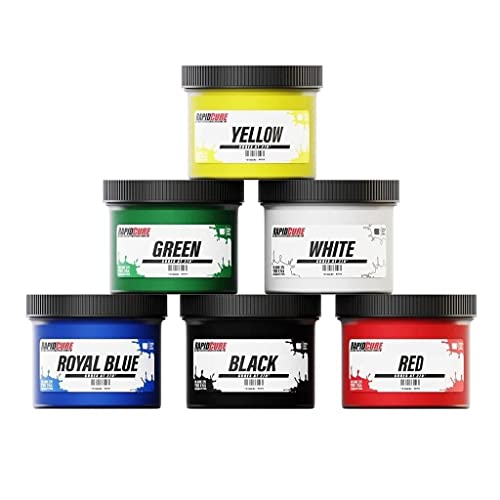
3. Rapid Cure 6 Color Plastisol Ink Set — Best Starter Kit
If you're building a screen printing setup from scratch and want a color selection that covers the essentials without having to purchase individual jars, this six-color plastisol set from Screen Print Direct is one of the smartest starting points in 2026. You get a range that spans primary, metallic, and pastel variations — enough to experiment with color mixing and multi-color designs without a huge upfront investment in individual inks.
The Rapid Cure formula is a genuine advantage here. These inks cure at temperatures as low as 270°F, significantly lower than the 320°F standard most plastisol inks require. That lower threshold is forgiving for beginners who are still dialing in their heat press settings, and it reduces the risk of scorching delicate fabrics. The low-odor, non-toxic formula also means you're not dealing with harsh fumes if you're working in a home studio or a space without industrial ventilation.
Coverage is vibrant and consistent across the set. The plastisol formulation gives you a soft but touchable finish that holds up through repeated washing. The set works on cotton, linen, polyester, and blends, and can also be used for heat transfer applications. The main limitation is that six colors — while a solid starting palette — will leave you mixing to get certain shades, and the 8 oz jars will go quickly if you're running large print volumes.
Pros:
- Low-temperature curing at 270°F reduces scorching risk for beginners
- Non-toxic, low-odor formula — safe for home studio use
- Versatile color range covering primaries, metallics, and pastels
- Works for heat transfers in addition to direct screen printing
Cons:
- Six colors require mixing for a full palette
- 8 oz jars per color limit production volume before reordering

4. Rapid Cure White Plastisol Ink — Best Low-Temp White Plastisol
White plastisol ink is often the hardest color to get right. Too thin and you get bleed-through; too thick and the squeegee fights you through every stroke. Rapid Cure's white formula walks that line better than most entry-to-mid-level options. It's described as having a "short body," which in practical terms means it releases cleanly from the screen and lays flat without trailing or stringing — a significant frustration saver when you're printing on a manual press.
The 270°F cure temperature sets it apart from conventional plastisol whites that demand 320°F. You get a highly opaque, bold white that layers well on dark fabrics, and the lower cure requirement means less heat stress on your garments. Shelf life is listed at over 12 months, which is meaningful if you're not burning through large volumes quickly. It can also be used for cold peel plastisol heat transfers, giving you a bit more versatility than a single-purpose fabric ink.
The opacity is genuinely impressive for a single-pass application, though on extremely dark or heavily dyed garments, two passes will give you a crisper result. This is true of virtually all plastisol whites, so it's not a knock specific to this product. If you're comparing screen printing to other decoration methods, our breakdown of screen printing vs sublimation explains why opacity matters so much in the ink selection decision.
Pros:
- Highly opaque white with a vibrant, bold finish
- Low cure temperature of 270°F reduces fabric damage risk
- Short body formula works cleanly through the screen without stringing
- 12+ month shelf life — stays usable even with infrequent use
Cons:
- May require two passes on very dark or saturated fabrics
- Plastisol requires proper ventilation and disposal — not as eco-friendly as water-based options
5. Permaset Aqua Supercover 300ml — Best Eco-Friendly Option
Permaset Aqua has built a reputation in professional screen printing circles as one of the most environmentally responsible inks available — and the Supercover formula backs that reputation with actual performance on dark fabrics. The water-based, odor-reduced formula is designed specifically for high-coverage applications on both natural and synthetic fibers, addressing one of the traditional weaknesses of water-based inks: opacity.
The Supercover range lives up to its name better than many premium water-based competitors. On dark-toned fabrics — the scenario where most water-based inks struggle most — it delivers richer coverage than you'd typically expect without resorting to discharge chemistry. The print feel is exceptionally soft, characteristic of premium water-based formulations, and the eco-friendly profile (no PVC, no phthalates, water-soluble cleanup) makes it the go-to choice for printers who prioritize sustainability or work in ventilation-limited spaces.
The 300ml jar is a bit larger than the standard 8 oz US offerings, giving you slightly more volume per purchase. It's made in Australia and meets stringent environmental standards, which is a selling point for shops that market their eco-friendly practices to customers. The trade-off is price — Permaset tends to cost more per ounce than domestically produced plastisol options. For high-volume production printing on light fabrics it performs well; for very dark fabrics, the Supercover formula narrows the gap considerably.
Pros:
- Eco-friendly, water-based, no PVC or phthalates
- Excellent softness — one of the best hand feels of any ink on this list
- Supercover formula offers better dark-fabric coverage than standard water-based inks
- Works on both natural and synthetic fibers
Cons:
- Higher price per ounce compared to most plastisol alternatives
- Water-based inks dry on screens faster — requires more frequent reclaiming during long print runs
6. Speedball Acrylic Screen Printing Ink, 8 oz — Best for Paper Printing
Not every screen printer works exclusively on fabric. If your primary output is art prints, posters, greeting cards, or paper-based merchandise, Speedball's acrylic formula is optimized specifically for that use case. While the fabric version is water-based and formulated for textile adhesion, this acrylic ink is engineered for richness and archival quality on paper, wooden surfaces, and cardboard — substrates where fabric inks can behave unpredictably.
The color range is one of this ink's strongest selling points. Thirty colors are available, including process colors, glow-in-the-dark options, and fluorescents — a breadth that most competitors don't come close to matching at this price point. Colors print with depth and vibrancy on paper, and they're made in the USA, which is consistent with Speedball's broader manufacturing story. For professional printmakers or fine art screen printers working on limited-edition runs, this is the kind of ink you can rely on for color consistency across large editions.
The main limitation is substrate specificity. This ink is not designed for fabric — don't expect the same wash durability you'd get from a proper textile ink if you try to use it on garments. It's a specialist ink for a specific application, and within that application it excels. If you're a mixed-media printer who splits time between apparel and paper, you'll likely want this alongside a dedicated fabric ink rather than as your only option.
Pros:
- 30-color range including fluorescents and glow-in-the-dark
- Formulated for archival quality on paper, wood, and cardboard
- Made in the USA by a long-established printmaking brand
- Professional-grade color richness suitable for fine art editions
Cons:
- Not designed for fabric printing — won't hold up through washing on garments
- Limited to non-textile substrates despite the broad color range
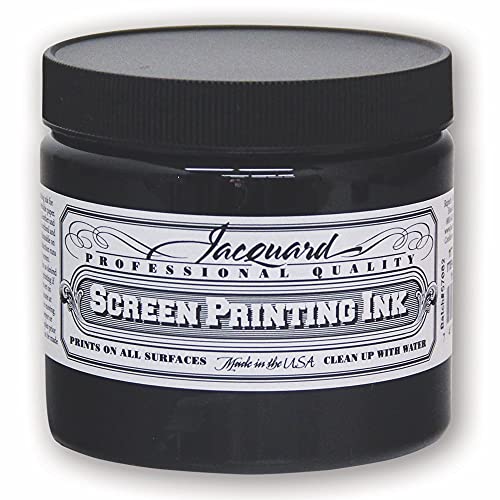
7. Jacquard Professional Screen Print Ink, 16oz — Best for Detail Work
Jacquard is a brand that professional printmakers and fiber artists tend to trust, and this 16 oz water-soluble screen print ink is a good example of why. It's built for archival quality and fine detail — two priorities that often get shortchanged in budget-oriented inks. The water-based formula won't cause paper to buckle or curl, which is a common frustration with heavier ink applications on lighter stock. The finish is a durable, scuff-proof semi-gloss, striking a visual balance between matte fabric inks and the high-gloss look of some acrylic alternatives.
Detail reproduction is where this ink genuinely stands out. Superior halftone and fine-line coverage makes it a strong choice for intricate designs where edge definition matters — illustrations, typography-heavy prints, or any work where bleeding or clogging would compromise the image. The lightfast formulation means prints retain their color fidelity over time, which is critical for art prints, archival posters, or any work meant to last years on a wall or in a collection.
The 16 oz jar gives you twice the volume of most competitors at the 8 oz level, which makes more economic sense for regular use. The water-soluble chemistry means cleanup is straightforward, though like all water-based inks, you need to reclaim screens promptly before the ink dries and becomes difficult to remove. For printers who work with fine art, illustration prints, or mixed paper and fabric runs, Jacquard Professional sits at the quality end of the accessible price range.
Pros:
- Archival and lightfast — excellent long-term color stability
- Scuff-proof semi-gloss finish looks polished on paper
- Superior fine-line and halftone detail reproduction
- 16 oz jar offers better value for regular users
Cons:
- Water-soluble formula requires prompt screen reclaiming to avoid drying issues
- Semi-gloss finish may not suit every aesthetic or substrate preference
Buying Guide: How to Choose the Best Screen Printing Ink
Choosing the right screen printing ink comes down to a few core questions: What are you printing on? What curing equipment do you have? How important is the hand feel of the finished print? And what's your tolerance for cleanup complexity? Here's what actually matters when you're making this decision.
Ink Type: Plastisol vs. Water-Based vs. Discharge
This is the most fundamental choice you'll make. Plastisol inks are the industry standard for a reason — they're stable on the screen, don't dry out between prints, and offer high opacity on dark fabrics. They require heat curing but have a long shelf life and forgive slow print runs better than water-based formulas. The trade-off is that they contain PVC and require more careful disposal.
Water-based inks are more environmentally friendly and produce a softer hand feel that many customers prefer on apparel. They're generally easier to reclaim from screens with soap and water, but they dry faster on the screen itself, which can cause issues during long runs or if you pause frequently. They typically require more passes to achieve full opacity on dark fabrics unless you're using a discharge or Supercover formula.
Discharge inks are a specialized category worth understanding if you print on dark fabrics. They chemically strip the dye from the fabric and replace it with ink, producing an incredibly soft, breathable print that feels like part of the shirt. They require an activator and specific curing conditions, but the result is something plastisol and standard water-based inks simply can't replicate. According to Wikipedia's overview of screen printing, discharge printing has been a professional technique for decades precisely because of this soft-hand advantage.
Substrate Compatibility
Not every ink works on every surface. If you're printing primarily on 100% cotton, most fabric inks will perform well. Polyester and blends introduce dye migration risk with plastisol, where the fabric dye bleeds into the ink during curing. Low-bleed or low-temperature plastisols help here. For paper, posters, or wood, you need an ink formulated for those surfaces — fabric inks can crack or peel on rigid or paper substrates over time.
If your work spans both fabric and paper, you may need two separate ink systems rather than trying to make one formula stretch across incompatible substrates. That's a worthwhile investment to protect print quality on both ends of your product line.
Curing Temperature and Equipment
Plastisol inks don't air-dry — they require heat to cure, typically between 270°F and 320°F depending on the formula. If you're working with a conveyor dryer in a production environment, standard plastisol is straightforward. If you're using a heat press or flash dryer in a home setup, low-temperature cure inks like the Rapid Cure options reviewed here are significantly more forgiving. Water-based and acrylic inks can often be heat set with a standard iron or heat press, which lowers the equipment barrier to entry.
Getting curing wrong is the number one cause of prints washing out or cracking prematurely. If you're evaluating your full setup, understanding how screen printing compares to heat press methods can help you figure out which curing approach fits your workflow best.
Volume, Shelf Life, and Value
Screen printing ink is a consumable — you'll go through it faster than you expect once you're printing regularly. Consider the price per ounce rather than the price per jar, especially if you print in high volumes. Plastisol inks generally have a longer shelf life (12+ months with proper storage) compared to water-based inks that can skin over or separate if stored improperly. Buying in larger jar sizes — like the 16 oz Jacquard option — makes economic sense for colors you use frequently, while smaller jars work better for accent colors or specialty shades you only need occasionally.
Frequently Asked Questions
What is the difference between plastisol and water-based screen printing ink?
Plastisol inks are PVC-based and don't air-dry, requiring heat curing at 270°F–320°F. They stay workable on the screen longer, offer high opacity, and have a longer shelf life. Water-based inks are more eco-friendly, produce a softer hand feel on fabric, and clean up easily with water, but they dry faster on the screen and typically require more passes for opacity on dark fabrics. Your choice depends on your substrate, curing setup, and hand-feel priorities.
What temperature do screen printing inks need to cure?
Standard plastisol inks cure at around 320°F (160°C). Low-temperature plastisols like the Rapid Cure formulas cure at 270°F (132°C), which is safer for delicate fabrics and easier to achieve with home equipment. Water-based and acrylic inks generally need between 300°F and 320°F for full cure, though many can be set with a standard iron. Always check the manufacturer's specifications for the specific ink you're using — undercuring is the primary cause of prints washing out.
Can I use screen printing ink on polyester fabric?
Yes, but with caveats. Polyester and synthetic blends introduce dye migration risk, where the fabric dye bleeds into the ink layer during curing and shifts the color. Low-bleed plastisol inks are specifically formulated to minimize this. Water-based inks generally have lower dye migration risk on polyester. For best results on high-polyester content garments, use a low-temperature, low-bleed ink formula and cure at the lowest effective temperature for your specific ink.
How long does screen printing ink last after opening?
Plastisol inks typically have a shelf life of 12 months or more when stored properly — keep lids sealed tight and store in a cool location away from direct sunlight. Water-based inks have a shorter shelf life, usually 6–12 months, and can skin over or separate if exposed to air. Always stir water-based inks before use and keep them sealed between sessions. If an ink has thickened significantly or developed a hard skin layer, it may no longer print correctly even if stirred.
What is discharge screen printing ink and when should I use it?
Discharge ink is a water-based ink that chemically removes the dye from the fabric rather than sitting on top of it. When activated with a discharge agent, it produces an extremely soft, breathable print on dark fabrics — something no standard plastisol or water-based ink can replicate in terms of hand feel. It works best on 100% cotton or high-cotton-content garments. Use discharge when your customers prioritize ultra-soft prints on dark shirts. Note that colors may not be as vibrant as plastisol on some fabric dyes, and results vary by fabric brand and dye lot.
Is screen printing ink safe for home use?
Most water-based and acrylic screen printing inks reviewed here are non-toxic and safe for home or studio use with basic ventilation. Plastisol inks contain PVC and require adequate airflow, particularly during the curing process. Low-odor plastisol formulas like the Rapid Cure line reduce fume levels compared to standard plastisols, making them more home-friendly. Always check the SDS (Safety Data Sheet) for the specific ink you're using and follow the manufacturer's handling and disposal guidelines. Avoid curing plastisol in unventilated enclosed spaces.
Buy on Walmart
- Speedball Fabric Screen Printing Ink, 8-Ounce, Black for T-S — Walmart Link
- Ecotex® Screen Printing Ink Snow White (8oz.) - Water Based — Walmart Link
- Screen Printing Ink Set - Rapid Cure® 6 Color Plastisol Ink — Walmart Link
- Rapid Cure® Screen Printing Ink White (8oz.) - Plastisol Ink — Walmart Link
- Permaset Aqua Supercover 300ml Fabric Printing Ink - Black — Walmart Link
- Speedball Acrylic Screen Printing Ink, 8 oz, Black for Paper — Walmart Link
- Jacquard Professional Screen Print Ink, Water-Soluable, 16oz — Walmart Link
Buy on eBay
- Speedball Fabric Screen Printing Ink, 8-Ounce, Black for T-S — eBay Link
- Ecotex® Screen Printing Ink Snow White (8oz.) - Water Based — eBay Link
- Screen Printing Ink Set - Rapid Cure® 6 Color Plastisol Ink — eBay Link
- Rapid Cure® Screen Printing Ink White (8oz.) - Plastisol Ink — eBay Link
- Permaset Aqua Supercover 300ml Fabric Printing Ink - Black — eBay Link
- Speedball Acrylic Screen Printing Ink, 8 oz, Black for Paper — eBay Link
- Jacquard Professional Screen Print Ink, Water-Soluable, 16oz — eBay Link
Next Steps
- Check the current price and availability of the ink that best matches your substrate and curing setup using the Amazon links above — prices change frequently in 2026.
- Read the full reviews for each product you're considering, paying close attention to the Cons section — especially if you print on dark fabrics or need specific opacity levels.
- If you're still building your setup, review our best screen printing kit guide to make sure your press, screens, and squeegees are compatible with the ink type you choose.
- Order a single jar of your top pick before committing to larger quantities — test it on your specific fabric and with your curing equipment to confirm it meets your standards.
- Bookmark the screen printing ink reviews category page and check back as new products enter the market throughout 2026 — this guide is updated regularly with new options and updated pricing.
 |  |  |  |
About Rachel Kim
Rachel Kim spent five years as a merchandise buyer for a national office supply retail chain, evaluating printers, scanners, and printing accessories from Canon, Epson, HP, Brother, Dymo, and Zebra before approving them for store inventory. Her buying process involved hands-on testing against competing models, reviewing long-term reliability data from vendor reports, and vetting price-to-performance claims that manufacturers routinely overstated. That structured evaluation experience translates directly into the kind of buying guidance that cuts through marketing language and focuses on what actually matters for a specific use case. At PrintablePress, she covers printer and printing equipment reviews, buying guides, and head-to-head product comparisons.


Get some FREE Gifts. Or latest free printing books here.
Disable Ad block to reveal all the secret. Once done, hit a button below
| | | |