Reviews ›
Best Plotter Printer Reviews, Buying Guide, and FAQs 2026
by Rachel Kim · April 22, 2022
Which plotter printer actually delivers the precision that architects, engineers, and designers need in 2026 — and which ones fall short despite the marketing promises? After evaluating the top models on the market, the HP DesignJet T650 stands out as the best overall choice for most professional users who need reliable 36-inch output with a comprehensive warranty backing the investment.
Plotter printers occupy a specialized corner of the printing world. Unlike standard desktop printers, these large-format machines handle technical drawings, CAD files, engineering blueprints, GIS maps, and wide-format posters with a level of line accuracy that conventional inkjet printers simply cannot match. Whether a buyer is outfitting an architecture firm, a construction office, or a home studio, the right plotter makes a genuine difference in workflow speed and output quality. For those also exploring compact print solutions, the best portable scanner printers offer a complementary option for on-the-go scanning and printing needs.
The 2026 market is dominated by two main players — HP DesignJet and Epson SureColor — each offering a range of models from compact 24-inch desktop units to high-end 44-inch professional systems. This guide breaks down the seven strongest contenders, evaluates their real-world performance, and provides a clear buying framework so buyers can match the right machine to their specific requirements. According to Wikipedia's overview of plotters, these devices have evolved significantly from their pen-based origins into sophisticated inkjet systems capable of photographic-quality output alongside technical precision.

Contents
- Best Choices for 2026
- In-Depth Reviews
- HP DesignJet T210 24-inch — Best Budget 24-inch Plotter
- HP DesignJet T650 36-inch — Best Overall 36-inch Plotter
- Epson SureColor T3170 24-inch — Best Compact Wireless Plotter
- Epson SureColor T5170 36-inch — Best 36-inch Wireless Epson
- HP DesignJet T630 36-inch — Best Value All-in-One 36-inch
- HP DesignJet Z9+ 44-inch — Best Professional Photo & Graphics Plotter
- Epson SureColor T2170 24-inch — Best Entry-Level Epson Plotter
- Key Features to Consider When Choosing
- Frequently Asked Questions
- Key Takeaways
Best Choices for 2026
- #PreviewProductRating
- Bestseller No. 1
 Rating:

- Bestseller No. 2
 Rating:
 - Bestseller No. 3
 Rating:
 - Bestseller No. 4
 Rating:
 - Bestseller No. 5
 Rating:
 - Bestseller No. 6
 Rating:
 - Bestseller No. 7
 Rating:
In-Depth Reviews
1. HP DesignJet T210 Large Format 24-inch Color Plotter Printer — Best Budget 24-inch Plotter
The HP DesignJet T210 is a no-frills, compact 24-inch plotter that punches well above its price point for users who need reliable technical line output without a large capital outlay. It handles everything from CAD drawings and architectural renders to poster prints and professional sewing patterns with clean, crisp lines that hold up under scrutiny. For small offices or solo practitioners who don't need 36-inch width, the T210 is the most cost-effective entry point on the market in 2026.
Media handling is straightforward and practical. The T210 accepts roll feed and sheet feed modes, and an optional automatic sheet feeder accessory extends usability to sheets up to 13 × 19 inches. The automatic horizontal cutter handles roll media cleanly without requiring manual intervention between prints. Setup through the HP Smart app is genuinely easy, and wireless connectivity means it doesn't need to be tethered directly to a workstation.
The trade-off for the T210's accessible price is speed — output times are slower compared to the Epson T3170 at this size class. For high-volume environments, that gap becomes noticeable. But for occasional or moderate-use scenarios, the T210 delivers consistent, accurate output that meets professional technical standards. Those curious about how different types of printers are categorized will find a useful overview at types of printers you should know in 2026.
Pros:
- Affordable entry price for a professional-grade 24-inch plotter
- Crisp, accurate line quality for CAD and technical drawings
- Supports roll feed, sheet feed, and optional auto sheet feeder
- Wireless connectivity with HP Smart app setup
- Automatic horizontal cutter for roll media
Cons:
- Slower print speeds compared to Epson T3170 at the same size
- Auto sheet feeder is an optional add-on, not included
- Limited to 24-inch media width — not suitable for larger format needs
2. HP DesignJet T650 Large Format 36-inch Plotter Printer — Best Overall 36-inch Plotter
The HP DesignJet T650 earns the top spot on this list for a clear reason: it pairs professional-grade 36-inch output with a 2-year onsite warranty that competitors at this price tier cannot match. For architecture firms, engineering offices, and construction professionals who depend on daily large-format output, that warranty is not a marketing footnote — it's a genuine operational safety net. Next-business-day onsite service, combined with remote support and HP parts coverage, means minimal downtime if something goes wrong.
Performance mirrors the T630 in most technical respects, but the T650 distinguishes itself with that warranty package and its included automatic sheet feeder accessory. Print quality on technical line drawings is excellent — accurate geometry, tight text rendering, and consistent color across the 36-inch width. The T650 handles roll feed and sheet feed interchangeably with an automatic switch, which speeds up multi-format workflows considerably. Connectivity covers USB and wireless, and the HP Smart app handles driver setup cleanly across Windows and macOS.
The T650 is ideal for environments where a printer failure would halt billable work. The additional warranty cost is absorbed into the purchase price rather than being a separate subscription, which simplifies budgeting. For offices producing high-stakes deliverables — permit sets, construction documents, presentation boards — the T650 is the most defensible purchase decision in 2026.
Pros:
- Industry-leading 2-year onsite warranty with next-business-day service
- 36-inch width handles full-size architectural and engineering sheets
- Automatic sheet feeder included (not an add-on)
- Precise line quality for CAD, technical renders, posters, and maps
- Automatic sheet/roll switch for versatile media handling
Cons:
- Higher purchase price compared to the T630
- Not designed for fine-art or photo printing — that's the Z9+'s domain
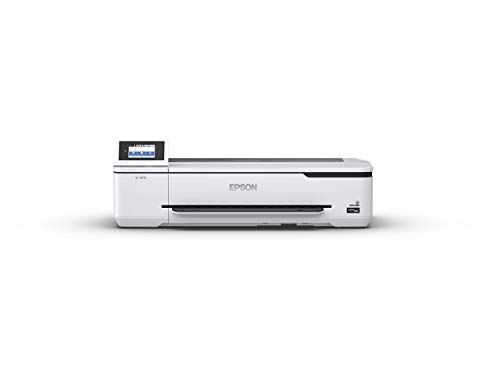
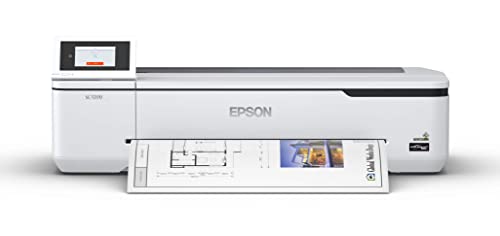
3. Epson SureColor T3170 24-Inch Desktop Wireless Plotter — Best Compact Wireless Plotter
The Epson SureColor T3170 is the speed champion of the 24-inch category. Producing accurate A1/D-size prints in just 34 seconds, it significantly outpaces the HP T210 and makes it a compelling choice for studios and offices where print volume is high and wait time is a real cost. The PrecisionCore printhead delivers Epson's signature accuracy on technical line work, and the all-pigment ink system ensures durable, fade-resistant output suitable for client presentations and long-term document storage.
Usability is a genuine strength. The 4.3-inch LCD color touchscreen is large enough and intuitive enough that users rarely need to consult a manual for routine tasks. The T3170's compact footprint is notable — this is a 24-inch plotter that fits comfortably on a desk without dominating the workspace. An optional floor stand is available for users who prefer an upright configuration. Wireless connectivity is included and reliable, covering both standard office networks and direct wireless printing from mobile devices.
The T3170 is a particularly strong fit for designers, GIS professionals, and CAD users in smaller offices who need fast throughput from a space-efficient machine. The all-pigment ink system also means output holds up better over time than dye-based alternatives, which matters for projects where printed documents need to retain legibility for months or years.
Pros:
- Industry-leading 34-second A1/D-size print speed in the 24-inch class
- All-pigment ink system for durable, long-lasting output
- Compact desktop footprint — smallest in its category
- Large 4.3-inch intuitive LCD touchscreen
- Reliable wireless and direct mobile printing
Cons:
- Optional stand sold separately — not included at base price
- No onsite warranty at the level HP offers with the T650
4. Epson SureColor T5170 36-Inch Wireless Printer — Best 36-inch Wireless Epson
The Epson SureColor T5170 scales the T3170's strengths up to the 36-inch format, making it the natural choice for Epson loyalists who need a wider output width. At 31 seconds per A1/D-size print, the T5170 is actually faster than the T3170 at the wider format — an unusual engineering outcome that Epson attributes to printhead optimization at the 36-inch width. For high-volume environments printing large engineering sets or wide presentation graphics, that speed advantage compounds quickly across a day's workload.
The same 4.3-inch LCD touchscreen from the T3170 carries over to the T5170, keeping the operation equally intuitive at the larger scale. The all-pigment ink system ensures consistent color accuracy and durability across both narrow and wide media. Wireless connectivity is standard, and the T5170 handles both roll and cut sheet media without requiring manual media switching in most configurations.
The T5170 competes directly with the HP T630 and T650 in the 36-inch segment. Its speed advantage is its primary differentiator. For offices that measure printer utilization by prints-per-hour, the T5170's output rate is a concrete operational benefit. Those evaluating the T5170 alongside other wireless printing solutions may also find value in checking out the best LED printer reviews for comparison on office-oriented alternatives.
Pros:
- Fastest 36-inch plotter in the comparison at 31 seconds per A1/D print
- All-pigment ink for durable, accurate output on technical documents
- Intuitive 4.3-inch LCD color touchscreen
- Reliable wireless connectivity and mobile printing support
Cons:
- No bundled onsite warranty coverage compared to HP T650
- Ink cartridge costs can be higher than HP equivalents in high-volume use
- Compact design means smaller onboard ink capacity than some competitors
5. HP DesignJet T630 Large Format 36-inch Color Plotter Printer — Best Value All-in-One 36-inch
The HP DesignJet T630 delivers the full 36-inch professional experience at a price point below the T650, making it the best value option for buyers who don't need the extended warranty package. The T630 ships with an auto sheet feeder, media bin, and stand included — a complete package that would add significant cost if purchased separately on competing models. Architects, engineers, and construction professionals who need a ready-to-deploy 36-inch solution out of the box will find the T630's bundle genuinely practical.
Print quality on the T630 matches the T650 for technical line work. Accurate geometry, precise text rendering, and consistent color output across the 36-inch width are all present. Media handling covers sheet feed, roll feed, automatic sheet/roll switching, and an integrated media bin to catch output without manual collection — a workflow convenience that matters in busy print environments. The automatic horizontal cutter handles roll media efficiently.
The T630 hits a sweet spot between the budget T210 and the warranty-heavy T650. For small to mid-size firms that maintain their own equipment contracts or prefer to handle service internally, the T630's lower entry cost and complete hardware bundle make it a compelling alternative to the T650. The stand and media bin alone justify the comparison.
Pros:
- Complete bundle: stand, media bin, and auto sheet feeder all included
- Professional 36-inch output at a lower price than the T650
- Accurate line quality for CAD, posters, and technical renders
- Automatic sheet/roll switch and horizontal cutter for flexible media handling
- Popular with architects and construction professionals
Cons:
- Warranty coverage is standard (not the 2-year onsite package of the T650)
- Speed is comparable to, but does not exceed, Epson T5170
6. HP DesignJet Z9+ 44-inch PostScript Large Format Printer (Renewed) — Best Professional Photo & Graphics Plotter
The HP DesignJet Z9+ operates in an entirely different category from the other printers on this list. Where the T-series models prioritize technical line accuracy, the Z9+ is engineered for gallery-quality photo printing, fine art reproduction, and high-end graphic output up to 44 inches wide. The 9-color pigment ink system — including HP Pixel Control technology — delivers smooth gradients, deep blacks, and vibrant color saturation that 4-color or 6-color systems cannot replicate. At 2400 × 1200 optimized dpi, output detail is exceptional.
The Z9+ includes built-in PostScript 3 and native PDF printing support, which makes it seamlessly compatible with Adobe Creative Cloud applications, professional CAD packages, and design tools without requiring third-party RIP software. For studios producing exhibition prints, fine art editions, photographic banners, or high-end marketing graphics, that native PostScript support eliminates a layer of workflow complexity. Gigabit Ethernet and USB connectivity ensure fast data transfer for large print files that would bottleneck over wireless.
This listing is a renewed (certified refurbished) unit, which is the primary consideration for buyers weighing the Z9+. HP certified renewed units undergo functional testing and include standard warranty coverage. For buyers comfortable with renewed hardware, the Z9+ represents extraordinary capability at a significantly reduced price point compared to purchasing new. No other printer on this list approaches the Z9+'s color depth or photo output quality — it's in a class of its own for creative professionals.
Pros:
- 9-color pigment ink system for gallery-quality photo and fine art output
- 44-inch width handles the largest poster, banner, and exhibition formats
- Native PostScript 3 and PDF support — no RIP required
- 2400 × 1200 optimized dpi for exceptional output detail
- Gigabit Ethernet for fast large-file transfer
- HP certified renewed unit at a fraction of new price
Cons:
- Renewed/refurbished — not a new unit; warranty terms differ from new
- Substantially higher cost than T-series models
- Overkill for technical line drawings — T650 or T630 are better value for CAD
7. Epson SureColor T2170 24-Inch Desktop Wireless Plotter — Best Entry-Level Epson Plotter
The Epson SureColor T2170 rounds out the 24-inch category as the entry point into Epson's SureColor T-series ecosystem. It produces A1/D-size prints in 43 seconds — slower than the T3170's 34 seconds, but still competitive and well ahead of standard inkjet printers attempting large-format output. The T2170's high-capacity cartridges — up to 80 mL for black and 50 mL for color — are a standout feature at this price level, reducing the frequency and cost of consumable replacements compared to lower-capacity alternatives.
The PrecisionCore printhead and all-pigment ink system carry over from the T3170, delivering the same durable, accurate output on technical documents, posters, and CAD drawings. The 4.3-inch LCD touchscreen is identical to the T3170's, keeping the user experience consistent. Wireless connectivity is included and stable for standard office environments. The T2170 fits comfortably on a desk and maintains the compact Epson footprint that makes the SureColor T-series practical for smaller workspaces.
For buyers who want Epson's ink quality and touch interface at a lower entry price than the T3170, the T2170 is a logical starting point. The reduced print speed is the only material trade-off. Firms with moderate print volumes and a preference for Epson's ink ecosystem will find the T2170 reliable and cost-effective. Those interested in related wide-format and specialty printing also benefit from exploring the full printer reviews category for additional guidance across printer types.
Pros:
- High-capacity cartridges (80 mL black, 50 mL color) reduce replacement frequency
- All-pigment durable ink system for fade-resistant technical output
- PrecisionCore printhead for accurate line quality
- 4.3-inch LCD touchscreen for easy operation
- Compact desktop footprint with wireless connectivity
Cons:
- 43-second A1/D print speed is slower than the T3170's 34 seconds
- Less suited to high-volume daily production compared to higher-tier models
Key Features to Consider When Choosing a Plotter Printer
Print Width and Media Size
Print width is the single most important specification to nail down before purchasing. Plotter printers are commonly available in 24-inch and 36-inch widths, with specialty models extending to 44 inches and beyond. Most architecture and engineering workflows require 36-inch output to accommodate full ANSI D and E-size sheets without rescaling. Users who primarily produce smaller technical drawings, sewing patterns, or posters may find a 24-inch model sufficient — and benefit from the lower purchase price and smaller footprint that comes with it. Confirm the required media sizes before committing to a width.
- 24-inch models: Ideal for solo practitioners, home offices, and studios with moderate format needs
- 36-inch models: Standard for architecture firms, engineering offices, and construction teams
- 44-inch+ models: Required for exhibition prints, large-format photography, and oversized banners
Print Speed and Throughput
In professional environments, print speed directly affects productivity. Measured in seconds per A1/D-size print, the range across these seven models runs from 31 seconds (Epson T5170) to 43 seconds (Epson T2170). That gap compounds significantly when printing multi-sheet drawing sets. High-volume offices should prioritize models with sub-35-second output times. For occasional use, speed is a secondary concern and price or warranty coverage may matter more.
- Under 35 seconds: T5170 (31s), T3170 (34s) — best for high-volume workflows
- 35–45 seconds: T2170 (43s), HP T-series — suitable for moderate daily use
- Always check rated speed at the quality mode most frequently used, not just draft mode
Ink System and Output Durability
Plotter printers use either dye-based or pigment-based ink systems. All seven models reviewed here use pigment inks, which is the correct choice for professional applications. Pigment inks deliver significantly better light-fastness and water resistance compared to dye-based alternatives, making output suitable for long-term document storage, client presentations, and display applications. The HP Z9+'s 9-color pigment system extends this further into fine-art and photographic territory, with color depth that standard 4-color configurations cannot match.
- 4-color pigment: Standard for technical printing — HP T-series, Epson T-series
- 9-color pigment: Required for photo-quality and fine art output — HP Z9+
- Ink cartridge capacity affects running costs — look for high-capacity options
Connectivity, Warranty, and Total Cost of Ownership
Connectivity requirements vary by office setup. Wireless printing is standard across all models reviewed, but high-volume professional environments benefit from Gigabit Ethernet for fast file transfer — particularly relevant for the Z9+ when handling large photo files. Beyond the hardware purchase price, total cost of ownership includes ink, media, and — critically — service coverage. The HP T650's 2-year onsite warranty with next-business-day service is the standout differentiator in this comparison. For businesses where printer downtime directly translates to lost billable hours, that warranty is worth the premium. Buyers exploring the broader landscape of printing and scanning capabilities may also benefit from reviewing the best portable scanner printers for workflows requiring combined input and output flexibility.
- Wireless: Sufficient for most office environments and moderate file sizes
- Gigabit Ethernet: Essential for large photo/graphics files (Z9+) or network-shared plotters
- Warranty: HP T650's 2-year onsite coverage is the benchmark — compare carefully
- Ink costs: High-capacity cartridges (Epson T2170's 80 mL black) reduce per-print cost
Frequently Asked Questions
What is a plotter printer used for?
Plotter printers are large-format printing devices designed for producing technical drawings, CAD files, architectural blueprints, engineering plans, GIS maps, posters, and wide-format graphics. Unlike standard desktop printers, plotters handle media widths from 24 inches to 44 inches or more, with precise line accuracy that technical and professional applications require. Modern plotters use inkjet technology rather than the original pen-based mechanism, making them suitable for both line-work and color graphics output.
What is the difference between a 24-inch and 36-inch plotter?
The primary difference is the maximum media width each model can handle. A 24-inch plotter accommodates media up to 24 inches wide, which covers ANSI B and C sheet sizes but falls short of full ANSI D and E sheets commonly used in architecture and engineering. A 36-inch plotter handles the full range of standard technical drawing formats without rescaling. For most professional AEC (architecture, engineering, construction) workflows, 36-inch is the standard minimum. 24-inch models are better suited to smaller studios, home offices, and design work that doesn't require full engineering sheet formats.
Is the HP DesignJet T650 worth the premium over the T630?
For offices that depend on daily plotter output for billable deliverables, yes. The T650's 2-year onsite warranty with next-business-day service is the defining difference between the two models. Both produce equivalent print quality on technical documents. If printer downtime would halt chargeable work, the warranty alone justifies the T650's higher price. For offices with in-house IT support, existing service contracts, or lower print criticality, the T630's complete hardware bundle (stand, media bin, auto sheet feeder) at a lower price is the more efficient spend.
How does the Epson SureColor T3170 compare to the HP DesignJet T210?
Both are 24-inch plotters aimed at professional technical output, but the Epson T3170 has a clear speed advantage at 34 seconds per A1/D-size print versus the T210's slower output rate. The T3170 also ships with a more intuitive 4.3-inch touchscreen interface and a slightly more compact footprint. The T210 holds an advantage in initial purchase price and benefits from HP's ecosystem for buyers already invested in HP supplies and software. For high-volume 24-inch printing, the T3170 is the stronger performer. For budget-conscious buyers with moderate throughput needs, the T210 remains capable and cost-effective.
Can plotter printers be used for photo printing?
Standard plotter printers like the HP T-series and Epson SureColor T-series are optimized for technical line work, CAD drawings, and posters rather than fine-art photo printing. Their 4-color pigment ink systems produce accurate, durable output, but lack the color depth and tonal range of dedicated photo printers. The HP DesignJet Z9+ is the exception — its 9-color pigment ink system and HP Pixel Control technology deliver genuine gallery-quality photo output at up to 44 inches wide, making it suitable for fine art editions, exhibition prints, and professional photographic output.
What media types can plotter printers handle?
Modern plotter printers handle a range of media types beyond standard bond paper. Roll media is the primary format, covering plain paper, coated paper, glossy photo paper, canvas, film, and technical drawing media. Most models also accommodate cut sheet media through sheet feeders, extending compatibility to individual sheets up to the printer's maximum width. Specialty media — including banner material, backlit film, and fine art paper — is supported on higher-end models like the Z9+. Always verify media compatibility with the specific model before purchasing specialty substrates, as accepted media weight (gsm) and coating type vary by printer.
Buy on Walmart
- HP DesignJet T210 Large Format 24-inch Color Plotter Printer — Walmart Link
- HP DesignJet T650 Large Format 36-inch Plotter Printer, Incl — Walmart Link
- Epson SureColor T3170 24-Inch Desktop Wireless Poster CAD Pl — Walmart Link
- Epson SureColor T5170 36” Wireless Printer, White — Walmart Link
- HP DesignJet T630 Large Format 36-inch Color Plotter Printer — Walmart Link
- HP DesignJet Z9+ 44-in Postscript Large Format Printer, 2400 — Walmart Link
- Epson SureColor T2170 24-Inch Desktop Wireless Poster CAD Pl — Walmart Link
Buy on eBay
- HP DesignJet T210 Large Format 24-inch Color Plotter Printer — eBay Link
- HP DesignJet T650 Large Format 36-inch Plotter Printer, Incl — eBay Link
- Epson SureColor T3170 24-Inch Desktop Wireless Poster CAD Pl — eBay Link
- Epson SureColor T5170 36” Wireless Printer, White — eBay Link
- HP DesignJet T630 Large Format 36-inch Color Plotter Printer — eBay Link
- HP DesignJet Z9+ 44-in Postscript Large Format Printer, 2400 — eBay Link
- Epson SureColor T2170 24-Inch Desktop Wireless Poster CAD Pl — eBay Link
Key Takeaways
- The HP DesignJet T650 is the best overall 36-inch plotter for professional offices in 2026, thanks to its 2-year onsite warranty and complete media handling package.
- The Epson SureColor T3170 is the fastest 24-inch plotter in the comparison at 34 seconds per A1/D print, making it the top choice for high-throughput compact workflows.
- The HP DesignJet Z9+ stands alone for photo-quality and fine-art output, with a 9-color pigment system and 44-inch width that no other model on this list can match.
- For buyers who want 36-inch capability at a value price with a full hardware bundle included, the HP DesignJet T630 (stand, media bin, auto sheet feeder) delivers the most complete out-of-box experience below the T650's price point.
 |  |  |  |
About Rachel Kim
Rachel Kim spent five years as a merchandise buyer for a national office supply retail chain, evaluating printers, scanners, and printing accessories from Canon, Epson, HP, Brother, Dymo, and Zebra before approving them for store inventory. Her buying process involved hands-on testing against competing models, reviewing long-term reliability data from vendor reports, and vetting price-to-performance claims that manufacturers routinely overstated. That structured evaluation experience translates directly into the kind of buying guidance that cuts through marketing language and focuses on what actually matters for a specific use case. At PrintablePress, she covers printer and printing equipment reviews, buying guides, and head-to-head product comparisons.


Get some FREE Gifts. Or latest free printing books here.
Disable Ad block to reveal all the secret. Once done, hit a button below
| | | |