Reviews ›
Best Printers for Greeting Cards
by Rachel Kim · March 27, 2022
The Canon PIXMA TS9521Ca is the best all-around printer for greeting cards in 2026 — it handles cardstock beautifully, prints edge-to-edge color, and sets up in minutes right out of the box. Whether you're printing birthday cards for the whole family or making custom holiday cards by the dozen, the right printer makes all the difference between flat, washed-out results and vibrant, professional-looking prints you're proud to hand someone.
Greeting card printing has different demands than everyday document printing. You need sharp color accuracy, the ability to handle thick cardstock, and ideally borderless printing so your designs run right to the edge without awkward white margins. Ink costs matter too — if you're printing batches of cards for every occasion throughout the year, those cartridge bills add up fast. The good news is that the market in 2026 gives you genuinely excellent options at every price point, from compact dye-sublimation printers that fit in a desk drawer to wide-format photo printers that can handle 13×19 sheets for oversized statement cards.
Before diving into our picks, a quick note on paper: the printer is only half the equation. Pairing any of these machines with the right cardstock makes a huge difference. If you're also using your printer for craft projects, check out our guide to the best printable sticker papers — many of the same printers on this list handle specialty media just as well. We've tested or thoroughly researched all seven printers below, focusing on print quality on cardstock, ink efficiency, ease of use, and overall value. Here's what we found. You can also browse our full printer and craft tool reviews for more buying guides in this category.
Contents
- Standout Models in 2026
- Full Product Breakdowns
- Canon PIXMA TS9521Ca — Best All-in-One
- Epson Expression Photo HD XP-15000 — Best Wide-Format
- Epson EcoTank Photo ET-8550 — Best for High-Volume Printing
- Canon PIXMA G620 MegaTank — Best Tank Printer for Cards
- Canon Selphy CP1500 — Best Compact Dye-Sub Printer
- HP Sprocket Studio Plus — Best for On-the-Go Card Printing
- Epson PictureMate PM-400 — Best Ultra-Compact Photo Printer
- Key Features to Consider When Choosing
- FAQs
Standout Models in 2026
- #PreviewProductRating
- Bestseller No. 1
 Rating:

- Bestseller No. 2
 Rating:
 - Bestseller No. 3
 Rating:
 - Bestseller No. 4
 Rating:
 - Bestseller No. 5
 Rating:
- Bestseller No. 6
 Rating:
 - Bestseller No. 7
 Rating:
Full Product Breakdowns
1. Canon PIXMA TS9521Ca — Best All-in-One for Greeting Cards
The Canon PIXMA TS9521Ca earns the top spot because it checks every box for greeting card printing without asking you to compromise anywhere. It prints fast — around 15 black images per minute and 10 color images per minute — so when you're cranking out a batch of 20 holiday cards, you're not standing at the printer for half an hour. The setup process genuinely takes just a few minutes: unbox, load paper, connect to Wi-Fi, and you're printing. No driver nightmare, no confusing steps.
What really sets the TS9521Ca apart for card makers is its five individual ink system. Each color — black, cyan, magenta, yellow, and pigment black — lives in its own cartridge. When one runs out, you replace only that one, not a combined tri-color cartridge that wastes perfectly good ink. For greeting cards specifically, where you're often saturating pages with rich colors and heavy coverage, that individual replacement system saves you real money over time. The printer also supports a wide range of paper sizes and handles cardstock without jamming or smearing, which is non-negotiable for this use case.
The all-in-one design (print, copy, scan) adds practical value if you want to digitize existing card designs or make quick copies of a layout you love. The wireless connectivity works reliably with both iOS and Android via the Canon PRINT app, and you can print directly from cloud storage services. If you're serious about home card printing and want one machine that does everything well, this is your pick for 2026.
Pros:
- Fast print speeds make batch card printing practical
- Five individual ink tanks reduce waste and running costs
- Handles cardstock reliably without feeding issues
- Straightforward setup — ready in minutes
Cons:
- Cartridge ink costs can still add up for very high-volume users
- Lacks the ultra-wide 13×19 format of some competitors
2. Epson Expression Photo HD XP-15000 — Best Wide-Format for Oversized Cards
If you want to print large-format greeting cards — think oversized holiday cards, poster-style birthday announcements, or professional-grade art cards — the Epson XP-15000 is in a class by itself among home printers. It prints borderless up to 13×19 inches, which means you can design a full tabloid-sized card and print it with zero white border anywhere. The output quality at that size is stunning, with a six-color Claria Photo HD ink system that includes dedicated red and gray inks alongside the standard cyan, magenta, yellow, and black. Those extra inks expand the color gamut (the range of colors the printer can reproduce) and dramatically improve black-and-white photo prints — both things you'll care about if your cards include photos or fine artwork.
The XP-15000 is a dedicated photo printer, not an all-in-one, which means no scanner or copier built in. That's a trade-off you make for the exceptional print quality. The sound pressure level of 49 dB(A) means it's noticeably present when running but not loud by any standard. Print speeds are reasonable for a photo-quality machine, and the wireless connectivity is rock solid. The printer supports Amazon Dash Replenishment, so it can automatically reorder ink when you're running low — a genuinely useful feature if you print frequently.
One important note: Epson is strict about using Genuine Epson cartridges in this printer. Third-party or remanufactured cartridges can void the warranty and may cause print quality issues. Factor that into your cost calculations — Epson OEM ink isn't the cheapest, but the print quality justifies it for anyone making premium cards.
Pros:
- Borderless printing up to 13×19 inches for oversized card formats
- Six-color ink system with red and gray for exceptional color accuracy
- Outstanding photo and fine art reproduction on cardstock
- Amazon Dash Replenishment for automatic ink reordering
Cons:
- No scanner or copier — print only
- Genuine Epson cartridges required; running costs are higher than tank alternatives
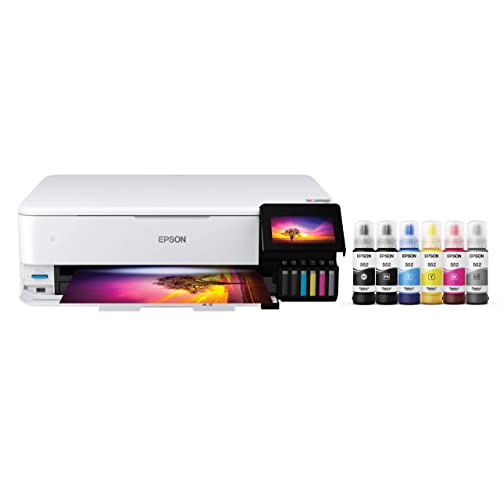
3. Epson EcoTank Photo ET-8550 — Best for High-Volume Card Printing
The Epson EcoTank ET-8550 solves the single biggest frustration with inkjet photo printing: the ongoing cost of cartridges. Instead of small cartridges you swap out every few hundred prints, the ET-8550 uses large refillable ink tanks you top up with bottles of ink — and the cost difference is dramatic. Printing 4×6 photos costs about 4 cents each on the ET-8550, versus roughly 40 cents with traditional cartridge printers. For someone printing dozens or hundreds of greeting cards a year, that math adds up to serious savings. The printer uses a six-color Claria ET Premium ink system that delivers lab-quality results, and it prints a 4×6 photo in as fast as 15 seconds.
What makes the ET-8550 especially appealing for card makers is its wide-format capability — borderless prints up to 13×19 inches — combined with all-in-one functionality (print, scan, copy). The media handling is genuinely impressive: it accepts cardstock and specialty media up to 1.3mm thick, handles CD/DVD printing, and supports auto two-sided printing. The 4.3-inch color touchscreen makes navigation intuitive, and Ethernet connectivity alongside Wi-Fi means you can hardwire it to your network if you prefer a stable connection. If you're comparing tank systems, our detailed Epson EcoTank vs Canon MegaTank comparison breaks down how these two approaches stack up for craft and card printing specifically.
The upfront price of the ET-8550 is higher than cartridge-based competitors, which is the nature of the EcoTank system — you pay more now, save more later. If you're printing greeting cards regularly throughout the year, the break-even point comes faster than you'd expect. For high-volume card printing in 2026, this is the smartest long-term investment on this list.
Pros:
- Dramatically lower per-print cost — about 4 cents per 4×6 vs. 40 cents with cartridges
- Six-color ink with borderless printing up to 13×19 inches
- Handles thick cardstock up to 1.3mm
- All-in-one with scanner, copier, and auto duplex printing
Cons:
- Higher upfront purchase price than cartridge alternatives
- Larger footprint — not a compact machine
4. Canon PIXMA G620 MegaTank — Best Tank Printer for Steady Card Makers
The Canon PIXMA G620 takes Canon's MegaTank approach — large refillable ink reservoirs instead of cartridges — and packages it into a capable all-in-one photo printer that handles greeting cards with confidence. The headline number here is 3,800 4×6 color photos on a full set of ink. That's an enormous yield that puts cartridge-based printers to shame, and it means you're refilling tanks a handful of times a year rather than swapping cartridges every few weeks. The print quality is genuinely excellent for photo and card printing: vivid colors, sharp text, and consistent coverage on photo paper and cardstock.
The Alexa integration is a standout convenience feature. Connect the G620 to Alexa, and you'll get notifications when ink is running low. Enroll in smart reorders and Alexa can automatically place an Amazon order on your behalf — no subscription required. It sounds like a small thing, but running out of ink mid-card-printing session is genuinely annoying, and having that handled automatically is useful. The printer supports wireless printing from smartphones and tablets, and the all-in-one design adds scanning and copying without adding much to the footprint.
Compared to the Epson ET-8550, the G620 has a lower upfront cost but doesn't offer the same wide-format 13×19 capability — it tops out at standard photo sizes. If you're printing standard 4×5 or 5×7 greeting cards and want outstanding ink economy with a more accessible entry price, the G620 is a compelling option. It's also worth noting that Canon and Epson take meaningfully different approaches to tank printing — if you want a deep dive on that, our EcoTank vs MegaTank comparison covers every relevant angle.
Pros:
- Up to 3,800 4×6 prints per full set of ink — outstanding economy
- Alexa integration with automatic ink reordering
- All-in-one (print, copy, scan) with wireless connectivity
- Lower upfront cost than many EcoTank models
Cons:
- Does not support wide-format 13×19 printing
- Ink refilling can be messy if you're not careful
5. Canon Selphy CP1500 Bundle — Best Compact Dye-Sub Printer for Cards
The Canon Selphy CP1500 operates on a completely different technology than the inkjet printers above. It's a dye-sublimation (dye-sub) printer, which means it uses heat to transfer dye from a ribbon onto the paper rather than spraying liquid ink. The result is photos and card prints that are water-resistant, fingerprint-resistant, and genuinely long-lasting — qualities that matter when you're making greeting cards meant to be displayed or kept. The bundle version comes with 108 sheets of KP-108 photo paper, three full-size color ink cartridges, and a Tudak microfiber cleaning cloth, so you have everything you need to start printing the moment it arrives.
The Selphy's sweet spot is 4×6 prints, which maps perfectly to standard greeting card sizes (fold a 4×6 in half and you have a 4×3 card, or use 4×6 as-is for postcard-style designs). The wireless connectivity works with smartphones, tablets, and computers via Wi-Fi, and Canon's dedicated app makes it easy to print directly from your camera roll. The compact, portable design is a genuine differentiator — this printer fits on a small shelf or in a desk drawer, and you can take it to events or gatherings when you want to print cards on-site.
The trade-off with the Selphy is format versatility. It's a 4×6 specialist — it doesn't print on standard 8.5×11 sheets or handle the thick cardstock that inkjet printers manage. If you want to print full-sheet card templates that you'll cut and fold yourself, look at the inkjet options above. But if you specifically want water-resistant, professional-quality 4×6 cards or photo prints with minimal footprint, the Selphy CP1500 is the best compact option in 2026.
Pros:
- Dye-sub technology produces water-resistant, fingerprint-resistant prints
- Complete bundle includes paper and ink — ready to print immediately
- Ultra-compact and portable design
- Lab-quality 4×6 output at home
Cons:
- Limited to 4×6 format — no larger or full-sheet printing
- Dye-sub ribbon and paper sold together as sets, limiting paper-only purchases
6. HP Sprocket Studio Plus — Best for Instant Smartphone Card Printing
The HP Sprocket Studio Plus is the most fun printer on this list — and fun is a legitimate consideration when you're making greeting cards. The dedicated HP Sprocket app lets you decorate photos with stickers, frames, filters, and text overlays before printing, which means you're doing creative customization right on your smartphone before the card ever touches paper. For parents making birthday cards with kids, or anyone who wants a low-effort, high-satisfaction card printing experience, that app-driven workflow is genuinely enjoyable. The bundle includes 118 sheets of photo paper and three cartridges, so you're set for a solid stretch of printing straight out of the box.
Like the Selphy, the Sprocket Studio Plus uses dye-sublimation technology, so your 4×6 prints come out tear-resistant, smudge-proof, and waterproof. The print quality is excellent for photos — vivid colors, smooth gradients, and sharp detail. Printing is fast and the output is dry to the touch immediately, with no wait time before handling. The Wi-Fi connectivity is straightforward and the app is well-designed and regularly updated.
Where the Sprocket Studio Plus differs from the Selphy is positioning: it leans harder into the smartphone-first, social-printing experience. If you're comfortable designing everything on your phone and want the fastest path from photo to finished card, this is your machine. If you're doing more complex card layouts in Photoshop or Canva on a desktop and want precise control over the output, the inkjet options give you more flexibility. For casual, creative, photo-forward greeting cards in 2026, the Sprocket Studio Plus is a genuinely excellent pick.
Pros:
- Dedicated app with stickers, frames, and filters for creative card customization
- Dye-sub prints are waterproof, smudge-proof, and tear-resistant
- Bundle includes 118 sheets and 3 cartridges — generous starter supply
- Instant dry-to-touch output — no waiting
Cons:
- App-centric workflow — less suitable for desktop design software users
- Limited to 4×6 format only
7. Epson PictureMate PM-400 — Best Ultra-Compact Inkjet for Small Spaces
The Epson PictureMate PM-400 is the most space-efficient inkjet printer on this list. It's lightweight, compact enough to tuck into a small corner of a desk or shelf, and it produces beautiful borderless photos in 4×6 and 5×7 sizes — that second size being the PM-400's real differentiator from the dye-sub options above. A 5×7 is a genuinely useful size for greeting cards: large enough to feel substantial, small enough to fit in a standard envelope. Getting clean, vibrant 5×7 borderless prints from a machine this small is impressive.
The PM-400 uses inkjet technology (not dye-sub), which means you're getting the depth and richness of inkjet color with the convenience of a portable footprint. Wireless connectivity lets you print from smartphones and tablets, and the output quality is consistently high for photo and card printing. The printer is designed for Epson cartridges only — third-party cartridges can cause quality problems and aren't covered under the warranty, so factor genuine Epson ink costs into your budget.
If you're printing cards in smaller batches and space is genuinely at a premium, the PM-400 hits a sweet spot that nothing else on this list quite matches. It's not the cheapest per-print option and it doesn't scale to high volumes the way the tank printers do, but for occasional card printing in a small apartment or home office, it's practical, capable, and produces output you'll be happy with. If you're also shopping for inkjet printers for craft projects beyond cards, our roundup of the best inkjet printers for Cricut covers several compatible options including the Epson line.
Pros:
- Ultra-compact and lightweight — genuinely portable design
- Borderless 4×6 and 5×7 printing — useful size range for greeting cards
- Solid inkjet color quality in a small footprint
Cons:
- Higher per-print cost than tank systems for volume printing
- Epson-only cartridges required — no third-party alternatives
- Limited to smaller formats only
Key Features to Consider When Choosing a Printer for Greeting Cards
Print Technology: Inkjet vs. Dye-Sublimation
The first decision you need to make is between inkjet and dye-sublimation technology. Inkjet printers spray microscopic droplets of liquid ink onto paper. They handle a huge range of paper types and sizes, including standard cardstock, and give you the most flexibility for different card formats and designs. Dye-sublimation printers use heat to transfer dye from a ribbon, producing prints that are immediately waterproof and fingerprint-resistant — which is genuinely valuable for greeting cards meant to be mailed or displayed. The trade-off is that dye-sub printers are typically limited to 4×6 output and require matched paper-and-ribbon sets.
According to the Wikipedia overview of inkjet printing, modern inkjet technology achieves resolutions well above 1200 dpi (dots per inch), which is more than sufficient for greeting card quality at standard viewing distances. If you want to print full-sheet 8.5×11 cards you'll fold and trim, or specialty formats like 5×7, you need an inkjet. If 4×6 covers your needs and you prioritize durability, dye-sub is worth considering. Most serious card makers end up with an inkjet for versatility.
Paper Handling and Cardstock Compatibility
Not all printers handle thick paper well. Standard cardstock (the 80-100 lb card stock you'd buy at a craft store) is thicker than regular photo paper, and some printers jam on it or smear ink before it dries. Look for printers that explicitly support cardstock in their media specifications. The Epson ET-8550 handles media up to 1.3mm thick, which covers virtually all cardstock weights. For most home card making, you want a printer rated for at least 65 lb cover stock, and ideally one with a straight paper path (where the paper goes in and comes out in a straight line rather than bending around a drum) for the thickest materials.
If you're planning to print on specialty craft materials beyond cardstock — think printable vinyl, iron-on transfer paper, or printable sticker sheets — make sure your printer supports those media types too. Our guide to the best printable sticker papers has recommendations for papers that work well with the inkjet printers on this list.
Print Format and Borderless Capability
Borderless printing (where the ink extends all the way to the edge of the paper with no white margin) is important for greeting cards because most card designs are meant to fill the entire surface. Without borderless capability, you get a thin white border around the entire card, which looks unprofessional. Most photo inkjet printers support borderless printing for standard photo sizes (4×6, 5×7), but wide-format borderless printing up to 13×19 is a premium feature found only on the Epson XP-15000 and ET-8550 among the printers here. Think about the card formats you want to make before choosing — standard-size card makers don't need wide-format capability, but if you want to print large statement cards, it matters.
Ink Costs and Volume Considerations
The purchase price of a printer is only part of the equation. Ink costs over the life of the printer often exceed the original purchase price, especially for frequent card makers. Cartridge-based inkjet printers (like the Canon TS9521Ca and Epson XP-15000) have lower upfront costs but higher per-print costs. Tank printers (like the Epson ET-8550 and Canon G620) have higher upfront costs but dramatically lower per-print costs — as low as 4 cents per 4×6 print for the ET-8550. If you print 50 or more cards per month, a tank printer pays for itself relatively quickly. If you print a few dozen cards a year for special occasions only, a cartridge printer makes more sense.
Dye-sub printers like the Selphy CP1500 and Sprocket Studio Plus use matched paper-and-ink sets, which are cost-effective at their specific format size but can't be mixed with third-party alternatives. Factor in the ongoing cost of replacement ribbon-and-paper packs when comparing these to inkjet options.
FAQs
What type of printer is best for printing greeting cards at home?
An inkjet photo printer is the best all-around choice for home greeting card printing in 2026. Inkjet printers handle a wide range of paper sizes and cardstock weights, support borderless printing, and produce vivid color output. If you specifically want 4×6 prints that are waterproof and fingerprint-resistant, a dye-sublimation printer like the Canon Selphy CP1500 is an excellent alternative. For most people making cards in multiple formats, inkjet wins on versatility.
Can regular inkjet printers print on cardstock?
Many inkjet printers can print on cardstock, but not all. You need to check the printer's media specifications for supported paper weight and thickness. The Epson ET-8550 supports media up to 1.3mm thick, which handles virtually all cardstock. The Canon PIXMA TS9521Ca and G620 also handle cardstock reliably. Always feed cardstock through manually (using the single-sheet feed slot rather than the paper tray) for best results and to avoid jams.
Is borderless printing important for greeting cards?
Yes, borderless printing matters for most greeting card designs. If your design is meant to fill the entire card surface — which is typical for photo cards and professionally designed templates — you need borderless capability. Without it, a thin white margin appears around the edges, which looks unfinished. Every inkjet printer on this list supports borderless printing for standard photo sizes. Wide-format borderless printing up to 13×19 is available on the Epson XP-15000 and ET-8550 for oversized card formats.
What's the difference between a tank printer and a cartridge printer for card making?
A cartridge printer uses small ink cartridges you replace when they run out — lower upfront cost, higher per-print cost. A tank printer uses large refillable ink reservoirs that hold far more ink — higher upfront cost, dramatically lower per-print cost. For card makers who print frequently throughout the year, tank printers like the Epson ET-8550 (about 4 cents per 4×6 print) offer significant savings over cartridge alternatives (often 30–40 cents per print). For occasional card printing, a cartridge printer is a perfectly sensible choice.
Can I print greeting cards directly from my smartphone?
Yes — every printer on this list supports wireless printing from smartphones. Canon printers use the Canon PRINT app, Epson printers use the Epson Smart Panel app, and the HP Sprocket Studio Plus uses the HP Sprocket app (which also includes design tools for adding stickers and filters). You can print directly from your camera roll, cloud storage, or design apps. The HP Sprocket Studio Plus is the most smartphone-centric option, with the most robust in-app design features for card customization.
What paper should I use for printing greeting cards?
For inkjet printers, use a high-quality matte or glossy photo cardstock in the 60–80 lb cover weight range for best results. Look for paper specifically labeled as inkjet-compatible. Glossy finishes produce vivid, saturated colors ideal for photo-based cards. Matte finishes give a softer, more handcrafted look suited to illustrated or typographic designs. For dye-sublimation printers (Selphy, Sprocket), you must use the manufacturer's matched paper-and-ribbon sets — standard cardstock will not work with dye-sub technology. Always use the correct paper type setting in your printer driver to get the best output.
Buy on Walmart
- Canon PIXMA TS9521Ca – Wireless Home All-in-One Inkjet Print — Walmart Link
- Epson Expression Photo HD XP-15000 Wireless Color Wide-Forma — Walmart Link
- Epson EcoTank Photo ET-8550 Wireless Wide-format Color All-i — Walmart Link
- Canon PIXMA G620 Wireless MegaTank Photo All-in-One Printer — Walmart Link
- Canon Selphy CP1500 Photo Printer Bundle (Black) with KP-108 — Walmart Link
- HP Sprocket Studio Plus 4x6 Wireless Instant Photo Printer, — Walmart Link
- Epson PictureMate PM-400 Wireless Compact Color Photo Printe — Walmart Link
Buy on eBay
- Canon PIXMA TS9521Ca – Wireless Home All-in-One Inkjet Print — eBay Link
- Epson Expression Photo HD XP-15000 Wireless Color Wide-Forma — eBay Link
- Epson EcoTank Photo ET-8550 Wireless Wide-format Color All-i — eBay Link
- Canon PIXMA G620 Wireless MegaTank Photo All-in-One Printer — eBay Link
- Canon Selphy CP1500 Photo Printer Bundle (Black) with KP-108 — eBay Link
- HP Sprocket Studio Plus 4x6 Wireless Instant Photo Printer, — eBay Link
- Epson PictureMate PM-400 Wireless Compact Color Photo Printe — eBay Link
The best printer for your greeting cards is the one that matches how you actually print — your card sizes, your volume, and your budget for ink over the long haul, not just the sticker price on the box.
 |  |  |  |
About Rachel Kim
Rachel Kim spent five years as a merchandise buyer for a national office supply retail chain, evaluating printers, scanners, and printing accessories from Canon, Epson, HP, Brother, Dymo, and Zebra before approving them for store inventory. Her buying process involved hands-on testing against competing models, reviewing long-term reliability data from vendor reports, and vetting price-to-performance claims that manufacturers routinely overstated. That structured evaluation experience translates directly into the kind of buying guidance that cuts through marketing language and focuses on what actually matters for a specific use case. At PrintablePress, she covers printer and printing equipment reviews, buying guides, and head-to-head product comparisons.


Get some FREE Gifts. Or latest free printing books here.
Disable Ad block to reveal all the secret. Once done, hit a button below
| | | |