Reviews ›
Best Scanner For Multiple Pages: Reviews, Buying Guide and FAQs 2026
by Rachel Kim · April 04, 2022
The Fujitsu ScanSnap iX1600 tops our list for 2026 — it combines blazing 40-page-per-minute speeds with a large touchscreen and near-effortless multi-user setup that makes it a natural fit for shared office environments. If you deal with stacks of paper every day, finding a scanner that handles multiple pages without jamming, skewing, or losing quality is genuinely life-changing. Whether you're digitizing receipts, archiving contracts, or clearing out filing cabinets, the right document scanner pays for itself fast.
Scanners built for multiple pages all share a core feature: an auto document feeder (ADF) — a tray that pulls in one sheet at a time, scans it, then grabs the next. That hands-free process is what separates a true document scanner from a basic flatbed. But beyond the ADF, you'll find meaningful differences in speed (measured in pages per minute, or ppm), connectivity (USB vs. Wi-Fi), duplex (double-sided) scanning capability, and bundled software. This guide walks you through the seven best options available right now and gives you a clear framework for picking the one that fits your workflow. You can also browse more office equipment options in our full reviews section.
We've tested and researched scanners across a range of price points — from budget-friendly compact models to workhorse desktop units — so you don't have to dig through spec sheets alone. If you're also interested in scanning photos or slides, check out our best photo scanner with auto feeder guide and our best slide scanner reviews for more targeted options. For now, let's get into the multi-page document scanners worth your money in 2026.

Contents
Standout Models in 2026
- #PreviewProductRating
- Bestseller No. 1
 Rating:

- Bestseller No. 2
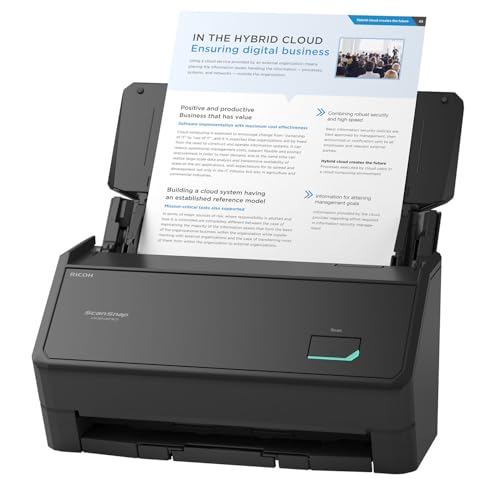 Rating:
 - Bestseller No. 3
 Rating:
 - Bestseller No. 4
 Rating:
 - Bestseller No. 5
 Rating:
 - Bestseller No. 6
 Rating:
 - Bestseller No. 7
 Rating:
Full Product Breakdowns
1. Fujitsu ScanSnap iX1600 ADF Scanner — Best Overall for Teams
The Fujitsu ScanSnap iX1600 is the scanner you buy when you're serious about getting paper off your desk permanently. It scans at up to 40 pages per minute in color, with a 600 dpi optical resolution that captures sharp text and clear graphics. The 4.3-inch color touchscreen lets you launch preset scan profiles with a single tap — no hunting through menus. You can store up to 30 custom profiles directly on the device, which is genuinely useful if multiple people in your office scan to different destinations.
Connectivity is a strong point. The iX1600 connects over both USB and Wi-Fi, and Fujitsu's ScanSnap Home software is one of the most polished document management tools in the industry. It handles automatic file naming, searchable PDF creation (via OCR), and direct upload to cloud services like Google Drive, Dropbox, and SharePoint. Setup is fast. You can have it scanning wirelessly to multiple computers in under ten minutes. The 50-sheet ADF handles standard paper, business cards, and even receipts without fussing.
The one honest trade-off here is price — the iX1600 sits at the premium end of the market. You're paying for build quality, software polish, and long-term reliability. Fujitsu has been in the scanner business for decades, and it shows. If your budget is flexible and you want a scanner that your whole team can share without constant support headaches, this is the one to buy.
Pros:
- 40 ppm color scanning speed with 600 dpi optical resolution
- Large 4.3" touchscreen with up to 30 customizable scan profiles
- Excellent ScanSnap Home software with OCR and cloud integration
- Dual connectivity — USB and Wi-Fi — ideal for shared office use
Cons:
- Premium price point may be steep for personal or light use
- ScanSnap Home software only — limited TWAIN/ISIS driver support for third-party apps
2. Fujitsu ScanSnap iX2400 — Best One-Touch Scanner for Speed
The ScanSnap iX2400 is Fujitsu's answer to users who want raw speed without the bells and whistles of a touchscreen. One button. One press. That's it. Up to 45 pages per minute with a 100-sheet ADF capacity — which is the highest feeder capacity on this list. You're not constantly reloading mid-stack, which matters a lot when you're digitizing a box of old paperwork in one sitting. The iX2400 connects via USB, keeping the connection stable and consistent without any Wi-Fi setup required.
Fujitsu's Quick Menu pops up after every scan, letting you drag and drop the result into whatever app you want — your PDF viewer, email client, cloud folder, or document management system. The scanner handles business cards, receipts, envelopes, and standard documents with the same ease. Photo scanning is also supported, though dedicated photo scanner results will be sharper if that's your primary use. OCR (optical character recognition — the technology that makes scanned text searchable and editable) is included through ScanSnap Home.
Because it's wired-only, the iX2400 isn't the right pick if you need to scan from a mobile device or share across multiple computers wirelessly. But if you're a solo user who wants maximum paper throughput at a lower price than the iX1600, this is an excellent trade. The iX2400 is newer than the iX1400 it replaces, with improved speed and reliability.
Pros:
- Fastest scanner on the list at 45 ppm with a 100-sheet ADF
- Simple one-touch operation — minimal learning curve
- Handles mixed document types including envelopes and receipts
- Stable USB connection for consistent performance
Cons:
- No Wi-Fi — USB only, so not suited for wireless or mobile workflows
- No touchscreen or on-device controls beyond the scan button
3. Brother ADS-1800W — Best Compact Wireless Scanner
The Brother ADS-1800W punches well above its compact size. It scans at up to 30 pages per minute with single-pass duplex (double-sided scanning in one pass), and it connects via both USB-C and Wi-Fi — making it genuinely flexible for desk or bag. The built-in 2.8-inch color touchscreen gives you control without needing your computer nearby. You can scan directly to cloud services, email, or USB drives right from the screen. That's a feature you usually only find on larger, more expensive office scanners.
Brother's bundled software suite handles document enhancement, workflow automation, and file routing. The Brother Mobile Connect app extends scanning capability to your smartphone or tablet over Wi-Fi, so you're not tethered to your desk. The 20-sheet ADF is smaller than the Epson or HP options on this list, but for the target user — a home office worker or remote employee — it's typically enough for daily batch scanning. Pages go through cleanly, and double-sided documents are captured in a single pass rather than requiring you to flip and re-feed.
The 20-sheet feeder is the clearest trade-off here. If you regularly process large stacks — 50 to 100 pages at a time — you'll be reloading frequently. For moderate daily scanning, though, the ADS-1800W offers a genuinely premium experience in a footprint that fits almost any desk. It's a strong pick for remote workers and home offices in 2026.
Pros:
- Compact design with both USB-C and Wi-Fi connectivity
- 2.8" color touchscreen for standalone operation
- Single-pass duplex scanning at 30 ppm
- Mobile scanning support via Brother Mobile Connect app
Cons:
- 20-sheet ADF is smaller than most competitors — frequent reloading for large jobs
- 30 ppm speed is on the lower end for the price
4. Epson Workforce ES-500W II — Best Wireless Scanner for Mixed Documents
Epson's Workforce ES-500W II hits a sweet spot between speed, features, and price. It delivers 35 pages per minute (70 images per minute for duplex) using Epson's Single-Step Technology, which captures both sides of a page in one pass without slowing down. The 50-sheet ADF handles stacks of mixed paper — standard sheets, business cards, receipts — without requiring you to sort them first. Wi-Fi connectivity means you can place this scanner anywhere on your desk or shelf and scan to your laptop, smartphone, tablet, or cloud storage from wherever you're sitting.
The Epson Smart Panel mobile app is well-designed. You can initiate scans, adjust settings, and route files to destinations without touching your computer. Scan to Dropbox, Google Drive, OneDrive, Evernote, and more are all supported. Document organization is handled by Epson's ScanSmart software, which includes automatic file naming and OCR for creating searchable PDFs. The image quality is sharp — color documents and black-and-white text both come out clean and readable at the default settings.
Where the ES-500W II falls slightly short is in advanced destination routing. It doesn't have an on-device screen for standalone operation — you need a connected device to initiate scans. That's a minor inconvenience for most users but worth knowing if you want a fully independent scanner. For wireless home or small office use with a 50-sheet ADF, this Epson is hard to beat on value.
Pros:
- Fast 35 ppm / 70 ipm duplex scanning via Single-Step Technology
- 50-sheet ADF handles mixed media types
- Wi-Fi with mobile app support for smartphone-initiated scanning
- Good ScanSmart software with OCR and cloud routing
Cons:
- No on-device screen — requires a connected computer or phone to start scans
- Wi-Fi setup can occasionally require troubleshooting on complex networks
5. Epson Workforce ES-400 II — Best USB Scanner for Office Workflows
The Epson Workforce ES-400 II is the wired sibling of the ES-500W II, and it earns its place on this list with a 50-sheet ADF, fast duplex scanning, and seamless integration with document management software. It uses the same ScanSmart software platform as the wireless model, giving you automatic file naming, one-click cloud upload, email integration, and OCR for searchable PDFs. If your scanner will live on a fixed desk connected to a single computer, you don't need to pay extra for Wi-Fi — and the ES-400 II is priced accordingly.
TWAIN driver support (TWAIN is the standard protocol that lets your scanner talk to third-party software like Adobe Acrobat, PaperPort, or document management platforms) is a standout feature here. Many ScanSnap users run into friction when trying to use their scanner with specialized software. The ES-400 II works cleanly with virtually any scanning application you're already using. Speed is competitive — comparable to the wireless models above — and image quality is consistent across text, graphics, and mixed-content pages.
If your work involves feeding scanned documents into accounting software, legal document management platforms, or enterprise content systems, the ES-400 II's broad software compatibility makes it a practical and reliable choice. It's not flashy, but it does its job without complaints. You might also find our best book scanner guide helpful if you need to digitize bound documents alongside loose paper.
Pros:
- 50-sheet ADF with fast duplex scanning
- TWAIN driver support for seamless integration with third-party software
- ScanSmart software with OCR, auto file naming, and cloud upload
- Lower price than wireless equivalent
Cons:
- USB only — no wireless or mobile scanning capability
- No on-device screen or controls
6. HP ScanJet Pro 3500 f1 — Best Flatbed + ADF Combo
The HP ScanJet Pro 3500 f1 is the only scanner on this list that combines a full-sized flatbed with a high-capacity ADF — and that combination opens up use cases the other models simply can't handle. You get 50 images per minute (25 pages, duplex) from the ADF, plus the ability to scan books, thick materials, and oversized documents up to 8.5 × 122 inches on the flatbed. An ultrasonic sensor (a built-in detector that senses when multiple pages feed together accidentally, preventing misfed documents from corrupting your scan) is included — something you'd expect at a higher price point.
HP's EveryPage technology works alongside the ultrasonic sensor to ensure every sheet gets captured cleanly. The daily duty cycle is rated at 3,000 sheets, which puts it firmly in the small business category rather than personal use. USB connectivity is standard, and HP's software handles OCR, searchable PDF creation, and routing to common destinations. The flatbed is particularly useful if you regularly scan passports, ID cards, bound documents, or anything that can't safely go through an ADF.
The trade-off is footprint. This is a larger, heavier unit than the compact models above. If desk space is tight, you'll feel it. But if you need the combination of high-volume ADF scanning and occasional flatbed access, this is the most complete machine on the list. It's a workhorse that handles the kinds of mixed scanning workloads that would trip up a pure ADF scanner.
Pros:
- Combines full flatbed and high-speed ADF in one unit
- Ultrasonic multi-feed detection prevents lost pages
- 3,000-sheet daily duty cycle for high-volume environments
- ADF handles documents up to 8.5 × 122 inches
Cons:
- Larger footprint — not ideal for cramped workspaces
- Older model with no Wi-Fi; USB only
7. Brother ADS-2200 — Best Budget High-Speed Desktop Scanner
The Brother ADS-2200 rounds out this list as a dependable, no-frills workhorse aimed at users who need solid document scanning without paying for premium features. It scans at up to 35 pages per minute with a 50-sheet ADF and handles duplex documents in a single pass. What makes it worth considering in 2026 is its scan-to-USB feature — you can plug in a flash drive directly and save files without a computer involved at all. That's genuinely useful in small offices, clinics, or anywhere that doesn't have a dedicated scanning computer nearby.
Multiple scan destinations are built in: scan to email, OCR, file, image, or USB flash drive. Page-continuous scanning means the ADS-2200 keeps feeding as long as you keep loading pages, making it practical for larger batches than the 50-sheet tray might suggest. The image quality is what you'd expect from Brother — clean, consistent, with no obvious color shifts or edge distortion on standard office documents. According to Wikipedia's overview of document scanners, CIS (contact image sensor) technology, which this scanner uses, is well-suited for flat, standard-sized documents and contributes to the compact build.
The ADS-2200 doesn't have Wi-Fi, a touchscreen, or the software polish of the Fujitsu or Epson models. If those features matter to you, step up to one of the wireless options above. But if you're working with a tighter budget and need a reliable desktop scanner that handles daily scanning without drama, the ADS-2200 earns its spot. It's proven, widely supported, and available at a price that makes it accessible for small teams and individual users alike.
Pros:
- 35 ppm single-pass duplex with a 50-sheet ADF
- Scan directly to USB flash drive — no computer required
- Multiple scan destinations including email, OCR, and file
- Competitive price for the feature set
Cons:
- No Wi-Fi or wireless connectivity
- No touchscreen or on-device display
Key Features to Consider When Choosing a Multi-Page Scanner
ADF Capacity and Scanning Speed
The size of the auto document feeder determines how many pages you can load at once before the scanner stops and waits for you. A 20-sheet feeder works for occasional scanning. A 50-sheet feeder covers most home office and small business needs. A 100-sheet feeder — like the iX2400 — is for high-volume users who want to load and walk away. Speed (ppm) matters too, but in practice the difference between 30 ppm and 45 ppm is less noticeable than you'd think for batches under 50 pages. ADF capacity usually has more day-to-day impact than speed numbers for most users.
Duplex scanning (both sides of a page in one pass) is a must-have if you work with two-sided documents. All seven scanners on this list support it, but make sure you're comparing single-pass duplex — where both sides are scanned simultaneously — versus re-feed duplex, which requires the paper to pass through twice. Single-pass is faster and gentler on paper.
Connectivity: USB vs. Wi-Fi
A USB connection is simpler, more reliable, and slightly faster. If your scanner lives on a fixed desk next to a single computer, USB is perfectly sufficient and saves you money. Wi-Fi matters when you need to share the scanner across multiple computers, scan from a smartphone or tablet, or place the scanner away from your primary workstation. Some models like the iX1600 offer both, giving you the flexibility to choose based on your setup.
Mobile app support is a related consideration. If you frequently need to start scans from your phone or route documents to mobile apps, look for models with a dedicated iOS/Android companion app — the Brother ADS-1800W and Epson ES-500W II both do this well. Not all USB-only models have any mobile functionality at all.
Software and OCR Capabilities
The scanner hardware matters, but the software is what you'll use every day. OCR (optical character recognition — technology that converts scanned images into editable, searchable text) is essential if you want to be able to search through your scanned documents later or copy text out of them. All the models here include OCR in their bundled software, but the quality and ease of use varies.
Fujitsu's ScanSnap Home and Epson's ScanSmart are both polished, consumer-friendly platforms. Brother's software works well but has a more utilitarian interface. If you need to integrate with enterprise document management platforms or specialized software, check for TWAIN driver support — the Epson ES-400 II and HP ScanJet Pro 3500 both include it, while ScanSnap models historically have limited TWAIN compatibility. Also think about cloud integration: most modern scanners can route files directly to Google Drive, Dropbox, OneDrive, and SharePoint without a computer in the middle.
Flatbed vs. ADF-Only Design
Most multi-page scanners are ADF-only, meaning they can't scan bound books, thick objects, or anything that can't safely pass through a feeder. If you occasionally need to scan a passport, an ID card, or the pages of a book, an ADF-only scanner will leave you stuck. The HP ScanJet Pro 3500 f1 is the only model here with a full flatbed glass surface in addition to its ADF — making it the right call for anyone with mixed scanning needs.
For purely digital document management — invoices, contracts, receipts, correspondence — an ADF-only model is perfectly adequate and typically more compact and affordable. Match the design to your actual workload, not a hypothetical one.
What People Ask
What is an auto document feeder (ADF) and why does it matter?
An auto document feeder is a tray that automatically pulls individual pages into the scanner one at a time, scans them, and moves to the next. Without an ADF, you'd have to manually place every single page on a flatbed glass surface. For scanning more than a few pages at a time, an ADF is essential — it lets you load a stack, press a button, and walk away while the scanner works through the pile automatically.
How many pages per minute do I actually need?
For most home office users, 30 ppm is more than enough. At 30 ppm, a 50-page stack is done in under two minutes. Speed becomes more important in shared office environments where multiple people are sending large batches throughout the day. If you're scanning hundreds of pages daily, look for 40+ ppm. For occasional personal use, even a 20–25 ppm scanner will rarely feel slow.
What does duplex scanning mean?
Duplex scanning means the scanner captures both sides of a double-sided page. Single-pass duplex does this in one trip through the scanner — both sides are captured simultaneously. Some older or budget models use re-feed duplex, where the page passes through twice. Single-pass duplex is faster and puts less wear on your documents, so it's worth looking for specifically.
Do I need a scanner with Wi-Fi, or is USB enough?
If your scanner will live on your desk next to one computer, USB is simpler and reliable. Wi-Fi makes sense when you want to share the scanner across multiple computers or scan directly from a smartphone or tablet. It also allows you to place the scanner anywhere in the room rather than right next to your computer. If you're not sure, a model that offers both — like the Fujitsu iX1600 — gives you flexibility to decide later.
What is OCR and should I care about it?
OCR stands for optical character recognition. It's the technology that takes a scanned image of a page and converts it into real, searchable, editable text. Without OCR, your scanned documents are just pictures — you can't search for a word inside them or copy text out. With OCR, a scan of a printed invoice becomes a fully searchable PDF. All seven scanners on this list include OCR in their bundled software, so you don't have to buy it separately.
Can these scanners handle receipts, business cards, and irregular paper sizes?
Yes — most modern ADF scanners handle mixed media. The Fujitsu ScanSnap models are particularly well-regarded for this, with software that automatically detects and adjusts for different paper sizes in the same batch. Receipts, business cards, and standard envelopes all feed through without issues on most of the models listed here. Very small items like loyalty cards may need a carrier sheet (a plastic sleeve that holds the item while it travels through the ADF) depending on the model.
Buy on Walmart
- Fujitsu ScanSnap iX1600 ADF Scanner - 600 dpi Optical, White — Walmart Link
- ScanSnap iX2400 High-Speed Simple One-Touch Button Color Doc — Walmart Link
- Brother ADS-1800W Wireless Compact Desktop Scanner | Scan Sp — Walmart Link
- Epson Workforce ES-500W II Wireless Color Duplex Desktop Doc — Walmart Link
- Epson Workforce ES-400 II Color Duplex Desktop Document Scan — Walmart Link
- HP ScanJet Pro 3500 f1 Flatbed Scanner (L2741A) — Walmart Link
- Brother High-Speed Desktop Document Scanner, ADS-2200, Multi — Walmart Link
Buy on eBay
- Fujitsu ScanSnap iX1600 ADF Scanner - 600 dpi Optical, White — eBay Link
- ScanSnap iX2400 High-Speed Simple One-Touch Button Color Doc — eBay Link
- Brother ADS-1800W Wireless Compact Desktop Scanner | Scan Sp — eBay Link
- Epson Workforce ES-500W II Wireless Color Duplex Desktop Doc — eBay Link
- Epson Workforce ES-400 II Color Duplex Desktop Document Scan — eBay Link
- HP ScanJet Pro 3500 f1 Flatbed Scanner (L2741A) — eBay Link
- Brother High-Speed Desktop Document Scanner, ADS-2200, Multi — eBay Link
Key Takeaways
- The Fujitsu ScanSnap iX1600 is the top all-around pick for teams — its touchscreen, dual connectivity, and polished software make shared scanning genuinely effortless.
- If raw throughput is your priority, the ScanSnap iX2400's 100-sheet ADF and 45 ppm speed let you clear larger document piles without constant reloading.
- The HP ScanJet Pro 3500 f1 is the right call when you need both a high-capacity ADF and a flatbed for scanning books, IDs, or bulky items the feeder can't handle.
- For budget-conscious buyers who still need reliable duplex and multi-destination scanning, the Brother ADS-2200 delivers solid performance at a price that's hard to argue with in 2026.
 |  |  |  |
About Rachel Kim
Rachel Kim spent five years as a merchandise buyer for a national office supply retail chain, evaluating printers, scanners, and printing accessories from Canon, Epson, HP, Brother, Dymo, and Zebra before approving them for store inventory. Her buying process involved hands-on testing against competing models, reviewing long-term reliability data from vendor reports, and vetting price-to-performance claims that manufacturers routinely overstated. That structured evaluation experience translates directly into the kind of buying guidance that cuts through marketing language and focuses on what actually matters for a specific use case. At PrintablePress, she covers printer and printing equipment reviews, buying guides, and head-to-head product comparisons.


Get some FREE Gifts. Or latest free printing books here.
Disable Ad block to reveal all the secret. Once done, hit a button below
| | | |