Reviews ›
Best Multifunction Heat Press Machines for T-Shirts 2026
by Rachel Kim · March 26, 2022
The global custom apparel market topped $3.9 billion in 2023 and is on track to exceed $7 billion by 2028 — and heat press machines are the single most important tool sitting between your design idea and a finished, sellable product. Whether you're running a small print-on-demand side hustle or scaling a home studio into a real business, the machine you choose determines your output quality, your versatility, and your margins. We tested and researched the top multifunction heat press machines available in 2026 to give you a clear, no-fluff breakdown of what actually performs.
Heat press technology has come a long way. Today's machines offer digital temperature and timer controls, swing-away heating elements for safety, and interchangeable platens that let you press everything from t-shirts and hoodies to mugs, hats, and ceramic plates. But not all machines are built equal — heating consistency, platen material, pressure adjustment, and build quality vary dramatically across price points. This guide cuts through the marketing noise and tells you exactly which machine is right for your workflow. If you're also building out your creative toolkit, check out our guide on how to create t-shirt designs to pair with the right machine.
Below you'll find hands-on reviews of seven top-performing models, followed by a buying guide covering everything you need to know before you spend a dollar. Browse the full product review library for more recommendations across printing and crafting equipment.

Standout Models in 2026
- #PreviewProductRating
- Bestseller No. 1
 Rating:

- Bestseller No. 2
 Rating:
 - Bestseller No. 3
 Rating:
 - Bestseller No. 4
 Rating:
 - Bestseller No. 5
 Rating:
 - Bestseller No. 6
 Rating:
 - Bestseller No. 7
 Rating:
Our Hands-On Reviews
1. Fancierstudio Power Heat Press 15x15 — Best Budget Entry-Level Pick
The Fancierstudio Power Heat Press is one of the most recognizable entry-level machines on the market, and it earns that reputation for a reason. It comes with a pre-coated 15×15-inch heat press sheet right out of the box, which saves you the hassle and cost of sourcing a Teflon sheet separately. The 1800W heating element is the most powerful on this list, which means faster heat-up times — you're pressing in minutes, not half an hour.
Temperature range tops out at 500°F, which covers virtually every heat transfer application: HTV vinyl, sublimation, screen print transfers, and direct-to-film. The digital control board is straightforward to use — set your temperature, set your time (up to 999 seconds), and press. For beginners learning the craft, there's no steep learning curve here. Build quality is solid for the price point, with a sturdy steel frame and a firm clamshell action that applies even pressure across the platen.
That said, you're working with a clamshell design rather than a swing-away, which limits positioning flexibility and increases the risk of accidental burns when placing garments. For a first machine or a secondary press dedicated to t-shirts only, the Fancierstudio delivers real value at its price point in 2026.
Pros:
- 1800W — fastest heat-up on this list
- Coated 15×15 inch heat sheet included
- Wide temperature range up to 500°F for all transfer types
- Simple digital controls with 0–999 second timer
- Strong steel frame construction
Cons:
- Clamshell design — less safe for garment positioning than swing-away
- No interchangeable platens — t-shirts only
- No bottom handle for opening a hot plate
2. PowerPress Industrial-Quality Digital Sublimation Heat Press 15x15 — Best for Reliability
The PowerPress machine earns its "industrial-quality" label with a build that holds up under daily production use. The Teflon-coated 15×15-inch heating plate delivers consistent, even heat distribution — no hot spots, no cold zones. Consistent heat is the single most important factor in getting professional sublimation results, and this machine delivers it reliably. At 1400W, it's slightly less powerful than the Fancierstudio but still heats up quickly for a production workflow.
The standout feature here is the removable silicone mat on the bottom board. Unlike competitors that glue the mat down, PowerPress makes it fully detachable. That means you can wash it when it gets ink-stained, replace it when it wears out, and reposition it as needed. This sounds like a minor detail until you've been fighting a permanently glued mat that's peeling at the edges. The bottom handle is another thoughtful addition — when the heating plate warps slightly under sustained heat (as all clamshell machines eventually do), the handle lets you open the plate safely without burning your fingers.
Digital controls cover a temperature range of 32–455°F and a timer from 0–999 seconds. It's a focused, well-executed machine for operators who press primarily t-shirts and flat garments at volume. The clamshell design is a trade-off, but if flat pressing is your primary use case, this machine is one of the most dependable choices in 2026.
Pros:
- Removable, washable, replaceable silicone mat — a genuine differentiator
- Bottom handle for safe opening under heat
- Consistent heat distribution across the full 15×15 platen
- Industrial build quality that holds up under daily use
- Digital temp/timer controls are precise and reliable
Cons:
- Clamshell only — no swing-away option
- 1400W is adequate but not the fastest heat-up time
- No combo attachments — flat garments only

3. VEVOR 5 in 1 Heat Press Machine 12x15 Inch — Best Versatile Combo for Beginners
If you're new to heat pressing and want to explore multiple product types without buying separate machines, the VEVOR 5 in 1 is where you start. Five attachments cover your most common pressing surfaces: the main 12×15-inch t-shirt platen, a 6×3-inch hat/cap press, an 11oz mug press, and two plate presses at 5-inch and 6-inch diameters. That range covers blankets, hoodies, mugs, cups, ceramic plates, and metal surfaces — all from a single machine footprint.
The 360-degree swing-away design is a safety feature you'll appreciate immediately. With a clamshell, your hands are hovering near a hot plate while you position your garment. With swing-away, you rotate the heating element fully to the side, position your item without any heat near your hands, then swing the plate back over and press. It's a meaningfully safer workflow, especially in a home studio where you're multitasking. The Teflon-coated platen protects your transfers and is easy to wipe clean between jobs.
The 12×15-inch platen is slightly smaller than the 15×15 options on this list — you'll notice this if you press adult XL or XXL shirts regularly. For standard adult sizes and most decorative items, the 12×15 is sufficient. For high-volume t-shirt businesses, you'll want to look at the 15×15 options below. But for a versatile starter combo, this VEVOR delivers strong value. If you're working with sublimation transfers, read our guide on how to use a sublimation printer to get the most out of this machine.
Pros:
- 5-in-1 versatility covers shirts, mugs, hats, and plates
- 360° swing-away design for safer garment positioning
- Teflon-coated platen with built-in audible completion beep
- Compact footprint relative to its attachment range
- Strong value for DIY enthusiasts and beginners
Cons:
- 12×15-inch platen is smaller than competitors' 15×15 offerings
- Not ideal for pressing adult XXL garments
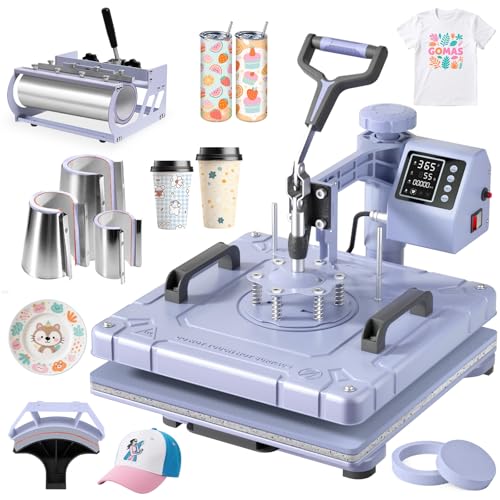
4. Slendor 8 in 1 Heat Press Machine 15x15 — Best for DIY Crafters Who Want Everything
The Slendor 8 in 1 expands the combo concept to its logical limit — eight pressing applications from a single machine with a full 15×15-inch main platen. The upgraded press-casting aluminum heating plate with Teflon coating runs hotter and more evenly than thin aluminum plates. Two bonus Teflon sheets are included, and the innovative alloy guide system makes swapping between the cup, hat, and plate attachments genuinely quick rather than a frustrating process.
The 360-degree swing-away design is standard on this machine, and the detachable lower platform makes attachment swaps cleaner. Temperature range covers 0–482°F (0–250°C) with both Fahrenheit and Celsius readout options. The digital control box stops heating automatically when the preset temperature is reached — a basic feature you absolutely want, since consistent temperature is everything in sublimation and HTV work. The sound alarm on timer completion means you don't need to stand over the machine between presses.
Build quality is where the Slendor earns its price premium over the basic VEVOR 5-in-1. The non-slip rubber handle feels secure, the pressure adjustment knob works smoothly across a full range of material thicknesses, and the lavender color scheme actually makes it look like a professional studio piece rather than an industrial appliance. If you're pressing adhesive vinyl on fabric, mugs, hats, and plates across a variety of DIY projects, this machine handles all of it without compromise.
Pros:
- Full 15×15-inch platen — handles adult XXL garments comfortably
- 8-in-1 versatility with quick-swap alloy guide system
- Upgraded aluminum plate with Teflon coating for even heat
- Both °F and °C readout options
- Auto-stop heating + sound alarm on timer completion
- Two bonus Teflon sheets included
Cons:
- Higher price point than 5-in-1 options
- Heavier and bulkier — requires dedicated workspace

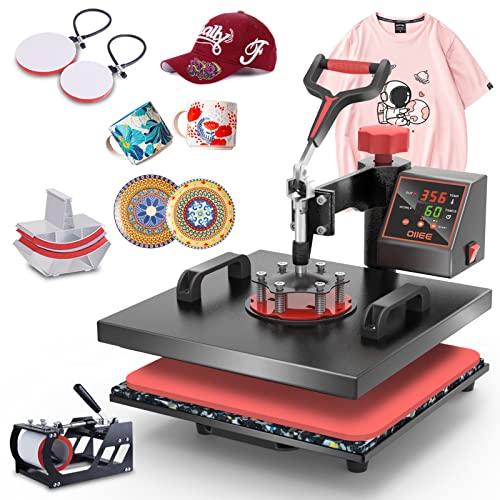
5. OIIEE Heat Press Machine 5 in 1 Combo 15x15 — Best Safety Features
The OIIEE 5 in 1 combines a full-size 15×15-inch t-shirt press with an 11oz mug attachment, hat press, and two plate attachments — giving you the key product types in one machine. Where it stands out from comparable 5-in-1 options is the safety engineering. The 360° swing-away mechanism is paired with a slide-out base that gives you a stable, heat-free working surface when you're positioning materials. This two-part safety design means both your hands and your workspace are clear of the hot plate during loading.
The intelligent LCD controller is well-implemented — precision time and temperature setting with an audible alarm on completion. The built-in overheat protection system is the feature that puts this machine ahead for home studio operators: if voltage spikes or temperature exceeds safe limits, the press automatically shuts off. Voltage fluctuations are a real issue in home wiring, and a machine that protects itself (and your workspace) from a runaway heating element is a machine worth investing in.
At 15×15 inches, the main platen covers full adult garment sizes. The combination of the swing-away design, slide-out base, and overheat protection makes this one of the most safety-conscious machines on this list. For a home studio where children might be nearby, or for operators working in confined spaces, the OIIEE's safety stack is the right call.
Pros:
- 360° swing-away plus slide-out base — best safety setup on this list
- Built-in overheat protection with auto shut-off
- Audible alarm on timer completion
- Full 15×15-inch platen for adult garments
- 5-in-1 versatility covering shirts, mugs, hats, and plates
Cons:
- 5 attachments — fewer than the 8-in-1 options
- No tumbler attachment for 20oz/30oz cups
6. Seeutek Heat Press Machine 15x15 with 20oz & 30oz Tumbler Attachments — Best for Tumbler Printing
Tumbler sublimation is one of the fastest-growing product categories in custom printing right now, and the Seeutek is the only machine on this list that comes bundled with both 20oz and 30oz tumbler attachments out of the box. If you're selling or planning to sell custom tumblers alongside shirts and mugs, this is your machine in 2026. You get the full 5-in-1 functionality — 15×15-inch t-shirt press, 11oz mug attachment, hat press, and plate presses — plus the two tumbler sizes that every competitor charges extra for.
The upgraded double-tube heating system is a genuine engineering improvement over single-tube designs. Double-tube heating delivers faster, more uniform heat across the full 15×15 platen, reducing cold spots at the edges that plague cheaper machines. The result is cleaner sublimation results with sharper color saturation and better edge-to-edge consistency. The Teflon-coated aluminum plate is paired with an ergonomic slide rail design that makes switching between attachments faster than the typical knob-and-slot systems.
Digital controls cover 0–482°F and 0–250°C with an auto shut-off and sound alarm. Two bonus Teflon sheets are included. The 360° swing-away design handles garment positioning safely. For anyone building a custom tumbler business or adding tumblers to an existing shirt printing operation, the Seeutek eliminates the need to buy a dedicated tumbler press separately — a real cost saving at scale.
Pros:
- Includes 20oz and 30oz tumbler attachments — unique on this list
- Upgraded double-tube heating for faster, more uniform heat
- Full 15×15-inch platen with Teflon coating
- Ergonomic slide rail for fast attachment changes
- 360° swing-away plus auto shut-off and audible alarm
- Two bonus Teflon sheets included
Cons:
- Newer model — less long-term user data than more established machines
- Tumbler attachment adds to total package weight and setup time
7. VEVOR Heat Press Machine 8 in 1 Combo 15x15 — Best Professional Multi-Application Setup
The VEVOR 8 in 1 is the most comprehensively equipped machine on this list. Eight applications cover four mug sizes (6oz, 11oz, 12oz, and 17oz), two plate sizes (5-inch and 6-inch), a 6×3-inch cap press, and the main 15×15-inch t-shirt platen. If you're running a small business with a wide custom product catalog, this is the machine that eliminates the need for multiple specialized presses.
The double-tube Teflon-coated heating plate is the technical highlight. Combined with two layers of thermal insulation cotton, 4mm aluminum silicate paper insulation, and a 10mm thick thermostable sponge beneath the plate, this machine is engineered for consistent, even heat from the center of the platen to the edges. That insulation stack also means the heating element holds temperature more consistently under repeated use — critical for production runs. The 360° swing-away function moves the heating plate completely out of the work area, and the pullable slide table keeps your hands clear during material positioning.
This is a machine designed for operators who take pressing seriously. The mug attachment range alone covers virtually every standard sublimation blank on the market. If you're also using a silhouette or vinyl cutter to create custom designs, pairing it with the right heat press is essential — the VEVOR 8 in 1 handles whatever material you throw at it. See our guide to the best Silhouette machines for the complete design-to-press workflow setup.
Pros:
- 8-in-1 — four mug sizes, two plate sizes, hat, and full t-shirt platen
- Double-tube heating with superior insulation stack for even heat
- 360° swing-away plus pullable slide table for maximum safety
- Full 15×15-inch platen handles all adult garment sizes
- Professional-grade build for production volume use
Cons:
- Larger physical footprint requires dedicated studio space
- Higher investment than entry-level or 5-in-1 options
- More attachments means more setup time per job switch
Buying Guide: How to Choose the Best Multifunction Heat Press Machine
Picking a heat press machine comes down to five core factors. Get these right and everything else falls into place.

Platen Size: 12×15 vs. 15×15
Platen size determines what you can press and how efficiently you can press it. Here's what the numbers mean for you:
- 12×15 inch — covers most adult S–L garments and standard transfer sheet sizes. Fine for hobbyists and low-volume production. Limited for XXL and larger.
- 15×15 inch — the industry standard for t-shirt production. Covers adult S through XXL comfortably. Allows single-press on most full-front designs. If you're selling shirts, get a 15×15.
- Print alignment — a larger platen also gives you more margin for positioning errors. Beginners benefit from the extra real estate.
For a hobby setup, 12×15 is workable. For any commercial application, invest in 15×15 from the start.
Clamshell vs. Swing-Away Design
This is a safety and workflow decision, not just a preference.
- Clamshell — the heating plate hinges directly upward. Compact footprint, faster to operate. Risk: your hands and arms are near the hot plate during garment placement. Best for experienced operators with fast, controlled technique.
- Swing-away (360°) — the heating plate rotates completely to the side. You load your garment on a clear, heat-free surface, then swing the plate back. Slower cycle time but dramatically safer. Standard on all combo machines for good reason.
- Slide-out base — an additional safety refinement seen on models like the OIIEE, which pulls the lower platen out from under the heat source. Maximizes safe working space.
If you're running a home studio — especially with kids nearby — go swing-away without hesitation. According to the U.S. Consumer Product Safety Commission, contact burns from heat-producing equipment are among the most common home workshop injuries. The swing-away design meaningfully reduces that risk.
Heating Technology: Single-Tube vs. Double-Tube
Heat consistency is what separates professional results from amateur ones. Uneven heating creates color inconsistencies in sublimation and incomplete bonding in HTV vinyl work.
- Single-tube — standard on entry-level and mid-range machines. Adequate for most applications but can create hot spots or cold edges on large platens.
- Double-tube — found on the Seeutek and VEVOR 8-in-1 on this list. Two heating elements ensure uniform heat distribution across the full platen surface. Noticeably better edge-to-edge results.
- Insulation layers — the VEVOR 8-in-1's insulation stack (thermal cotton + aluminum silicate + thermostable sponge) holds temperature more consistently under sustained production use.
For sublimation specifically, temperature consistency is non-negotiable. Cold spots produce dull, washed-out areas in your print. If sublimation is your primary application, prioritize double-tube heating.

Number of Functions: Do You Actually Need 8-in-1?
More attachments aren't always better — they're only better if you'll use them. Think about your actual product catalog before you pay for functions you won't use.
- T-shirts only — a dedicated flat press (Fancierstudio or PowerPress) costs less, heats faster, and presses more garments per hour. Don't pay for combo features you won't touch.
- T-shirts + mugs + hats — the sweet spot for most small businesses. A 5-in-1 covers all three product types without excessive cost or complexity.
- Full product catalog — shirts, mugs in multiple sizes, hats, plates, tumblers. The VEVOR 8-in-1 or Seeutek with tumbler attachments is the right investment. One machine replaces four.
- Tumbler-specific — if tumblers are a significant revenue line, the Seeutek's bundled 20oz and 30oz attachments make it the clear winner for that use case.
Match the machine to your current catalog, then consider where you'll be in 12 months. Buying an 8-in-1 when you only press shirts wastes money. Buying a t-shirt-only press when you're about to launch a mug line forces a second purchase immediately.
Common Questions
What's the difference between sublimation and HTV heat pressing?
Sublimation uses heat and pressure to convert dye into a gas that bonds permanently with polyester fibers — the color becomes part of the fabric. HTV (heat transfer vinyl) uses heat to melt an adhesive backing that bonds a vinyl layer to the surface of the garment. Sublimation requires polyester-rich fabrics and a sublimation printer. HTV works on cotton, polyester, and blends. Both processes use the same heat press machine — you just adjust temperature and pressure settings based on the material. Most machines on this list include a settings reference card for common transfer types.
What temperature should I set for t-shirt sublimation?
The standard sublimation temperature for polyester garments is 385–400°F (196–204°C) for 45–60 seconds at medium-to-firm pressure. Lighter polyester blends may require slightly lower temperatures (370–385°F) to prevent scorching. Always do a test press on a scrap garment before committing to a full production run. Temperature accuracy on digital machines like those reviewed here is typically within ±5°F of the set point — close enough for consistent results when you dial in the right settings for your specific transfer paper and garment combination.
Can I press 100% cotton shirts with a heat press machine?
Yes, but the method matters. Sublimation does not work on 100% cotton — the dye won't bond without polyester fibers. For cotton, you use HTV vinyl or plastisol heat transfers instead. Cotton sublimation workarounds involve special cotton sublimation sprays or coatings, but results are inconsistent. For a true cotton garment business, HTV vinyl paired with a Silhouette or Cricut cutter is the most reliable workflow. Set your press to 305–320°F for standard HTV on cotton, press for 10–15 seconds, and peel according to your vinyl manufacturer's instructions (hot peel or cold peel).
How do I press mugs with a combo heat press machine?
Attach the mug press element to your machine's lower platform and preheat the element to the manufacturer's recommended temperature — typically 350–375°F for standard sublimation mugs. Wrap your printed sublimation transfer paper tightly around the mug with heat-resistant tape, slide the mug into the curved mug element, close the clamp, and set your timer to 180–240 seconds depending on your transfer paper and mug type. Remove carefully with heat-resistant gloves, peel the transfer immediately while hot, and let the mug cool before handling. The Seeutek and VEVOR 8-in-1 cover the widest mug size range on this list.
What is a Teflon sheet and do I really need one?
A Teflon sheet (PTFE sheet) is a non-stick, heat-resistant barrier placed between the heating element and your transfer or garment. It serves two critical functions: it protects delicate fabrics from direct contact with the hot plate, and it prevents adhesive residue from building up on your platen surface. Without a Teflon sheet, HTV adhesive can transfer to your heating plate and ruin subsequent presses. Most machines on this list include at least one sheet, with several including two bonus sheets. Replace your Teflon sheet when it discolors or develops holes — a damaged sheet transfers marks to your garments.
Is a swing-away heat press better than a clamshell for beginners?
Yes, definitively. Swing-away is the right choice for anyone new to heat pressing. The ability to position your garment on a heat-free surface — without a 400°F plate hovering directly above your hands — eliminates the most common source of beginner burns. Clamshell machines are faster to operate once you've developed muscle memory for positioning, but that speed advantage comes with a burn risk that's not worth it in the learning phase. All of the combo machines on this list use swing-away designs for exactly this reason. Start with swing-away, and if you later move to dedicated high-volume flat pressing, reassess then.
Buy on Walmart
- Fancierstudio Power Heat Press 15-by-15-Inch Digital Sublima — Walmart Link
- PowerPress Industrial-Quality Digital Sublimation Heat Press — Walmart Link
- VEVOR 5 in 1 Heat Press Machine 12x15 Inch, 360° Swing Away — Walmart Link
- Slendor 8 in 1 Heat Press Machine 15x15 inch 360-Degree Swin — Walmart Link
- OIIEE Heat Press Machine 5 in 1 Combo Heat Press 15 x 15 Inc — Walmart Link
- Seeutek Heat Press Machine 15x15 Inch, 5 in 1 Swing Away Sub — Walmart Link
- VEVOR Heat Press Machine 8 in 1 Combo Heat Press 15x15 Inch — Walmart Link
Buy on eBay
- Fancierstudio Power Heat Press 15-by-15-Inch Digital Sublima — eBay Link
- PowerPress Industrial-Quality Digital Sublimation Heat Press — eBay Link
- VEVOR 5 in 1 Heat Press Machine 12x15 Inch, 360° Swing Away — eBay Link
- Slendor 8 in 1 Heat Press Machine 15x15 inch 360-Degree Swin — eBay Link
- OIIEE Heat Press Machine 5 in 1 Combo Heat Press 15 x 15 Inc — eBay Link
- Seeutek Heat Press Machine 15x15 Inch, 5 in 1 Swing Away Sub — eBay Link
- VEVOR Heat Press Machine 8 in 1 Combo Heat Press 15x15 Inch — eBay Link
Next Steps
- Match your machine to your product catalog. If you press only t-shirts, get a dedicated flat press. If you press shirts, mugs, and hats, get a 5-in-1 or 8-in-1. Don't pay for functions you won't use — and don't undersell yourself by buying a machine that can't grow with your business.
- Check current prices on Amazon. Heat press machines fluctuate in price regularly. The VEVOR 8-in-1 and Seeutek tumbler bundle in particular see frequent promotional pricing. Check your top two picks on the same day before deciding.
- Set up your first design before the machine arrives. Read our guide on how to create t-shirt designs and have your first transfer ready to press on day one. Waiting for both the machine and the design to be ready doubles your lead time unnecessarily.
- Buy sublimation paper and Teflon sheets alongside the machine. Budget for consumables in your first order: a pack of sublimation transfer paper compatible with your printer, an extra Teflon sheet, and heat-resistant tape for mug wrapping. These run out fast once you start pressing in volume.
- Do a calibration press on your first day. Set the machine to your target temperature, wait 10 minutes for full thermal stabilization, and do a test press on a scrap garment or blank. Dial in your time and pressure before pressing anything you plan to sell. Every machine runs slightly different from spec — calibrate yours before you commit to production.
 |  |  |  |
About Rachel Kim
Rachel Kim spent five years as a merchandise buyer for a national office supply retail chain, evaluating printers, scanners, and printing accessories from Canon, Epson, HP, Brother, Dymo, and Zebra before approving them for store inventory. Her buying process involved hands-on testing against competing models, reviewing long-term reliability data from vendor reports, and vetting price-to-performance claims that manufacturers routinely overstated. That structured evaluation experience translates directly into the kind of buying guidance that cuts through marketing language and focuses on what actually matters for a specific use case. At PrintablePress, she covers printer and printing equipment reviews, buying guides, and head-to-head product comparisons.


Get some FREE Gifts. Or latest free printing books here.
Disable Ad block to reveal all the secret. Once done, hit a button below
| | | |