Reviews ›
Best Printable Heat Transfer Paper: Reviews, Buying Guide and FAQs 2026
by Rachel Kim · April 04, 2022
You've spent twenty minutes staring at the craft supply aisle — or scrolling through Amazon listings — trying to figure out which heat transfer paper won't bleed, crack, or peel after the third wash. The options look similar on the surface, but the differences matter enormously once you're mid-project with a ruined shirt on your hands. Whether you're personalizing tees for a family reunion, launching a small print-on-demand business, or just experimenting with DIY apparel, choosing the right transfer paper is the difference between a crisp, lasting design and a cloudy, faded mess.
The heat transfer paper market has matured a lot heading into 2026. You have traditional iron-on sheets for inkjet printers, specialty papers for dark and light fabrics, sublimation paper for polyester blanks, and everything in between. Not all of them work with every printer, every fabric, or every heat source. This guide cuts through the noise. We tested and reviewed seven of the most popular options available right now, and we'll tell you exactly which one fits your setup. For a broader look at the category, check out our full heat transfer paper reviews hub.
A quick note before we dive in: the paper you choose must match both your printer type (inkjet vs. sublimation) and your fabric color (light vs. dark). If you're still deciding on a printer, our guide to the best printer for heat transfer paper will help you pair the right hardware with the paper below. Now let's get into the picks.
Contents
- Standout Models in 2026
- Our Hands-On Reviews
- Avery Heat Transfer Paper for Dark Fabrics
- Avery Heat Transfer Paper for Light Fabrics
- PrintWorks Iron on Heat Transfer Paper for Dark Fabric
- NEENAH 3G JET-OPAQUE Heat Transfer Paper
- Epson Iron-on Cool Peel Transfer Paper
- Transfer Magic FXTD-5 Ink Jet Transfer Paper for Dark Fabric
- A-SUB Sublimation Paper 8.5x11 Inch
- Key Features to Consider When Choosing
- Frequently Asked Questions
- Next Steps
Standout Models in 2026
- #PreviewProductRating
- Bestseller No. 1
 Rating:

- Bestseller No. 2
 Rating:
 - Bestseller No. 3
 Rating:
 - Bestseller No. 4
 Rating:
- Bestseller No. 5
 Rating:
 - Bestseller No. 6
 Rating:
 - Bestseller No. 7
 Rating:
Our Hands-On Reviews

1. Avery Printable Heat Transfer Paper for Dark Fabrics — Best for Dark Cotton Shirts
Avery is one of the most recognized names in printable media, and their dark fabric transfer paper earns that reputation. Each 8.5" x 11" sheet is engineered specifically for dark-colored cotton and cotton/poly blends, which is where most beginner-friendly transfer papers completely fall apart. The Color Shield formula keeps your printed colors vivid against dark backgrounds — you're not relying on a white underbase coating to be invisible; it actually holds up through up to 20 washes without significant fading or cracking. That's a meaningful benchmark for garments you intend to wear regularly.
Application is straightforward. The package includes step-by-step instructions, and compatibility extends to both standard household irons and commercial heat presses. The inkjet-only requirement is worth underscoring — do not attempt this with a laser printer. The pack includes 5 sheets, which is a modest count but appropriate for testing a new design or running a small batch of custom shirts, uniforms, or personalized gifts. The design prints in mirror, transfers face-down, and the backing peels away while warm. Alignment is easy because of the paper's dimensional stability — it doesn't curl under heat the way cheaper sheets tend to.
The results on black and navy cotton are genuinely solid. Colors land close to what you see on-screen, and the transfer edge is clean rather than jagged. For a dark-fabric paper at this accessible price point, Avery delivers consistent, repeatable results that beginners and hobbyists will appreciate immediately.
Pros:
- Color Shield formula produces vivid prints on dark fabrics without underbase bleed
- Compatible with household irons and heat presses
- Includes detailed step-by-step application instructions
- Rated for up to 20 washes with minimal fading
Cons:
- Only 5 sheets per pack — higher cost per sheet for large runs
- Inkjet printers only; laser incompatible
- Warm peel requires careful timing to avoid tearing
2. Avery Printable Heat Transfer Paper for Light Fabrics — Best for White and Pastel Shirts
Where the dark-fabric version uses an opaque formula to block through dark textiles, this light-fabric counterpart takes a transparent approach — the transfer layer is clear, so the fabric color shows through where there's no ink. That means your white shirt background remains white, and lighter hues like sky blue or cream stay true. The same Color Shield fade-resistance technology applies here, and Avery rates this paper for up to 20 washes as well. You get 6 sheets per pack instead of 5, which is a small but welcome addition for anyone juggling multiple designs.
The application process mirrors the dark-fabric version: print in mirror, apply with iron or heat press, peel warm. White and light-colored cotton and cotton/poly blends are the intended substrate — don't try this on a black shirt or the design will disappear entirely. The transparent film means that fine details and gradients render beautifully without the slight plasticky sheen that opaque dark-fabric papers sometimes produce. If your project involves photography-style images or complex gradient artwork on light garments, this is your paper.
One practical tip: the transfer does show a visible film boundary around the design edges under close inspection, especially on solid-color shirts. For designs with irregular or feathered edges, consider trimming closely around the artwork before application. That minor step eliminates the film border and gives transfers a far more professional appearance.
Pros:
- Transparent transfer film preserves true fabric color in unprinted areas
- 6 sheets per pack — slightly better value than the dark version
- Excellent for gradient-heavy and photographic designs on light garments
- Works with standard irons and heat presses
Cons:
- Not suitable for dark fabrics — designs vanish on anything but light colors
- Visible film border around design edges without trimming
- Inkjet only
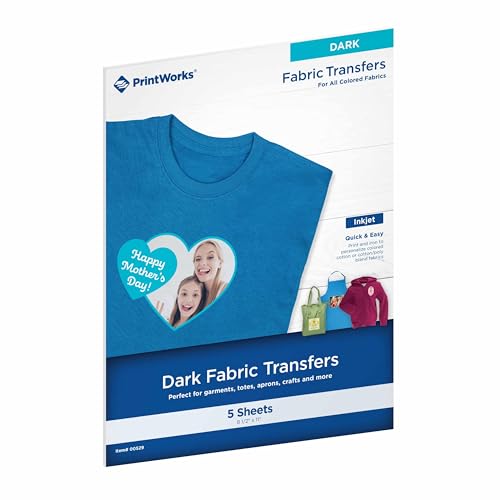
3. PrintWorks Iron on Heat Transfer Paper for Dark Fabric — Best USA-Made Option for Dark Fabric
PrintWorks earns its place in this list by being made in the USA and by including everything you need out of the box — 5 sheets of dark fabric transfer paper, parchment paper for pressing, and step-by-step instructions. The parchment paper inclusion is genuinely useful; it protects both your iron and the transfer surface from direct contact, producing a more even heat distribution across the design. Tutorial videos are also available online, which makes this one of the most beginner-accessible options in the category.
Performance-wise, PrintWorks holds up well on t-shirts, hoodies, canvas bags, and hats. The durable coating resists cracking, peeling, and discoloration over time, and the paper is machine washable — turn your garment inside out and use cold water for best longevity. Color vibrancy on dark fabrics is competitive with Avery, though you may notice very slightly softer edge definition on highly detailed vector designs. For bold graphics, text, and logos, the output is sharp and clean.
The USA manufacturing is a real differentiator for buyers who prioritize domestic sourcing for small business or school projects. Ink adhesion is consistent across the sheet surface — no ghosting or patchy areas even near the edges, which cheaper imported papers sometimes exhibit. Five sheets is a sensible starter quantity, and the included parchment paper saves you from sourcing that separately.
Pros:
- Made in the USA
- Includes parchment paper and full instructions in the box
- Machine washable with durable crack-resistant coating
- Works on t-shirts, hoodies, bags, and hats
Cons:
- Only 5 sheets per pack limits batch production
- Slightly softer edge definition on very fine detail artwork
4. NEENAH 3G JET-OPAQUE Heat Transfer Paper — Best Bulk Option for Dark Fabrics
NEENAH is the professional's choice. The 3G JET-OPAQUE line is a staple in small-run apparel decoration shops and among serious crafters who work in volume. This custom pack of 100 sheets at 8.5" x 11" represents a dramatically lower cost per sheet compared to consumer 5- or 6-sheet packs, and the print quality justifies the wholesale mindset. The opaque white base layer ensures colors pop on dark, black, and even red fabrics — substrates that expose the weaknesses of lower-tier dark-fabric papers.
NEENAH's 3G formula is a three-step process — print, powder, press — which delivers exceptional wash durability and color permanence well beyond what single-step papers provide. The powder activator (sold separately) bonds the ink to the transfer layer at a chemical level, not just a surface level. This means the design flexes with the fabric rather than sitting on top of it as a rigid film. If garment longevity across 40+ wash cycles matters to your use case, this is the paper that delivers it.
The trade-off is complexity. This is not a beginner paper. You need a heat press (not just a household iron) for reliable results, and the powder step adds time and cost to each transfer. But for anyone running an apparel decoration business in 2026 or producing merchandise at scale, the NEENAH 3G JET-OPAQUE pays for itself quickly in reduced reprints and customer returns.
Pros:
- 100-sheet bulk pack delivers the lowest cost per sheet in this category
- Superior wash durability via three-step powder-bond process
- Opaque white base works on any dark fabric color including black and red
- Design flexes with fabric — no rigid film feel
Cons:
- Requires powder activator (sold separately) — adds cost and process steps
- Best results demand a heat press, not a household iron
- Not beginner-friendly without research and practice
5. Epson Iron-on Cool Peel Transfer Paper — Best for Epson Inkjet Users
Epson made this paper to pair with their own inkjet printers, and that first-party optimization shows in the color output. Epson inks and Epson transfer paper are profiled to work together — you get color accuracy, ink adhesion, and transfer consistency that third-party papers can't always replicate on Epson hardware. The Cool Peel design is the defining feature: you wait for the transfer to cool completely before peeling, which reduces the risk of smearing or tearing mid-peel that warm-peel papers occasionally produce when timing is slightly off.
The pack includes 10 sheets at 8.5" x 11", making it one of the better per-sheet values among consumer small packs. It's designed for light-colored fabrics, canvas bags, and similar substrates — do not use this on dark garments. The application process is clean and low-stress: press with a household iron, let it cool to room temperature, then peel. The release is smooth and reliable. Photo-quality images transfer particularly well, with natural skin tones and color gradients that look polished on white cotton.
One honest limitation: the wash durability is adequate for casual use but not exceptional by professional standards. You'll want to wash in cold water, inside-out, and avoid high heat drying. For personalized gifts, one-off custom shirts, or occasional-wear items, it's absolutely sufficient. For workwear or garments worn and washed daily, consider upgrading to the NEENAH 3G formula above.
Pros:
- Cool peel design eliminates timing stress during transfer
- 10 sheets per pack — strong value for a consumer pack
- Optimized for Epson inkjet printers with accurate color output
- Excellent photographic and gradient reproduction
Cons:
- Light fabrics only — not suitable for dark garments
- Wash durability is moderate; not ideal for daily-wear items
- Best results with Epson printers; other brands may vary
6. Transfer Magic FXTD-5 Ink Jet Transfer Paper for Dark Fabric — Best Budget Dark Fabric Option
Transfer Magic positions the FXTD-5 as a budget-accessible entry point for dark fabric transfers, and at 5 sheets per pack it keeps the commitment light if you're testing the product for the first time. The paper is machine wash and dry rated, which is worth noting at this price tier — many budget dark-fabric papers specify hand wash only. High-resolution output is the advertised feature, and in practice the paper handles crisp linework and bold color fills competently.
The iron-and-peel workflow is standard: print in mirror, apply with a hot iron or heat press, and peel. The transfer itself adheres firmly to dark cotton, and the opaque backing layer does a reasonable job of blocking through dark fabric so colors read correctly. Don't expect the same level of edge precision or wash longevity as NEENAH or Avery — the coating is thinner and you'll notice some softening of very fine details. But for bold logos, text-based designs, and simple graphics on dark garments, Transfer Magic delivers a clean result at a lower price per project.
If you're building a small custom T-shirt side business and want to test dark fabric transfers before committing to a higher-cost professional paper, this is an intelligent starting point. The machine-washable certification means you can actually give away or sell what you make without worrying about the design dissolving on the first laundry cycle. For more context on comparing this type of product to vinyl alternatives, see our guide on best heat transfer vinyl for shirts.
Pros:
- Machine wash and dry rated — unusual for budget-tier dark fabric paper
- High-resolution output handles bold graphics and text cleanly
- Accessible price point for testing and prototyping
Cons:
- Thinner coating reduces longevity versus premium options
- Fine detail softening on intricate artwork
- Only 5 sheets per pack

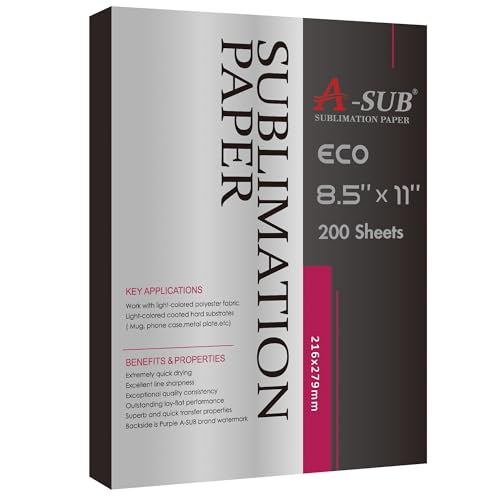
7. A-SUB Sublimation Paper 8.5x11 Inch — Best for Sublimation on Polyester
A-SUB's sublimation paper occupies a different category than the iron-on inkjet papers above, and that distinction matters. Sublimation is not iron-on transfer — it requires a sublimation-converted inkjet printer loaded with sublimation ink, and it only works on light-colored polyester fabric (or polyester-coated hard substrates like mugs, phone cases, and metal plates). If your setup matches those requirements, the A-SUB paper delivers a genuinely exceptional result: over 98% transfer rate, no cracking, no peeling, and colors that are dyed into the fabric rather than sitting on top of it. That means permanent, soft-hand decoration that survives unlimited machine washes without degradation.
The 200-sheet pack is the standout value proposition. At this quantity, A-SUB's economic series is cost-effective for anyone running a sublimation printing side business or producing a high volume of decorated merchandise — mugs, tumblers, pillow covers, canvas bags, mouse pads, and more. A silicone sheet is included to protect your heat press platen from ink bleed, which is a thoughtful add-on that saves you a separate purchase. The 125g paper weight gives it enough rigidity for reliable feeding through standard inkjet printers without jamming.
Fast dry time prevents ink smearing during printing, and the high transfer rate means you're not leaving color on the backing paper after pressing — what you see printed is what ends up on the substrate. If you want to understand how sublimation paper differs from standard iron-on options, our detailed breakdown in sublimation paper vs transfer paper covers the technical distinctions thoroughly. The A-SUB is the right call if you're already in the sublimation ecosystem. It's not a crossover product — it won't work with standard inkjet ink on cotton.
Pros:
- 200-sheet pack with included silicone sheet — outstanding value for volume work
- Over 98% transfer rate with true color and precision reproduction
- No cracking or peeling — dye bonds permanently into polyester fibers
- Works on a wide variety of substrates: fabric, mugs, phone cases, metal, ceramic
- Fast dry time prevents in-printer smearing
Cons:
- Requires sublimation ink and a sublimation-compatible printer — not for standard inkjet use
- Light-colored polyester only — will not produce results on cotton or dark fabrics
- Higher upfront system cost if you're not already in the sublimation workflow
Key Features to Consider When Choosing Heat Transfer Paper
Before you click buy on any of the papers above, there are four core criteria that determine whether a product works for your specific situation. Get these right and the rest falls into place.
Fabric Color: Light vs. Dark
This is the first and most important filter. Light fabric papers use a transparent or translucent transfer layer, which works perfectly on white, cream, or pastel garments but completely disappears on anything dark. Dark fabric papers use an opaque white base layer to block through dark textiles, ensuring your colors show up correctly. Using the wrong paper for your fabric color is the single most common mistake beginners make, and no amount of technique or equipment compensates for it. Check the product label before ordering.
The trade-off is aesthetic: opaque dark-fabric papers produce a slightly thicker, more tactile feel on the garment compared to transparent light-fabric papers. This is inherent to the technology, not a product quality issue. According to the Wikipedia overview of heat transfer printing, the distinction between opaque and transparent transfer media is fundamental to how the technology functions across different substrates.
Printer Compatibility: Inkjet vs. Sublimation
Every iron-on paper in this guide (Avery, PrintWorks, NEENAH, Epson, Transfer Magic) is designed for standard inkjet printers — the kind that uses water-based dye or pigment ink cartridges. The A-SUB paper is the sole exception: it requires a sublimation ink system. Sublimation printers are either purpose-built or standard inkjet printers converted with sublimation ink cartridges. Do not use sublimation paper with standard inkjet ink or vice versa. The results will be unusable and you'll waste both ink and paper.
Laser printers are incompatible with all papers in this guide. If you own a laser printer and want to do heat transfer work, you need laser-specific transfer paper, which is a different product category entirely.
Application Method: Iron vs. Heat Press
All consumer-grade papers in this guide list household iron compatibility, but a heat press produces more consistent results every time. An iron delivers uneven pressure and inconsistent temperature, which means some areas of a large design may transfer while others lift. A heat press applies uniform pressure and temperature across the entire sheet simultaneously. For small, simple designs on occasional-use items, an iron works fine. For anything larger than a 4" design, garments you intend to sell, or repeated production runs, invest in a heat press. The NEENAH 3G paper specifically requires a heat press to activate the powder step reliably.
Sheet Count and Cost Per Sheet
Small packs (5–10 sheets) make sense for testing a new paper, experimenting with a design, or producing one-off gifts. Once you've validated that a paper works with your printer and fabric, buying in bulk reduces cost per sheet dramatically. The NEENAH 3G at 100 sheets and the A-SUB at 200 sheets represent the professional-volume end of the market. Calculate your cost per transfer — including ink usage — before committing to a paper at scale. Wash durability also factors into true cost: a cheaper paper that fails after 10 washes costs more in reprints and reputation than a premium paper that lasts 40+ washes.

Frequently Asked Questions
What is the difference between heat transfer paper for light and dark fabrics?
Light fabric transfer paper uses a transparent or semi-transparent layer that allows the fabric color to show through where there's no ink. It only works on white and light-colored garments. Dark fabric transfer paper includes an opaque white base layer that blocks through dark textiles, ensuring your printed colors are visible regardless of the garment color underneath. Using the wrong type for your fabric color will produce either invisible or heavily distorted results.
Can I use heat transfer paper with a laser printer?
No — every heat transfer paper in this guide is designed for inkjet printers only, including inkjet sublimation printers. Laser printers use a toner-fusing process that is incompatible with standard iron-on transfer paper chemistry. If you own a laser printer, you need to source laser-specific transfer paper, which is a separate product category. Attempting to run inkjet transfer paper through a laser printer can damage the printer's fuser unit.
How many washes will a heat transfer paper design survive?
Most consumer-grade papers like Avery and PrintWorks are rated for up to 20 washes when care instructions are followed — cold water, inside-out, low or no heat drying. Professional-grade papers using a powder-bond process like NEENAH 3G can survive 40 or more wash cycles with proper care. Sublimation transfers (A-SUB) are the most durable of all — because the dye bonds into the polyester fiber rather than sitting on the surface, they essentially last the life of the garment. Wash temperature, drying heat, and detergent type all affect longevity regardless of paper quality.
Do I need a heat press or can I use a regular iron?
A regular household iron works for most consumer-grade transfer papers, and all papers in this guide list iron compatibility. However, a heat press produces significantly more consistent results because it delivers uniform temperature and pressure across the entire design simultaneously. For designs larger than 4 inches, multiple transfers per session, or garments you plan to sell, a heat press is the better investment. The NEENAH 3G JET-OPAQUE in particular performs best with a heat press due to the three-step powder-activation process.
Is sublimation paper the same as iron-on transfer paper?
No — they are fundamentally different products and workflows. Iron-on transfer paper uses water-based inkjet ink that is printed onto a transfer layer and then bonded to the fabric surface under heat. Sublimation paper works with sublimation ink, which under heat converts from a solid to a gas and permanently dyes polyester fibers from within. The results look and feel completely different: iron-on transfers sit on top of the fabric as a distinct layer, while sublimation becomes part of the fabric itself. Sublimation is limited to light-colored polyester and polyester-coated substrates. For a deeper comparison, see our article on sublimation paper vs transfer paper.
What is the best heat transfer paper for a beginner in 2026?
For beginners working with light-colored cotton garments, the Avery Light Fabrics paper or the Epson Cool Peel are both excellent starting points — clear instructions, household iron compatibility, and forgiving application processes. For dark garments, Avery Dark Fabrics or PrintWorks are the most beginner-friendly options, with both providing step-by-step instructions and included accessories. Start with a small pack to test your printer's output quality and your iron or heat press settings before committing to a larger bulk purchase. Getting the temperature and pressure settings dialed in on a test shirt is always worth the investment before running a full batch.
Buy on Walmart
- Avery Printable Heat Transfer Paper for Dark Fabrics, 8.5" x — Walmart Link
- Avery Printable Heat Transfer Paper for Light Fabrics, 8.5" — Walmart Link
- PrintWorks Iron on Heat Transfer Paper for Inkjet Printer - — Walmart Link
- NEENAH 3G JET-OPAQUE HEAT TRANSFER PAPER 8.5 X 11" CUSTOM PA — Walmart Link
- Epson Iron-on Cool Peel Transfer (8.5x11 Inches, 10 Sheets) — Walmart Link
- Transfer Magic FXTD-5 Ink Jet Transfer Paper for Dark Fabric — Walmart Link
- A-SUB Sublimation Paper 8.5x11 Inch-200 Sheets Heat Transfer — Walmart Link
Buy on eBay
- Avery Printable Heat Transfer Paper for Dark Fabrics, 8.5" x — eBay Link
- Avery Printable Heat Transfer Paper for Light Fabrics, 8.5" — eBay Link
- PrintWorks Iron on Heat Transfer Paper for Inkjet Printer - — eBay Link
- NEENAH 3G JET-OPAQUE HEAT TRANSFER PAPER 8.5 X 11" CUSTOM PA — eBay Link
- Epson Iron-on Cool Peel Transfer (8.5x11 Inches, 10 Sheets) — eBay Link
- Transfer Magic FXTD-5 Ink Jet Transfer Paper for Dark Fabric — eBay Link
- A-SUB Sublimation Paper 8.5x11 Inch-200 Sheets Heat Transfer — eBay Link
Next Steps
- Identify your fabric color and printer type first — confirm whether you need light or dark fabric paper, and verify your printer is an inkjet (not laser) before ordering anything.
- Check current prices on Amazon for your shortlisted papers — pricing fluctuates and bulk packs often go on sale, changing the per-sheet math in your favor.
- Order a small test pack before committing to bulk — run a test transfer on a scrap shirt to dial in your heat and pressure settings before producing garments you intend to sell or give away.
- Read our full buying guide on the heat transfer paper reviews page for additional options and updated testing notes for 2026.
- If you're comparing transfer paper to vinyl, review our best heat transfer vinyl for shirts guide — vinyl offers different durability and design possibilities that may better suit your specific project requirements.
 |  |  |  |
About Rachel Kim
Rachel Kim spent five years as a merchandise buyer for a national office supply retail chain, evaluating printers, scanners, and printing accessories from Canon, Epson, HP, Brother, Dymo, and Zebra before approving them for store inventory. Her buying process involved hands-on testing against competing models, reviewing long-term reliability data from vendor reports, and vetting price-to-performance claims that manufacturers routinely overstated. That structured evaluation experience translates directly into the kind of buying guidance that cuts through marketing language and focuses on what actually matters for a specific use case. At PrintablePress, she covers printer and printing equipment reviews, buying guides, and head-to-head product comparisons.


Get some FREE Gifts. Or latest free printing books here.
Disable Ad block to reveal all the secret. Once done, hit a button below
| | | |