Reviews ›
9 Best Leather Paints Reviewed
by Rachel Kim · March 27, 2022
Which leather paint is actually going to hold up on your favorite sneakers, your vintage jacket, or that leather bag you've been wanting to restore? If you've spent any time searching for a reliable answer, you already know the options are overwhelming — dozens of brands, countless formulations, and a bewildering range of price points that make choosing feel like a gamble. The good news is that after testing and researching the most popular options available in 2026, one product keeps rising to the top of almost every shortlist: the Angelus Acrylic Leather Paint Best Sellers Kit, which delivers professional-grade performance at a price point that's genuinely accessible to hobbyists and serious crafters alike.
Leather painting has evolved considerably over the past decade, and the products available today are a significant step up from the stiff, crack-prone paints that frustrated crafters in earlier years. Modern acrylic-based leather paints are formulated to flex with the material, resist fading from UV exposure, and withstand the kind of daily wear that a static canvas painting would never face. Whether you're customizing a pair of sneakers, restoring a worn leather couch, or adding decorative detail to a handmade leather goods project, your paint choice will determine whether your work lasts for years or begins flaking within weeks. According to Wikipedia's overview of acrylic paint, the water-based polymer medium that forms the backbone of most leather paints offers excellent adhesion and flexibility once cured — both critical properties for any surface that bends and stretches with regular use.
In this guide, you'll find honest, in-depth reviews of the top leather paints on the market right now, organized to help you match each product to your specific project type. If you've already explored options in adjacent categories like our best fabric paint reviews, you'll notice that leather paints share some characteristics with fabric formulations but require additional flexibility agents and surface prep considerations that make them a distinct category worth understanding on their own. Browse our full product review library if you're outfitting a complete craft studio, and read on to find the leather paint that fits your workflow.

Contents
- Our Top Picks for 2026
- In-Depth Reviews
- Angelus Acrylic Leather Paint Best Sellers Kit — Best for Beginners & All-Around Use
- Angelus Neon Acrylic Leather Paint Set — Best for Bold, Vibrant Designs
- Leather Studio Leather Paint 2oz Black — Best Single-Color Value
- Angelus Leather Paint Set of 12 (4 oz) — Best for High-Volume Projects
- Tandy Leather Eco-Flo Cova Color Pack — Best for Traditional Leatherwork
- Jacquard Lumiere Pearlescent White — Best for Metallic & Pearlescent Effects
- U.S. Art Supply 36 Color Airbrush Set — Best for Airbrushing
- What to Look For When Buying Leather Paint
- FAQs
Our Top Picks for 2026
- #PreviewProductRating
- Bestseller No. 1
 Rating:

- Bestseller No. 2
 Rating:
- Bestseller No. 3
 Rating:
- Bestseller No. 4
 Rating:
 - Bestseller No. 5
 Rating:
 - Bestseller No. 6
 Rating:
 - Bestseller No. 7
 Rating:
In-Depth Reviews
1. Angelus Acrylic Leather Paint Best Sellers Kit — Best for Beginners & All-Around Use
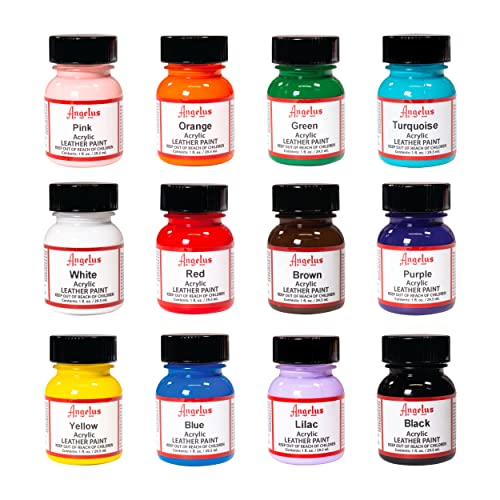
If you're stepping into leather customization for the first time, or if you want a single kit that handles the broadest range of projects without forcing you to source individual colors from multiple brands, the Angelus Best Sellers Kit is the most logical starting point in 2026. The set includes 12 colors — each in a 1 oz bottle — that represent a well-chosen palette of core hues, giving you enough range to mix custom shades while keeping the initial investment reasonable. Angelus has built its reputation as the go-to brand for sneaker customization, and this kit is very much the product that cemented that reputation, offering a formulation that adheres to smooth leather, nubuck, canvas, and synthetic materials without requiring a separate primer in most cases.
What genuinely separates Angelus paints from cheaper alternatives is the flexibility of the cured film. When you paint on leather — especially on shoes or bags that flex constantly throughout the day — a brittle paint layer will begin cracking within weeks, even if it looks perfect at first application. The acrylic binder in Angelus paints remains pliable after drying, allowing the paint to move with the leather rather than fighting against it. You can apply it with a fine brush for detail work, a sponge for smooth flat coverage, or thin it slightly for airbrush application, which gives you genuinely professional results regardless of your preferred technique. The colors in this kit are vibrant out of the bottle and can be mixed together directly, which means your color options are effectively unlimited once you learn how the pigments interact.
The one area where new users sometimes encounter friction is surface preparation. For the paint to bond properly and deliver on its durability promises, you need to clean the leather thoroughly and use an acetone-based leather preparer to strip any factory finish before applying the first coat. Skipping this step will result in poor adhesion and early flaking, which unfairly gives the product a bad reputation in reviews from users who bypassed the prep work. When properly applied over prepared leather and finished with an Angelus finisher (sold separately), this paint will not crack, peel, fade, or rub off under normal daily-wear conditions — a claim that holds up under long-term real-world use.
Pros:
- 12 well-chosen core colors that mix together seamlessly for custom shades
- Flexible cured film that won't crack or peel on surfaces that bend regularly
- Works on leather, canvas, synthetic materials, and even furniture upholstery
Cons:
- Surface prep with a leather preparer is essential and sold separately
- 1 oz bottles go quickly on larger projects like furniture or full jackets
2. Angelus Neon Acrylic Leather Paint Set — Best for Bold, Vibrant Designs
Once you've mastered the fundamentals with a standard palette, the Angelus Neon set opens up a completely different register of creative possibility that standard color ranges simply can't reach. These 12 neon shades — including Amazon Green, Bahama Blue, Flaming Orange, Jamaican Joy, Paradise Purple, and several others — are formulated to deliver maximum visual impact, the kind of punchy, eye-catching brightness that makes custom sneakers and statement handbags stop people in their tracks. Each color comes in the same 1 oz format as the standard Angelus range, and because the formula is fully compatible, you can blend neons with standard Angelus shades to create intermediate tones and gradient effects that keep their intensity under varied lighting conditions.
The non-toxic formula makes this set suitable for crafters of all experience levels, including those working in shared spaces or with younger hobbyists nearby, and the same surface preparation principles that apply to the standard Angelus range apply here — clean, strip the factory finish, apply in thin layers, and finish with a compatible sealant. Where neon paints sometimes disappoint is in their opacity on dark leather, since the reflective pigments that create the neon effect can require additional coats to achieve full coverage on black or dark brown substrates. On lighter leather or over a white base coat, however, these colors are genuinely spectacular, and the final result is the kind of professional-looking custom work that commands attention.
If your creative work leans toward bold graphic designs, streetwear aesthetics, or festival-inspired accessories, this set gives you a complete neon toolkit that pairs naturally with the standard Angelus Best Sellers Kit reviewed above. The two sets together give you a palette broad enough to handle virtually any design concept you bring to your leather projects in 2026.
Pros:
- All 12 Angelus neon shades in one set, covering the full neon spectrum
- Fully compatible with standard Angelus colors for blending and gradient work
- Non-toxic formula safe for all skill levels and shared studio environments
Cons:
- Requires a white base coat for full opacity on dark leather substrates
- Neon colors can show brush strokes more readily than matte formulations
3. Leather Studio Leather Paint (2 oz) Black — Best Single-Color Value
Not every leather paint project calls for a full multi-color kit — sometimes you need a reliable, workhorse black that you can reach for repeatedly without depleting an expensive set. The Leather Studio Leather Paint in black fills that role admirably, offering a 2 oz bottle with a quick-drying, high-quality satin finish formulation that performs well on both natural leather and vinyl surfaces without the fuss of a complex prep routine. Ideal for shoe touch-ups, belt restoration, bag repair, and decorative work on leather accessories, this paint bonds firmly to the surface and dries to a satin sheen that looks polished rather than plasticky — an important distinction for restoration work where you want the result to blend naturally with aged leather rather than calling attention to itself.
The satin finish is worth discussing in more detail because it sits in the sweet spot between matte (which can look flat and dull on leather) and high-gloss (which can look artificial and cheap on everyday items). For shoe restorations and bag touch-ups in particular, that natural satin sheen means your repaired areas will blend into the surrounding leather without looking freshly painted — which is exactly what you want when the goal is restoration rather than customization. The paint won't crack or peel under normal use conditions, and the quick-drying formula means you can apply multiple coats in a single session without long waiting periods between layers.
The limitation here is obvious: you're buying a single color in a relatively modest volume, which makes this product unsuitable for large-scale or multi-color projects. But for the user who wants a dedicated black paint for ongoing maintenance and repair work — touching up scuffs on leather shoes after each season, restoring faded black leather car seats, or adding detail lines to a custom project — this product delivers excellent value per ounce and earns a place in any leather crafter's toolkit as a reliable everyday option.
Pros:
- Satin finish looks natural and blends well with existing leather surfaces
- Quick-drying formula allows multiple coats in a single session
- Works on both genuine leather and vinyl surfaces
Cons:
- Single color limits its versatility for multi-color or creative projects
- 2 oz volume depletes quickly on larger restoration projects
4. Angelus Leather Paint Set of 12 (4 oz) — Best for High-Volume Projects
For those of you who are already comfortable with Angelus paints and have moved beyond the 1 oz starter quantities, the 4 oz set of 12 colors is the natural next step — offering four times the paint volume per color at a cost-per-ounce that makes more sense for anyone working on multiple projects or painting larger surfaces like furniture upholstery, leather jackets, or equestrian tack. The same trusted Angelus formula applies: flexible, non-toxic, and formulated to adhere to athletic shoes, boots, jackets, purses, and leather riding equipment without cracking or peeling under the conditions those items experience during actual use.
The 12-color selection mirrors the classic Angelus palette of core hues, giving you a versatile range that covers the most common project needs and mixes down into a wide variety of custom shades. Working with 4 oz jars rather than 1 oz bottles changes your workflow in practical ways — you can load a brush or sponge more freely without worrying about depleting your supply mid-project, and the larger containers are better suited to airbrush cups and mixing palettes where you need to work with meaningful quantities of paint. For professional custom painters and dedicated hobbyists who turn out regular work, the economics of the 4 oz set are simply better, and the consistent Angelus quality means you're not trading reliability for volume.
The main consideration before purchasing is storage: 12 jars of 4 oz paint represent a meaningful amount of material, and acrylic leather paint needs to be stored at room temperature away from freezing conditions to maintain its consistency over time. If you're working in a climate-controlled studio, this is a non-issue, but if your workspace gets very cold in winter, you'll want to bring your paint supply indoors between sessions to prevent the acrylic binder from separating or degrading.
Pros:
- Four times the paint volume per color compared to the 1 oz set
- Better cost-per-ounce economics for regular or high-volume painters
- Same reliable Angelus formula with full non-toxic certification
Cons:
- Larger investment upfront — better suited to committed crafters than casual users
- Requires proper temperature-controlled storage to maintain consistency
5. Tandy Leather Eco-Flo Cova Color Pack — Best for Traditional Leatherwork
Tandy Leather is one of the oldest names in the leatherworking supply industry, and the Eco-Flo Cova Color line reflects that heritage with a water-based, environmentally conscious formulation that appeals to traditional leather artisans who prioritize compatibility with vegetable-tanned and natural leathers alongside a cleaner chemical profile. The Eco-Flo range is designed for artisans working in the classical leathercraft tradition — saddle making, tooling, carving, and hand-stitching — where the paint or colorant needs to penetrate the leather surface and work with the material's natural character rather than sitting on top of it like a film-forming acrylic coating.
What distinguishes the Eco-Flo Cova Color from standard acrylic leather paints is its coverage-first formulation, which delivers a more opaque, solid coat that works particularly well over tooled or carved leather surfaces where you want the color to fill the recesses and high relief areas evenly without the translucency that some lighter acrylics exhibit. For those of you working on craft projects that complement other handmade goods — similar to the precision and color control required when working with a Silhouette cutting machine for vinyl and paper projects — the Eco-Flo's predictable behavior and consistent coverage will feel familiar and controllable.
The trade-off is that this paint is more specialized in its intended use case. On smooth finished leather — the kind used in sneakers, modern handbags, and fashion accessories — the Eco-Flo formula performs adequately but doesn't offer the same flexibility insurance that Angelus-style formulations do. For traditional leatherwork applications, however, it's a trusted, proven product from a supplier that has served professional craftspeople for decades, and the environmentally responsible formula means you're not working with harsh solvents in your studio.
Pros:
- Water-based eco-friendly formula with no harsh solvent content
- Excellent opaque coverage ideal for tooled and carved leather surfaces
- Trusted brand with a long history serving professional leather artisans
Cons:
- Less flexible than dedicated sneaker/fashion-leather formulations when cured
- Better suited to traditional leatherwork than modern sneaker or bag customization
6. Jacquard Lumiere 2.25oz Pearlescent White — Best for Metallic & Pearlescent Effects
When you want your leather project to catch the light and shimmer with a metallic or pearlescent effect that standard matte and satin acrylics simply cannot produce, the Jacquard Lumiere line delivers a distinctly different aesthetic that makes it a valuable specialty option in any leather painter's collection. The Pearlescent White variant is the most versatile entry point into the Lumiere range — it works beautifully on its own for white-with-shimmer applications, but it also functions as a mixing base for tinting with other Jacquard products to create custom pearlescent shades that maintain the iridescent depth characteristic of the entire line. The mica powder incorporated into the formula creates that signature metallic depth and sparkle that shifts subtly as the viewing angle changes, giving your finished work a dimensional quality that flat colors can't replicate.
Jacquard formulates the Lumiere line to be lightfast and colorfast, which means the metallic effects you apply today will remain vibrant and stable under direct sunlight and through washing cycles without dulling or fading over time — a genuine durability claim that holds up for fabric and leather applications alike. The light-bodied consistency creates a completely opaque film that works on both light and dark backgrounds, so you can apply Pearlescent White over black leather and still achieve full coverage without layering endlessly. The smooth application characteristics make it suitable for brush, sponge, or airbrush delivery, giving you flexibility in how you build up your metallic effects across different project scales.
Keep in mind that this product is purpose-built for decorative and artistic applications where the metallic shimmer is the point — it's not a replacement for standard opaque coverage paints in everyday restoration work. If you're customizing a statement piece, adding metallic accents to a leather accessory, or creating wearable art that you want to stand out visually, the Lumiere Pearlescent White brings a level of sophistication and visual complexity that standard leather paints genuinely can't match, and it pairs naturally with other Jacquard products if you want to build a complete metallic palette for more complex multi-color work.
Pros:
- Mica-powder formula creates genuine metallic shimmer depth that shifts with viewing angle
- Lightfast and colorfast — maintains vibrancy under sunlight and through washing
- Fully opaque coverage on both light and dark leather backgrounds
Cons:
- Specialty product — not a substitute for standard opaque leather paint in restoration work
- Single color per bottle; building a full metallic palette requires multiple purchases
7. U.S. Art Supply 36 Color Deluxe Acrylic Airbrush & Leather Paint Set — Best for Airbrushing
If you've invested in an airbrush setup and want a comprehensive color system specifically pre-thinned for spray application on leather and shoes, the U.S. Art Supply 36 Color Deluxe kit represents an unusually complete package that eliminates the guesswork of sourcing compatible accessories separately. The set includes 36 colors across three groups — 12 primary opaque colors, 12 secondary opaque colors, and 12 pearlized colors — along with two bottles of airbrush cleaner, two bottles of airbrush reducer and extender base, 50 plastic mixing cups, 50 wooden mixing sticks, and a color mixing wheel. The sheer completeness of this kit means you can set up a functional airbrush painting station immediately without additional purchases, which is a genuine advantage for anyone who wants to get started quickly rather than assembling a system piecemeal.
The colors are formulated to spray ready-to-use straight from the 1 oz bottles without thinning, which simplifies the process for users who are still learning their airbrush equipment's pressure and flow characteristics, and optional thinning with the included reducer is available for users who prefer a finer, more translucent mist. All colors use high-quality lightfast pigments and meet ASTM D-4236 standards for safe studio use. The inclusion of 12 pearlized colors alongside the standard opaque palette gives you built-in access to metallic-effect airbrush work without needing a separate specialty product, and the mixing accessories let you create and document custom color formulations with enough consistency to reproduce results across multiple sessions or projects. For crafters who also work with heat-transfer tools or cutting machines — similar to the workflow considerations involved in choosing the best heat press machine for multi-step garment projects — having a complete, self-contained system removes a significant source of process friction.
Where this kit shows its limitations is in the depth of quality compared to dedicated leather-specific brands like Angelus. The formula performs well and holds up under typical use conditions, but users working on high-end leather goods or professional custom commissions may find that the Angelus-style formulation offers superior long-term flexibility and durability on premium leathers. For hobbyists, beginners transitioning into airbrushing, and anyone who wants the most complete starter kit available at a reasonable price point, however, this set delivers genuine value and covers the full range of airbrush leather and shoe painting techniques.
Pros:
- 36 colors including 12 pearlized shades plus all accessories in one complete kit
- Ready-to-spray formula requires no thinning for standard airbrush work
- ASTM D-4236 certified non-toxic pigments with strong lightfastness
Cons:
- Overall formula quality doesn't fully match dedicated leather brands for professional work
- 1 oz bottles deplete quickly when airbrushing larger surface areas
What to Look For When Buying Leather Paint
Flexibility and Adhesion After Curing
The single most important performance characteristic to evaluate before buying any leather paint is how the cured film behaves when the surface flexes during normal use. Leather is not a static material — shoes bend at the toe box with every step you take, bags flex when you open and close them, and jackets crease constantly at the elbows and waist. A paint that adheres well when first applied but becomes brittle as it cures will begin cracking along those flex lines within weeks, regardless of how carefully you applied it or how many finish coats you layered on top. Look for formulations that specifically advertise flexibility in the cured state and check user reviews for comments on long-term wear — three months to six months of actual use will reveal cracking problems that don't show up in first-impression reviews.
Surface Compatibility and Prep Requirements
Not all leather paints perform equally across all leather types, and understanding your specific material before choosing a paint will save you significant frustration. Smooth finished leathers — the kind used in dress shoes, designer handbags, and modern fashion accessories — are typically coated with a factory finish that resists paint adhesion unless the surface is properly prepared with a leather deglazer or acetone-based preparer. Vegetable-tanned leathers used in traditional leathercraft and saddlery have more open pores that accept color penetration more readily and may respond better to penetrating colorants like the Tandy Eco-Flo range. Vinyl and synthetic materials require paints specifically formulated for non-porous surfaces. Always read the product's surface compatibility specifications carefully and plan your prep work accordingly before opening your first bottle.
Color Range, Mixability, and Palette Planning
Unless you're working exclusively in a single color for restoration or touch-up purposes, the range of colors available — and how well those colors mix together — matters enormously for creative projects. Brands like Angelus have built large, compatible color systems where every product in the line blends seamlessly with every other, giving you access to essentially unlimited custom colors through mixing. Smaller, more specialized lines may offer a narrower base palette that limits your options without purchasing multiple sets. Before committing to a brand, consider whether the colors you need are available within that system, whether the paints can be mixed with other products in the line, and whether the brand offers specialty formulations — neons, metallics, pearlescents — that you might want to incorporate into future projects as your skills develop.
Application Method and Finish Options
Different leather painting techniques call for different paint properties, and matching the formulation to your preferred application method will significantly improve your results. Brush-applied paints need good flow characteristics without excessive running, and a slight thickening that helps the paint stay where you put it during detail work. Airbrush applications require pre-thinned or thinnable formulations with fine particle sizes that won't clog the needle or tip. Sponge application for smooth base coats benefits from medium viscosity and fast drying times that allow multiple coats without lifting previous layers. Finish options — matte, satin, gloss — should also be considered relative to your project's final aesthetic goals. Just as choosing the right ink pad for a stamping project determines the character of the final impression, your choice of leather paint finish determines whether your finished piece reads as natural and understated or bold and high-impact.
FAQs
Do I need to seal leather paint after applying it?
Yes, sealing your finished leather paint work with a compatible finisher or top coat is strongly recommended for any item that will see regular use or handling. The paint itself provides color and adhesion, but a finisher adds an additional protective layer that guards against scuffs, moisture, and the gradual abrasion that comes from normal handling. Most major leather paint brands including Angelus offer dedicated finishers in matte, satin, and gloss formulations that are formulated to work with their specific paint chemistry — using the same brand's finisher is the safest approach for guaranteed compatibility and maximum durability of your finished work.
Can you use regular acrylic paint on leather instead of leather-specific paint?
You can apply regular craft acrylic paint to leather and it will adhere initially, but the results will almost certainly disappoint you over time because standard acrylic paints are not formulated with the flexibility agents required to move with leather without cracking. Regular acrylics cure to a relatively rigid film that begins fracturing along flex lines within weeks on any leather surface that moves during normal use. Leather-specific paints contain plasticizers and binders designed to remain pliable after curing, which is a fundamental difference that matters enormously for anything beyond static decorative applications.
How many coats of leather paint do you typically need?
Most leather painting projects require between two and four thin coats to achieve solid, even coverage, with light sanding or buffing between coats for the smoothest results. Applying one thick coat is tempting for beginners trying to save time, but thick coats are more prone to cracking, peeling, and showing brush marks than multiple thin layers built up gradually. Dark colors going over light leather will generally need more coats than lighter colors, and highly saturated neon or white shades may require a white base coat first to achieve the vibrancy shown in product photos. Each coat should dry completely before the next application, which typically takes 15 to 30 minutes depending on temperature and humidity.
Does leather paint work on faux leather and vinyl surfaces?
Many leather paints, including the Angelus acrylic range and the Leather Studio formula, are explicitly formulated to work on both genuine leather and vinyl or synthetic surfaces, making them suitable for furniture upholstery, car interiors, and fashion accessories made from PU leather or similar materials. The key difference is that vinyl and synthetic surfaces are non-porous, so adhesion depends entirely on the surface preparation and the paint's bonding chemistry rather than any penetration into the material. Cleaning the surface thoroughly with isopropyl alcohol and applying a compatible vinyl or plastic prep product before painting will significantly improve adhesion and longevity on synthetic surfaces.
Can you use leather paint on a leather couch or chair?
Yes, leather furniture is one of the most popular applications for acrylic leather paint, particularly for restoration and color refresh projects on aging or faded upholstery. The main consideration for furniture projects is scale — you'll need significantly more paint than for a shoe or bag project, which makes the 4 oz Angelus set or similarly large-volume options much more practical than 1 oz starter kits. Furniture leather also tends to be a different grade and finish from fashion leather, so testing your paint and prep approach on a hidden area before committing to the full piece is always a worthwhile precaution that can save you from a very visible mistake.
How do you remove leather paint if you make a mistake?
Fresh leather paint can be removed while still wet with a damp cloth and a small amount of isopropyl alcohol, acting quickly before the acrylic binder sets into the surface. Once the paint has fully cured, removal becomes considerably more challenging and typically requires a leather paint remover or acetone-based deglazer applied carefully with a cotton swab or cloth, followed by re-prepping the surface for a fresh application. For significant errors on finished pieces, complete removal may not be practical, and a cover coat in a new color may be the most effective path forward. Prevention through careful masking and working in thin, controlled layers is far easier than correction after the fact.
Buy on Walmart
- Angelus Acrylic Leather Paint, Best Sellers Kit, Flexible Pa — Walmart Link
- Angelus Neon Acrylic Leather Paint Set – 12 Vibrant Colors, — Walmart Link
- Leather Studio Leather Paint (2-Ounce), 71412 Black — Walmart Link
- Angelus Leather Paint Set Of 12 4 oz — Walmart Link
- Tandy Leather Eco-Flo Cova Color Pack 2650-06 — Walmart Link
- Jacquard Lumiere 2.25oz Fabric Paint Pearlescent White - Met — Walmart Link
- U.S. Art Supply 36 Color Deluxe Acrylic Airbrush, Leather & — Walmart Link
Buy on eBay
- Angelus Acrylic Leather Paint, Best Sellers Kit, Flexible Pa — eBay Link
- Angelus Neon Acrylic Leather Paint Set – 12 Vibrant Colors, — eBay Link
- Leather Studio Leather Paint (2-Ounce), 71412 Black — eBay Link
- Angelus Leather Paint Set Of 12 4 oz — eBay Link
- Tandy Leather Eco-Flo Cova Color Pack 2650-06 — eBay Link
- Jacquard Lumiere 2.25oz Fabric Paint Pearlescent White - Met — eBay Link
- U.S. Art Supply 36 Color Deluxe Acrylic Airbrush, Leather & — eBay Link
The best leather paint is the one you'll actually prep for properly — because no formula, however good, outlasts skipped surface prep and a rushed first coat.
 |  |  |  |
About Rachel Kim
Rachel Kim spent five years as a merchandise buyer for a national office supply retail chain, evaluating printers, scanners, and printing accessories from Canon, Epson, HP, Brother, Dymo, and Zebra before approving them for store inventory. Her buying process involved hands-on testing against competing models, reviewing long-term reliability data from vendor reports, and vetting price-to-performance claims that manufacturers routinely overstated. That structured evaluation experience translates directly into the kind of buying guidance that cuts through marketing language and focuses on what actually matters for a specific use case. At PrintablePress, she covers printer and printing equipment reviews, buying guides, and head-to-head product comparisons.


Get some FREE Gifts. Or latest free printing books here.
Disable Ad block to reveal all the secret. Once done, hit a button below
| | | |