Reviews ›
Best Document Scanner 2026: Review, Buying Guide, and FAQ
by Rachel Kim · March 26, 2022
The Fujitsu ScanSnap iX1600 is the best document scanner you can buy in 2026 — it's fast, dead simple to set up, and handles everything from receipts to legal-size documents without fuss. But the right scanner for you depends on your workspace, workflow, and budget, so we tested all seven models on this list to help you choose.
Paper is still everywhere. Tax documents, contracts, school records, medical forms — the pile never stops. A good document scanner turns that chaos into searchable digital files you can find in seconds. Whether you're running a home office, managing a small business, or just trying to declutter, a dedicated scanner beats your phone camera or all-in-one printer every single time. For 2026, the market has some genuinely excellent options across every price point.
We've reviewed our full document scanner collection to bring you only the top performers. These seven scanners cover everything from ultra-portable USB-powered units to heavy-duty professional workhorses. If you're also in the market to pair your scanner with a reliable printer, check out our guide to the best black and white printers for a complete paper management setup. And once your documents are digital, our roundup of OCR tools in 2026 will help you extract and edit text from every scan.
Contents
Our Top Picks for 2026
- #PreviewProductRating
- Bestseller No. 1
 Rating:

- Bestseller No. 2
 Rating:
- Bestseller No. 3
 Rating:
- Bestseller No. 4
 Rating:
 - Bestseller No. 5
 Rating:
 - Bestseller No. 6
 Rating:
 - Bestseller No. 7
 Rating:
Our Hands-On Reviews
1. Fujitsu ScanSnap iX1600 ADF Scanner — Best Overall
The ScanSnap iX1600 is Fujitsu's flagship consumer scanner, and it earns that title. You get a 4.3-inch color touchscreen that makes setup and profile selection genuinely easy — even for people who've never used a dedicated scanner before. It handles a 50-sheet auto document feeder (ADF) at up to 40 pages per minute (ppm), so a stack of bills or contracts disappears in under a minute. Wireless setup via Wi-Fi means you can park it anywhere on your desk without running cables to your computer.
What sets this scanner apart is how well it handles a shared office environment. Up to 30 user profiles can be stored directly on the touchscreen, each pointing to a different cloud destination, folder, or app. Drop a stack in and tap your name — done. The ScanSnap Home software is polished, automatically straightening skewed pages, removing blank sheets, and optimizing color. At 600 dpi (dots per inch — a measure of scan resolution, where more means sharper detail), it captures fine print and photo details cleanly.
The iX1600 is designed for people who want scanning to feel effortless. It's not the cheapest scanner on this list, but the combination of touchscreen control, strong software, and rock-solid reliability makes it worth every dollar for home offices and small teams alike.
Pros:
- 4.3-inch touchscreen with up to 30 personalized user profiles
- Fast 40 ppm / 80 ipm (images per minute) duplex scanning
- Excellent ScanSnap Home software with automatic corrections
- Wi-Fi and USB connectivity — works with or without a PC
- 50-sheet ADF handles mixed document batches reliably
Cons:
- Premium price point compared to competitors
- No ISIS driver support (matters for some enterprise software)
2. Epson WorkForce ES-400 II — Best Mid-Range Value
The Epson WorkForce ES-400 II hits a sweet spot that a lot of buyers are looking for: professional-grade speed and features at a price that won't make you wince. It powers through a 50-sheet ADF at up to 35 ppm, handling both color and black-and-white documents in a single duplex (double-sided) pass. For home office use or small team workflows, that's more than fast enough to clear your inbox daily.
Epson's ScanSmart Software is the real star here. It lets you preview scans before saving, automatically names files based on content, and sends documents straight to email or cloud storage. There's no learning curve — the interface is clean and logical. You also get a full TWAIN driver (a standard interface that lets scanner and software communicate — almost every document management app supports it), so it integrates cleanly with tools like Adobe Acrobat, QuickBooks, and most EMR (electronic medical record) systems.
If you're scanning to process invoices, organize tax documents, or manage client files, the ES-400 II delivers dependable results day after day. It's not flashy, but it does exactly what it promises without drama.
Pros:
- 35 ppm / 70 ipm duplex speed — fast for the price
- Intuitive ScanSmart software with automatic file naming
- TWAIN driver ensures compatibility with virtually all document software
- Cloud and email integration built in
- Compact footprint fits easily on a crowded desk
Cons:
- No Wi-Fi — USB connection only
- 50-sheet ADF is adequate but not generous for high-volume days
3. Brother ADS-4900W Professional Desktop Scanner — Best for Busy Offices
When the volume of daily scanning goes up, the Brother ADS-4900W keeps pace. This is a professional-tier machine built for workgroups — teams of 3 to 10 people who share a single scanner and need it to handle hundreds of pages without slowing down or jamming. The 100-page capacity ADF (auto document feeder) is the largest on this list, and at 60 ppm in both color and black-and-white, it's also the fastest. A continuous scanning mode lets you keep adding pages mid-batch, which is a genuine time-saver when you're processing thick files.
The large touchscreen makes navigation easy, and the wireless connectivity (Wi-Fi and Ethernet) means you can position it wherever it works best for your team. Brother backs this scanner with an impressive range of driver support: TWAIN, WIA (Windows Image Acquisition), ISIS (a driver standard used in high-end document management systems), and SANE (for Linux users). That means it plays nicely with essentially any software environment, including enterprise ECM (Enterprise Content Management) platforms.
Scan destinations are equally broad — email, cloud services, SharePoint, SSH/SFTP servers, USB drives — so whatever your workflow looks like, this scanner fits in. For a busy office that can't afford downtime, the ADS-4900W is the safest choice on this list.

Pros:
- 60 ppm / 120 ipm — fastest scanner on this list
- 100-page ADF with continuous scanning mode
- Full driver support: TWAIN, WIA, ISIS, SANE
- Wide scan-to destinations including SharePoint and SFTP
- Wi-Fi, Ethernet, and USB connectivity
Cons:
- Larger footprint — takes up real desk space
- Higher price reflects its professional positioning
4. Fujitsu ScanSnap iX1300 — Best Compact Scanner
Small desk? The ScanSnap iX1300 solves that problem elegantly. Fujitsu designed this scanner with a U-turn paper path — documents feed in from the front and exit back out the same side, so you don't need clearance behind the machine. When you're not scanning, it folds flat and practically disappears. That's a real advantage in cramped home offices, studio apartments, or shared workspaces where every inch counts.
Despite its compact size, the iX1300 doesn't cut corners on performance. It scans at up to 30 ppm duplex (double-sided), handles documents, photos, business cards, and plastic cards, and connects via both USB and Wi-Fi. The exclusive Quick Menu lets you drag-and-drop scans directly into your favorite apps — no extra steps, no file hunting. Automatic corrections kick in immediately: de-skew (straightening crooked pages), blank page removal, and color optimization all happen without you touching a setting.
The 20-sheet ADF is smaller than full-size scanners, so it's not the right tool for processing large batches. But for daily personal use — bills, receipts, forms, cards — it's genuinely great. You'll forget scanning used to feel like a chore.
Pros:
- Space-saving U-turn paper path — fits tiny desks
- Handles documents, photos, plastic cards, and receipts
- 30 ppm duplex with automatic image corrections
- Wi-Fi and USB connectivity
- Quick Menu for instant drag-and-drop to any app
Cons:
- 20-sheet ADF limits batch size — not for high-volume offices
- No large touchscreen like the iX1600 or iX2500
5. Canon imageFORMULA R10 — Best Portable Scanner
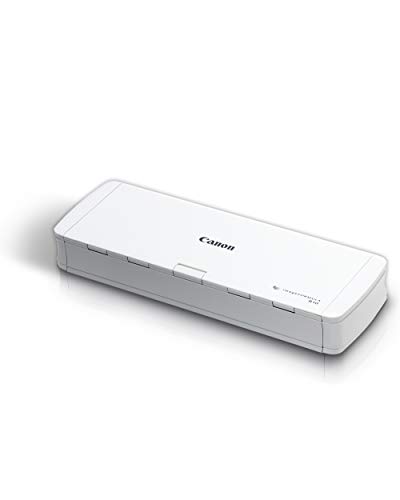
The Canon imageFORMULA R10 is the only scanner on this list that fits in a bag. It's USB-powered — no wall adapter, no power brick — which means you grab it, plug it into your laptop, and you're scanning. That simplicity makes it genuinely useful for people who move between locations: freelancers visiting client offices, teachers in classrooms, remote workers who bounce between home and a shared workspace. At under 2 pounds, you won't even notice it in your bag.
Don't let the portable form factor fool you. The R10 handles a real range of media: standard documents, receipts, business cards, plastic cards, embossed cards, and legal documents. It scans both sides in a single pass (duplex) and converts output to searchable PDF, JPEG, and other common formats. Setup takes about five minutes — plug in, install the driver, and scan. There's no Wi-Fi, no touchscreen, and no 50-page ADF, but that's intentional. This scanner prioritizes simplicity and portability above all else.
If your scanning needs are light — a few dozen pages a day at most — and you value the freedom to scan anywhere, the R10 delivers that at an accessible price. It's not a replacement for a desktop scanner in a busy office, but for its target user, it's exactly right.
Pros:
- Truly portable — USB powered, no external adapter needed
- Handles receipts, business cards, plastic cards, and standard documents
- Duplex scanning in a single pass
- Easy five-minute setup, minimal software complexity
- Compact and lightweight — fits in any laptop bag
Cons:
- No Wi-Fi or wireless connectivity
- Suggested daily volume of 500 scans — not for heavy workloads
6. HP ScanJet Pro 3600 f1 — Best Flatbed and ADF Combo
Most scanners on this list are ADF-only (auto document feeder — you stack pages and they feed through automatically). The HP ScanJet Pro 3600 f1 adds a flatbed (a flat glass surface, like a photocopier lid) to the mix. That matters when you need to scan items that can't feed through an ADF: bound books, passports, photos from albums, fragile documents, or anything thicker than a standard page. You get the best of both worlds in one device.
The specs are solid: 600 dpi optical resolution, 30 ppm / 60 ipm through the 60-sheet ADF, and a daily duty cycle (the number of pages a scanner is designed to handle per day without strain) of up to 3,000 pages. The scan-to-text and scan-to-file features are genuinely useful — you can output directly to searchable PDF, Word (DOC/DOCX), Excel (XLS/XLSX), or CSV formats without needing separate OCR (optical character recognition) software. That's a feature a lot of smaller businesses will use constantly.
HP's software is functional if not flashy. The scanner connects via USB and is compatible with Windows and Mac. If your document mix includes both loose sheets and items that need flatbed scanning, the 3600 f1 solves that problem without buying two machines.
Pros:
- Flatbed + ADF in one unit — scans books, passports, and photos
- Built-in scan-to-Word, Excel, and CSV — no extra OCR software needed
- 3,000 pages/day duty cycle for consistent daily use
- 600 dpi optical resolution for sharp, detailed scans
- 60-sheet two-sided ADF in a single pass
Cons:
- USB only — no Wi-Fi option
- 30 ppm is on the slower side for dedicated ADF scanners at this price
7. Fujitsu ScanSnap iX2500 — Best Premium Upgrade for 2026
The ScanSnap iX2500 is Fujitsu's newest flagship, replacing the discontinued iX1600 at the top of their consumer lineup. It takes everything people loved about the iX1600 and upgrades it: a larger 5-inch touchscreen (compared to 4.3 inches), faster 45 ppm duplex scanning, a 100-sheet ADF, and Wi-Fi 6 (the latest wireless standard, offering faster and more stable connections than Wi-Fi 5). If you're planning to buy a scanner in 2026 and want it to stay current for the next five or more years, this is the one to get.
The iX2500 works entirely without a computer if you want — connect directly to cloud services or mobile devices over Wi-Fi 6, or use the USB-C port for a wired connection. Personalized profiles on the touchscreen let each user in your household or small office send scans exactly where they need to go with one tap. The Quick Menu feature lets you drag-and-drop completed scans into any app open on your screen, which sounds minor but saves real time when you're processing a lot of documents.
Automatic optimizations handle the details: color balance, de-skew, blank page removal, and image enhancement all run without you setting anything up. For users who want the absolute best scanning experience money can buy in 2026 — and don't mind paying for it — the iX2500 is the answer.
Pros:
- Large 5-inch touchscreen with personalized user profiles
- 45 ppm duplex with 100-sheet ADF — serious capacity
- Wi-Fi 6 for fastest, most stable wireless scanning
- USB-C connection as an alternative to wireless
- Works completely without a PC — connects directly to cloud and mobile
Cons:
- The most expensive option on this list
- New model — longer-term reliability data still accumulating
How to Pick the Best Document Scanner
Scan Speed and Daily Volume
Speed is measured in ppm (pages per minute). For light personal use — bills, forms, occasional receipts — 20 to 30 ppm is more than enough. If you're running a small office and processing invoices, contracts, or medical records daily, aim for 35 ppm or higher. The Brother ADS-4900W at 60 ppm is overkill for home use but exactly right for a shared office environment.
Match your scanner to your actual daily volume:
- Under 50 pages/day: Any scanner on this list works. Focus on size and features.
- 50–200 pages/day: Epson ES-400 II or HP ScanJet Pro 3600 f1.
- 200–500 pages/day: Fujitsu iX1600, iX2500, or Brother ADS-4900W.
- 500+ pages/day: Brother ADS-4900W is your answer.
ADF Capacity and Paper Handling
The ADF capacity tells you how many sheets you can load at once before the scanner needs a refill. Bigger ADFs mean fewer interruptions during long scanning sessions:
- 20-sheet ADF (iX1300): Fine for daily personal use, one document type at a time.
- 50-sheet ADF (iX1600, ES-400 II, HP 3600): The standard sweet spot for most home and small office users.
- 100-sheet ADF (iX2500, Brother ADS-4900W): Ideal when you're scanning thick files or need to step away while scanning runs.
Also consider what types of media you'll scan. If you need to scan plastic ID cards, passports, or bound books, you need either a scanner with a manual single-sheet feeder (like the iX1300) or a flatbed (like the HP 3600 f1). Most ADF-only scanners can't handle rigid or bound items.
Connectivity: Wired vs. Wireless
USB-only scanners (Epson ES-400 II, Canon R10, HP 3600 f1) are simpler to set up and have no wireless interference issues. They're perfectly reliable — just remember you need a direct cable connection to your computer.
Wi-Fi scanners (Fujitsu iX1600, iX1300, iX2500, Brother ADS-4900W) give you placement flexibility and can connect to multiple computers or mobile devices without replugging cables. The iX2500 steps this up with Wi-Fi 6, the fastest current standard. For shared office use, wireless is a genuine quality-of-life improvement. According to Wikipedia's overview of document management systems, digital workflows that include scanner-to-cloud integration significantly reduce document retrieval time — and wireless scanners make that integration seamless.
Software and Integration
The bundled software matters more than most buyers realize. Good scanner software:
- Automatically names files based on date, content, or your own rules
- Sends scans directly to cloud storage (Google Drive, Dropbox, OneDrive)
- Outputs searchable PDFs using built-in OCR
- Integrates with business apps like QuickBooks or your document management system
Fujitsu's ScanSnap Home and Epson's ScanSmart are the strongest consumer-grade bundles. For enterprise integration, check driver support — TWAIN works with almost everything, while ISIS support (Brother ADS-4900W) is required by some high-end ECM platforms. If you plan to digitize a large archive and need powerful text extraction, pair your scanner with dedicated OCR software tools in 2026 for the best results. And if you're building a complete home or small business setup, our guide to the best color printers for small business covers the print side of the equation.
Frequently Asked Questions
What is the difference between an ADF scanner and a flatbed scanner?
An ADF (auto document feeder) scanner automatically pulls pages from a stack and feeds them through one at a time — fast and hands-free for multi-page documents. A flatbed scanner has a flat glass surface where you place one document at a time, like a photocopier. Flatbeds are better for books, photos, passports, and fragile items. Some scanners, like the HP ScanJet Pro 3600 f1, combine both in one unit.
How many dpi do I need for document scanning?
For standard text documents and receipts, 300 dpi (dots per inch) is plenty — that's what most scanners default to. For photos or documents with fine detail you may want to zoom in on later, use 600 dpi. For archiving high-quality photos or artwork, 1200 dpi or higher is ideal, though most document scanners max out at 600 dpi optical resolution.
Can I scan directly to the cloud without a computer?
Yes — with the right scanner. The Fujitsu ScanSnap iX1600, iX1300, and iX2500 all support direct cloud scanning via Wi-Fi without a PC. The Brother ADS-4900W also supports cloud destinations over Wi-Fi or Ethernet. USB-only scanners like the Epson ES-400 II and HP ScanJet Pro 3600 f1 require a computer to relay scans to the cloud.
What is duplex scanning?
Duplex scanning means the scanner captures both sides of a page in a single pass through the machine. Without duplex, you'd have to flip every page and run it through again to get the back side. Every scanner on this list supports duplex scanning, which cuts your scanning time roughly in half for double-sided documents.
Is a dedicated document scanner better than scanning with my smartphone?
For occasional scans of a single page, your phone is fine. For anything more — multi-page documents, consistent quality, searchable PDFs, OCR, or daily use — a dedicated scanner is dramatically better. Dedicated scanners produce straighter, sharper, more consistent images; they output proper searchable PDFs automatically; and they process pages 10 to 20 times faster than photographing each one manually with a phone.
How do I choose between the Fujitsu iX1600 and the newer iX2500?
If you can find the iX1600 at a significant discount, it's still an excellent scanner. The iX2500 offers a larger touchscreen (5 inches vs. 4.3 inches), faster scanning (45 ppm vs. 40 ppm), a larger ADF (100 sheets vs. 50 sheets), and Wi-Fi 6 instead of Wi-Fi 5. For individuals and small home offices, the iX1600 at a sale price is a great value. For teams or anyone buying new in 2026 at full retail, the iX2500 is the better long-term investment.
Buy on Walmart
- Fujitsu ScanSnap iX1600 ADF Scanner - 600 dpi Optical, White — Walmart Link
- Epson Workforce ES-400 II Color Duplex Desktop Document Scan — Walmart Link
- Brother ADS-4900W Professional Desktop Scanner with Fast Sca — Walmart Link
- ScanSnap iX1300 Compact Wireless or USB Double-Sided Color D — Walmart Link
- Canon imageFORMULA R10 - Portable Document Scanner, USB Powe — Walmart Link
- HP ScanJet Pro 3600 f1 Flatbed/ADF Scanner - 600 dpi Optical — Walmart Link
- ScanSnap iX2500 Wireless or USB High-Speed Cloud Enabled Doc — Walmart Link
Buy on eBay
- Fujitsu ScanSnap iX1600 ADF Scanner - 600 dpi Optical, White — eBay Link
- Epson Workforce ES-400 II Color Duplex Desktop Document Scan — eBay Link
- Brother ADS-4900W Professional Desktop Scanner with Fast Sca — eBay Link
- ScanSnap iX1300 Compact Wireless or USB Double-Sided Color D — eBay Link
- Canon imageFORMULA R10 - Portable Document Scanner, USB Powe — eBay Link
- HP ScanJet Pro 3600 f1 Flatbed/ADF Scanner - 600 dpi Optical — eBay Link
- ScanSnap iX2500 Wireless or USB High-Speed Cloud Enabled Doc — eBay Link
Buy for the scanner you'll use every day — not the most impressive spec sheet — and you'll never regret the investment.
 |  |  |  |
About Rachel Kim
Rachel Kim spent five years as a merchandise buyer for a national office supply retail chain, evaluating printers, scanners, and printing accessories from Canon, Epson, HP, Brother, Dymo, and Zebra before approving them for store inventory. Her buying process involved hands-on testing against competing models, reviewing long-term reliability data from vendor reports, and vetting price-to-performance claims that manufacturers routinely overstated. That structured evaluation experience translates directly into the kind of buying guidance that cuts through marketing language and focuses on what actually matters for a specific use case. At PrintablePress, she covers printer and printing equipment reviews, buying guides, and head-to-head product comparisons.


Get some FREE Gifts. Or latest free printing books here.
Disable Ad block to reveal all the secret. Once done, hit a button below
| | | |