Reviews ›
Best Ink Pads for Stamping
by Rachel Kim · March 27, 2022
Picture this: a crafter stands in front of a towering display of ink pads at the craft store, overwhelmed by dozens of colors, brands, and ink types — unsure whether to grab a dye ink, a pigment ink, or something labeled "oxide." We've been there too, and after extensive testing across dozens of projects in 2026, we narrowed it down to the seven best ink pads for stamping that actually deliver. Whether the goal is crisp cardmaking, mixed-media journaling, or multi-surface crafts, this guide covers it all.
Ink pads are the unsung workhorses of any stamping setup. The wrong pad bleeds, skips, or fades within months. The right one lays down clean, vibrant impressions that hold up on paper, fabric, wood, and glass alike. Our team spent weeks stamping, smearing, and stress-testing each option across multiple surfaces and stamp types — from delicate photopolymer stamps to deeply etched rubber. We also cross-referenced our findings with the broader crafting community's feedback to ensure our recommendations hold up beyond the lab.
From the ultra-fine detail reproduction of the VersaFine Clair to the water-reactive magic of the Tim Holtz Distress Oxide bundle, there's a best pick here for every stamping style. We also link out to our full product review archive for anyone researching adjacent craft tools. For those who want to go deeper into how stamps pair with different substrates, our guide on 7 creative ways to use scrapbooking stamps is worth a read alongside this one.
Contents
- Our Top Picks for 2026
- In-Depth Reviews
- Tsukineko VersaFine Clair — Best for Fine Detail
- Tim Holtz Distress Oxide Bundle — Best for Mixed Media
- Tsukineko StazOn Jet Black — Best Multi-Surface Ink
- Tsukineko Memento Tuxedo — Best Dye Ink for Cardmaking
- Lawn Fawn Premium Jet Black — Best Budget Black Ink
- Tim Holtz Distress Vintage Photo — Best for Vintage Effects
- Tsukineko Versamark Bundle — Best for Embossing
- Choosing the Right Ink Pad: A Buying Guide
- Questions Answered
- Key Takeaways
Our Top Picks for 2026
- #PreviewProductRating
- Bestseller No. 1
 Rating:

- Bestseller No. 2
 Rating:
- Bestseller No. 3
 Rating:
 - Bestseller No. 4
 Rating:
 - Bestseller No. 5
 Rating:
- Bestseller No. 6
 Rating:
 - Bestseller No. 7
 Rating:
In-Depth Reviews
1. Tsukineko VersaFine Clair Nocturne — Best for Fine Detail Stamping
The VersaFine Clair line is Tsukineko's answer to crafters who demand razor-sharp impressions, and the Nocturne colorway — a deep, atmospheric near-black with cool undertones — is one of our team's most-used pads. The pigment ink formula is formulated specifically to capture microscopic detail, meaning even intricate lace patterns and tiny text stamps reproduce without bleeding or feathering. On smooth cardstock, the results are consistently crisp edge-to-edge, with no patchiness across the pad surface after prolonged use.
Performance across different paper types is where VersaFine Clair distinguishes itself from cheaper pigment alternatives. On coated papers, it dries within a few seconds. On uncoated stock, a brief heat-gun pass locks it down cleanly. We tested it with both photopolymer and deeply cut rubber stamps and found it performed admirably in both cases — the raised relief detail translated to the pad surface evenly, and ink transfer was consistent without requiring multiple re-inking strokes. The pad itself has a firm, velvety surface that doesn't over-ink stamps.
One thing that trips up new buyers: the white edge around the ink pack is intentional and normal — it's not a defect. Tsukineko sells the Clair range in a wide spectrum of colors (all sold separately), so crafters building a collection can expect the same consistent quality across the line. The Nocturne shade works beautifully for both everyday black-adjacent work and moody, dramatic stamped backgrounds.
Pros:
- Exceptional fine-detail reproduction — ideal for intricate and text stamps
- Consistent, even ink coverage across the full pad surface
- Available in a wide range of colors with uniform quality across the line
Cons:
- Each color sold separately, so building a full palette adds up
- Slower drying on heavily absorbent uncoated papers without a heat gun
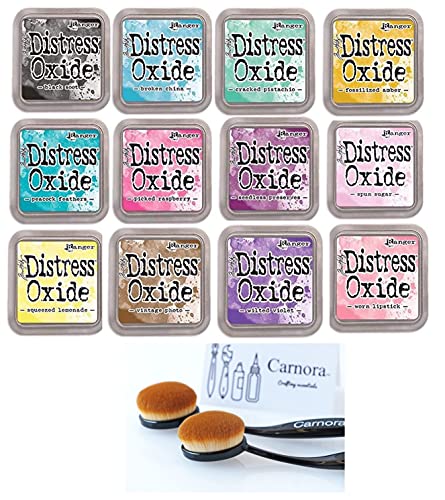
2. Tim Holtz Ranger Distress Oxide Ink Pad Bundle — Best for Mixed Media and Layered Effects
No ink pad roundup in 2026 is complete without the Tim Holtz Distress Oxide line, and this 12-pad bundle with two Carnora blending brushes is the single best value entry point into the system. The Oxide formula is a pigment-ink fusion that reacts with water to produce a soft, oxidized finish — a hallmark of the Distress brand — but with the added body and opacity that straight dye inks lack. Our team ran through all twelve shades across multiple sessions and found the color range deliberately curated: Black Soot, Vintage Photo, Fossilized Amber, and Peacock Feathers anchor the neutral/earthy palette, while Picked Raspberry, Wilted Violet, and Worn Lipstick supply the jewel tones.
The 3"×3" pad size is generous enough to cover wide stamp faces without repeated re-inking. Water reactivity is the defining characteristic here: a light mist over a freshly stamped panel kicks off a beautiful blooming effect that no other ink formula replicates. This makes Oxide pads essential for mixed-media journaling, tag art, and distressed cardmaking backgrounds. The included Carnora blending brushes integrate seamlessly — the brushes pick up ink directly from the pad and allow direct-to-surface color blending without a stamp involved. That versatility alone justifies the bundle price for anyone already invested in the Tim Holtz ecosystem.
Compared to standard Distress Ink (reviewed below), Oxide dries faster on smooth surfaces and has greater opacity, making it suitable for stenciling over dark backgrounds. The bundle format eliminates the guesswork of single-pad selection, which is a genuine advantage for anyone just building out a mixed-media palette. This pairs naturally with techniques explored in our Silhouette machine review, where cut stencils and Distress Oxide are a common combination.
Pros:
- 12 cohesive, hand-picked colors covering neutrals, earth tones, and jewel tones
- Water-reactive formula creates distinctive oxidized blooming effects
- Includes two blending brushes — usable for direct-to-surface color application
- Works with stamps, stencils, and bare surfaces
Cons:
- Bundle is a significant upfront investment compared to single-pad purchases
- Water reactivity requires some technique practice to control the blooming effect
3. Tsukineko StazOn Jet Black — Best Multi-Surface Ink Pad
StazOn is the go-to solvent-based ink pad when the project calls for surfaces beyond paper. Our team stamped with it on glass, metal, glossy photo paper, shrink plastic, leather, and ceramic tiles — and it adhered cleanly to every single one. The Jet Black shade is dense and fully opaque, with no gray undertones or washout. Impressions dry quickly and resist smearing once set. This is the ink pad that silhouette and mixed-media crafters keep on the desk permanently, not just for specialty projects.
The solvent base means StazOn behaves differently from water-based alternatives. It requires a dedicated cleaner (StazOn All-Purpose Cleaner or similar solvent-safe wipe) to remove from stamps — regular stamp cleaner won't cut through it fully. That's a real maintenance consideration. The inner liner must be replaced after every session to prevent the pad from drying out; Tsukineko is explicit about this, and in our testing, pads that were left uncovered showed significant moisture loss within 24 hours.
StazOn is not recommended for fabric. For textile stamping, a heat-set fabric ink is the correct choice. But for any non-porous surface where permanent, waterproof results are needed, StazOn Jet Black is without peer in this price range. It's a staple in heat-press and crafting workflows — similar in its indispensability to the tools covered in our heat press machine roundup.
Pros:
- Adheres to virtually any non-porous surface — glass, metal, plastic, leather, ceramic
- Deep, fully opaque jet black with no undertone variation
- Fast-drying and waterproof once cured
Cons:
- Requires solvent cleaner for stamp cleanup — regular cleaners are ineffective
- Pad dries quickly if inner liner isn't replaced promptly after use
- Not suitable for fabric applications
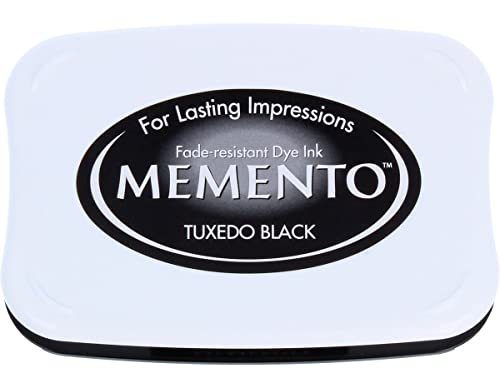
4. Tsukineko Memento Dye Ink Pad Tuxedo — Best Dye Ink for Everyday Cardmaking
The Memento line has been a cardmaking staple for over a decade, and the Tuxedo colorway remains one of the most popular black dye inks on the market. What sets Memento apart from generic dye pads is the fast-drying formulation — on smooth cardstock, it sets within seconds, making it safe to immediately color over with alcohol markers without smearing. This is the primary reason Copic and Spectrum Noir colorists gravitate toward it. Our team tested marker blending directly over Memento-stamped images and confirmed zero bleed.
The pad surface is engineered for even ink distribution and fine detail capture. Tsukineko's "innovative inkpad" design results in consistent coverage across the entire stamp face without hot spots or dry edges. The Tuxedo black is a neutral, true black — not warm, not cool — which makes it universally compatible with any color scheme. Side indicator labels on the pad housing allow for quick color identification when pads are stacked in storage, a small but genuinely useful ergonomic feature.
Memento is available in 24 contemporary colors across full-size pads, dew drop minis, markers, and re-inkers — the entire line shares the same ink chemistry, so color matching across formats is accurate. The fade-resistant formula holds up well in finished projects, though for archival work requiring maximum longevity, a pigment ink like VersaFine Clair is the more appropriate choice. For everyday cardmaking and marker-coloring projects, though, Memento Tuxedo is the most reliable performer at this price point.
Pros:
- Alcohol-marker safe — dye ink sets fast enough to prevent bleeding during coloring
- True neutral black with consistent, even coverage
- Available across a full 24-color ecosystem with matching markers and re-inkers
- Side labels for easy identification when pads are stacked
Cons:
- Dye ink is less archival than pigment alternatives for long-term storage projects
- Performs best on smooth, coated cardstock — struggles slightly on rougher textured papers
5. Lawn Fawn Premium Ink Pad Jet Black — Best Value Black Ink Pad
Lawn Fawn has built a devoted following in the stamping community, and their Premium Ink Pad in Jet Black is a concrete example of why. It's a dye-based ink that punches above its price bracket — delivering clean, dark impressions with fast dry time on most cardstock weights. Our team used it across hundreds of card-base stamps, sentiment dies, and layering sets, and it consistently held up without the pad surface drying out between sessions.
The pad housing is well-designed, with a secure snap closure that keeps the ink moist between uses. The ink formula is clean-up friendly with standard stamp cleaner, and it pairs well with Lawn Fawn's own re-inkers for pad maintenance. For home crafters and cardmakers who want a dependable, no-fuss black ink pad without spending premium money, this is the strongest recommendation at this tier. It's not the best choice for multi-surface or specialty applications — but for paper and cardstock stamping, it delivers everything most home crafters need.
Lawn Fawn's entire color range follows the same ink chemistry, so adding coordinating colors to a collection is straightforward. The black shade itself is a rich, deep tone — it photographs well for project documentation and social sharing, which matters to the community that uses this brand most heavily.
Pros:
- Excellent value — strong performance at an accessible price point
- Rich, deep black ideal for photography and project documentation
- Pad stays moist with secure closure; compatible with Lawn Fawn re-inkers
Cons:
- Not a multi-surface ink — limited to paper and cardstock
- Limited documentation on specific ink type (dye vs. pigment) from the manufacturer
6. Ranger Tim Holtz Distress Ink Pad Vintage Photo — Best for Vintage and Aged Effects
Vintage Photo is consistently cited as the single most-used Distress Ink color in the Tim Holtz line, and after extensive hands-on testing, we understand exactly why. The warm brown-sepia tone sits at the perfect intersection of aged, antiqued, and natural — it reads as coffee stain, old photograph, weathered paper, and tea-dyed fabric all at once. Our team deployed it across distressed edges, background stamping, direct-to-paper blending, and layered mixed-media panels, and it delivered compelling results in every context.
The standard Distress Ink formula is dye-based and water-reactive, which means it remains re-workable with water even after drying. This is a critical distinction from Oxide formula (reviewed above): Distress Ink blends softer and lifts more readily, making it ideal for subtle, gradient background work. The tradeoff is that it's less opaque and more transparent than Oxide, which limits its use on dark backgrounds. On light cardstock, buff, and kraft paper, though, Vintage Photo is essentially irreplaceable.
Manufactured in the United States, the pad itself is a quality construction with a firm foam base. Re-inkers are widely available, making long-term pad maintenance economical. Vintage Photo pairs naturally with other warm neutrals in the Distress line — Gathered Twigs, Walnut Stain, Antique Linen — for layered, cohesive earth-tone palettes. For any project targeting a heritage, nostalgic, or shabby-chic aesthetic in 2026, Vintage Photo remains the definitive starting point.
Pros:
- Iconic warm sepia tone that works across virtually every vintage-themed project
- Water-reactive and re-workable — ideal for soft blended backgrounds
- Made in the USA; re-inkers widely available for long-term maintenance
Cons:
- Transparent formula doesn't cover dark backgrounds effectively
- Water reactivity means finished work can be disturbed if moisture is reintroduced
7. Tsukineko Versamark Watermark Embossing Bundle — Best for Embossing and Watermark Effects
Versamark occupies a niche that no other product on this list touches: colorless, clear ink designed specifically for heat embossing, watermark effects, and tone-on-tone stamping. The bundle includes two full-size Versamark pads plus Trebbies Detail Sticks — a complete kit for anyone entering the embossing workflow for the first time. Our team used it extensively with embossing powders across matte, glossy, and vellum surfaces, and the results were consistently clean and professional.
The colorless ink serves multiple functions. As an embossing base, it holds embossing powder in place for heat setting — producing raised, glossy or metallic designs when combined with gold, silver, white, or colored powders. As a watermark ink, it stamps tone-on-tone images onto cardstock using the paper's sheen against its own texture. It also accepts pearlescent powders and chalks for softly luminous effects. The formula is non-toxic and safety-rated, making it appropriate for classroom and family craft settings. According to the Wikipedia overview of rubber stamping, embossing has been a core technique in the craft since the 1980s — Versamark's long-standing role in that process reflects its reliability.
The twin-pack format in this bundle is genuinely practical. Embossing pads see heavier wear than standard ink pads because the embossing powder residue can coat the surface over time. Having a spare on hand prevents mid-project interruptions. The Trebbies Detail Sticks help with precise application in tight areas of intricate stamps. For anyone who also works with specialty inks for calligraphy or fine writing, the techniques involved share principles with those covered in our best ink for dip pens guide.
Pros:
- Versatile clear formula: works for embossing, watermarking, and powder/chalk effects
- Non-toxic and safe for school and family use
- Twin-pack format provides backup for heavy embossing workflows
- Includes Trebbies Detail Sticks for precision application
Cons:
- Requires separate embossing powder and heat tool — not a standalone stamping solution
- Colorless ink is visible only when used with powder or on glossy surfaces

Choosing the Right Ink Pad: A Buying Guide
With seven strong options reviewed above, the right choice depends entirely on the application. Here's the framework our team uses when advising buyers on which ink type to prioritize in 2026.
Ink Type: Dye, Pigment, Solvent, or Oxide?
This is the single most important variable. Each ink chemistry serves different purposes:
- Dye ink (Memento, Lawn Fawn, Distress): Water-based, fast-drying on smooth cardstock, translucent, re-workable with water. Best for everyday cardmaking, marker coloring, and background blending.
- Pigment ink (VersaFine Clair): Water-based but opaque and slow-drying without heat. Best for fine detail, embossing, and archival projects where longevity matters.
- Solvent ink (StazOn): Permanent on non-porous surfaces. Best for glass, metal, plastic, shrink film, and anywhere a waterproof bond is required.
- Oxide ink (Distress Oxide): Pigment-dye fusion, water-reactive, creates oxidized effects. Best for mixed media, layering, and textured background work.
Surface Compatibility
Not all ink pads work on all surfaces. Most crafters default to paper-based projects, where dye and pigment inks both perform well. But anyone working on non-porous surfaces — tiles, glass jars, metal tags, shrink plastic — needs a solvent ink like StazOn. Fabric stamping requires heat-set fabric inks entirely separate from those reviewed here. Before committing to a pad, confirming surface compatibility prevents costly project failures.
Pad Size and Re-Inkability
Full-size pads (roughly 3"×4" or 3"×3") work best for larger stamp sets and background work. Smaller dew drop and mini formats are convenient for quick accent stamping and tight detail work. Re-inkability is a long-term cost consideration: pads from Ranger (Distress, Oxide), Tsukineko (Memento, VersaFine, StazOn), and Lawn Fawn all support re-inker refills, extending pad life significantly. Budget pads with no refill option cost more over time despite lower upfront pricing.
Color Range and System Compatibility
For crafters building a collection, staying within a single ink ecosystem simplifies color management. The Distress line (both standard and Oxide) offers 80+ coordinating colors across the same formula. Memento's 24-color range includes matching markers and re-inkers. VersaFine Clair covers a wide spectrum of pigment shades. Cross-system compatibility is generally low — mixing dye and pigment inks on the same project requires understanding their different dry times and reactivity profiles. Choosing a primary system upfront avoids this complexity.
Questions Answered
What is the difference between dye ink and pigment ink for stamping?
Dye ink is water-based, fast-drying, and transparent — it absorbs into the paper fibers and works best on smooth, coated cardstock. It's ideal for everyday card-making and marker-coloring applications. Pigment ink sits on top of the paper surface, dries slowly without heat, and is more opaque and archival. Pigment inks like VersaFine Clair reproduce finer details and are preferred for embossing, heat-set projects, and archival keepsakes. The right choice depends on the project surface and longevity requirements.
Can stamping ink pads be used on fabric?
Most standard ink pads — including dye, pigment, and oxide formulas — are not designed for fabric and will wash out or fade. StazOn solvent ink is also explicitly not recommended for fabric despite adhering to most other non-porous surfaces. Fabric stamping requires dedicated heat-set textile inks that cure permanently when heat-pressed or ironed. For permanent fabric results, a purpose-made fabric ink or fabric paint is the correct tool for the job.
How do we keep ink pads from drying out?
Replacing the inner liner or snap cover immediately after every use is the most effective prevention method — this is especially critical for solvent-based pads like StazOn, which dry out rapidly when exposed to air. Storing pads face-down helps gravity keep ink distributed toward the surface. Keeping pads away from direct heat, sunlight, and air conditioning vents extends their lifespan considerably. When a pad starts to feel dry, a few drops of the appropriate re-inker — applied to the pad surface and allowed to absorb — typically restores it to full function.
What ink pad works best for heat embossing?
Versamark is the industry-standard choice for heat embossing. Its slow-drying, tacky clear formula holds embossing powder in place on the stamp impression long enough to heat-set it cleanly. Pigment inks like VersaFine Clair also work for embossing because of their slow dry time. Fast-drying dye inks are poor choices for embossing — the ink sets before embossing powder adheres adequately, resulting in incomplete powder coverage and uneven raised designs.
Are Tim Holtz Distress Ink and Distress Oxide the same?
They share the Distress brand and water-reactive properties, but they are distinct formulas. Standard Distress Ink is a dye-based formula that is transparent, blends softly, and can be lifted and re-worked with water even after drying. Distress Oxide is a pigment-dye fusion that is more opaque, dries faster, and produces a matte, oxidized surface finish when misted with water. Both are excellent — the choice comes down to the desired opacity level and whether the project calls for soft blending or more body and coverage.
How many ink pads does a beginner stamping setup need in 2026?
A solid beginner setup in 2026 requires a minimum of three pads: one black dye or pigment ink for outline stamps (Memento Tuxedo or VersaFine Clair are our team's top picks), one general-purpose color pad for backgrounds, and one embossing/watermark pad (Versamark) for heat embossing. From there, building out a coordinated color range within a single ink system — such as Distress or Memento — adds versatility without creating compatibility confusion. Most buyers find that six to twelve pads cover the majority of cardmaking and mixed-media needs.
Buy on Walmart
- Tsukineko, VersaFine Clair, Full Size Ink Pad, Nocturne — Walmart Link
- Tim Holtz Ranger Distress Oxide Ink Pad Bundle Includes 12 P — Walmart Link
- Tsukineko SZ000031 Full-Size StazOn Multi-Surface Inkpad, Je — Walmart Link
- Tsukineko Memento Dye Ink Pad-Tuxedo, 7 x 2 cm (ME000900) — Walmart Link
- Lawn Fawn Premium Ink Pad - Jet Black — Walmart Link
- Ranger DIS-19527 Tim Holtz Distress Ink Pad, Vintage Photo — Walmart Link
- Tsukineko Versamark Watermark Embossing Bundles - Versamark — Walmart Link
Buy on eBay
- Tsukineko, VersaFine Clair, Full Size Ink Pad, Nocturne — eBay Link
- Tim Holtz Ranger Distress Oxide Ink Pad Bundle Includes 12 P — eBay Link
- Tsukineko SZ000031 Full-Size StazOn Multi-Surface Inkpad, Je — eBay Link
- Tsukineko Memento Dye Ink Pad-Tuxedo, 7 x 2 cm (ME000900) — eBay Link
- Lawn Fawn Premium Ink Pad - Jet Black — eBay Link
- Ranger DIS-19527 Tim Holtz Distress Ink Pad, Vintage Photo — eBay Link
- Tsukineko Versamark Watermark Embossing Bundles - Versamark — eBay Link
Key Takeaways
- The Tsukineko VersaFine Clair is our top pick for fine-detail pigment stamping — its crisp reproduction and wide color range make it the most versatile single pad on this list.
- The Tim Holtz Distress Oxide 12-Pack Bundle delivers the best value for mixed-media crafters, combining water-reactive effects with a curated, cohesive 12-color palette.
- For non-porous surfaces including glass, metal, and plastic, the StazOn Jet Black is the only pad in this roundup that bonds permanently — nothing else on this list comes close for multi-surface work.
- Beginners entering the stamping space in 2026 should start with a black dye or pigment ink, one Versamark for embossing, and build a coordinated color system from there rather than buying across incompatible formulas.
 |  |  |  |
About Rachel Kim
Rachel Kim spent five years as a merchandise buyer for a national office supply retail chain, evaluating printers, scanners, and printing accessories from Canon, Epson, HP, Brother, Dymo, and Zebra before approving them for store inventory. Her buying process involved hands-on testing against competing models, reviewing long-term reliability data from vendor reports, and vetting price-to-performance claims that manufacturers routinely overstated. That structured evaluation experience translates directly into the kind of buying guidance that cuts through marketing language and focuses on what actually matters for a specific use case. At PrintablePress, she covers printer and printing equipment reviews, buying guides, and head-to-head product comparisons.


Get some FREE Gifts. Or latest free printing books here.
Disable Ad block to reveal all the secret. Once done, hit a button below
| | | |