Reviews ›
Best Embroidery Machine Reviews: Buying Guide and FAQs 2026
by Rachel Kim · April 04, 2022
Which embroidery machine is actually worth your money in 2026 — and which ones will have you fighting tangled threads and frozen screens two months in? That's the question most buyers are struggling with right now. The good news: after working through the specs and real-world performance of the top models on the market, the Brother PE800 consistently stands out as a rock-solid choice for home embroiderers who want reliability without overpaying. But it's not the right machine for everyone, and the rest of this list has some genuinely strong competitors worth knowing about.
Embroidery machines have come a long way. Where older machines required clunky software dongles and external design converters, today's models come with wireless connectivity, app integration, and large color touchscreens that make design editing feel intuitive rather than frustrating. Whether you're personalizing baby blankets, running a small custom gift business, or diving into monogramming for the first time, there's a machine on this list built for your workflow. You can browse more options anytime on our embroidery machines review page.
This guide walks you through seven machines at different price points and skill levels. You'll get honest assessments of what each one does well, where it falls short, and who it's actually best suited for. We've also included a buying guide and FAQ section to help you make a confident purchase. And if you're exploring other ways to customize fabric and apparel, don't miss our breakdown of tackle twill — a popular alternative to embroidery for lettering and logos on performance wear.
Best Choices for 2026
- #PreviewProductRating
- Bestseller No. 1
 Rating:

- Bestseller No. 2
 Rating:
 - Bestseller No. 3
 Rating:
 - Bestseller No. 4
 Rating:
 - Bestseller No. 5
 Rating:
 - Bestseller No. 6
 Rating:
 - Bestseller No. 7
 Rating:
Detailed Product Reviews
1. Brother PE800 Embroidery Machine — Best Overall
The Brother PE800 has earned its reputation as one of the most dependable home embroidery machines you can buy in 2026. At its core, you're getting a 5" x 7" hoop area — generous enough for jacket backs, pillow designs, and larger monograms — paired with a 3.2-inch LCD touchscreen that makes navigating the 138 built-in designs feel effortless rather than like a chore. The library itself covers a solid range: scrollwork, floral patterns, quilt designs, and holiday motifs that give you plenty to work with right out of the box.
What makes the PE800 stand apart for everyday use is how smoothly it handles USB design imports. You can grab a design from an embroidery site, drop it on a USB stick, and be stitching within minutes. The 11 font styles — including seven English, three Japanese, and one Cyrillic — give you real flexibility for monogramming, which is still one of the most popular uses for machines at this price point. The drop-in top bobbin keeps thread tension consistent, and the automatic needle threader eliminates one of the most common frustrations for new embroiderers.
If you're coming from an older machine or starting fresh, the PE800 strikes the right balance between capability and approachability. It doesn't try to do everything, but what it does, it does well and consistently. For most home embroiderers, that's exactly what you need.
Pros:
- Larger 5" x 7" hoop area supports bigger designs
- 138 built-in designs with solid variety across styles
- USB port makes importing custom designs fast and simple
- 11 font styles including Japanese and Cyrillic for versatile monogramming
- Reliable automatic needle threader and drop-in bobbin system
Cons:
- No wireless connectivity — USB only for design transfers
- 3.2" touchscreen is functional but feels small compared to newer models
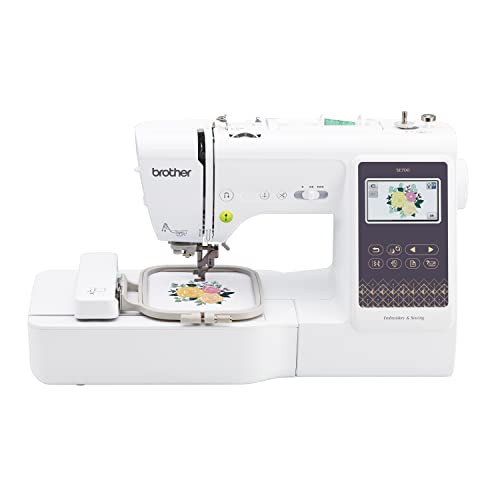
2. Brother SE700 Sewing and Embroidery Machine — Best for Wireless Workflow
If cutting cables out of your workspace is a priority, the Brother SE700 is worth your serious attention. This machine brings wireless LAN connectivity to a price point that used to require stepping up to semi-professional equipment. Using Brother's free Design Database Transfer software, you can push embroidery files from your PC directly to the SE700 without touching a USB drive. The Artspira mobile app adds another layer — draw a design on your phone, send it to the machine wirelessly, and start stitching. That kind of integration feels genuinely modern in a way that most embroidery machines still haven't matched.
The SE700 is a combo machine, meaning it handles both sewing and embroidery. You get 135 built-in embroidery designs and 103 built-in sewing stitches, which covers the basics comfortably. The 4" x 4" hoop area is the trade-off here — smaller than the PE800, which limits you on larger standalone embroidery designs. But if you're doing a mix of sewing projects and embroidery accents, that constraint rarely becomes an issue. The 3.7-inch touchscreen is the largest in Brother's mid-range lineup and makes design editing noticeably easier than squinting at smaller displays.
Eight presser feet are included, which is a solid starting kit. The SE700 is well-suited for makers who split their time between garment construction and embellishment and want a single machine that handles both without constant reconfiguration.
Pros:
- Wireless LAN and Artspira app connectivity — genuinely useful, not just a gimmick
- Largest touchscreen in its class at 3.7 inches
- Handles both sewing and embroidery competently
- 8 presser feet included for immediate versatility
Cons:
- 4" x 4" hoop limits embroidery design size
- Wireless setup can be finicky on some home networks
3. Brother SE1900 Sewing and Embroidery Machine — Best Combo Machine
The Brother SE1900 is essentially what you get when you combine the PE800's larger hoop area with the SE700's combo machine versatility — and then push the stitch count up significantly. With 240 built-in sewing stitches, this machine handles quilting, garment construction, decorative stitching, and embroidery under one roof. The 5" x 7" hoop area matches the PE800, so you're not sacrificing embroidery space to gain the sewing functionality. That makes this one of the more well-rounded machines in the mid-range bracket.
The 138 built-in embroidery designs and 11 embroidery fonts mirror the PE800's library, which means you're getting the same solid starting point on that front. Where the SE1900 pulls ahead is its advanced needle threader — it's noticeably more reliable than older Brother designs — and the 10 auto-size buttonhole styles, which matter a lot if you're doing any garment sewing alongside your embroidery projects. The drop-in top bobbin is jam-resistant, and the machine overall feels well-built for daily use.
Eight presser feet are included in the box, giving you a useful kit to start with. If you're the kind of maker who switches regularly between quilting, sewing, and embroidery, the SE1900 is one of the most practical all-in-one options at its price point. Just know you're getting the same 3.2" touchscreen as the PE800 — perfectly usable, but not the most spacious editing experience.
Pros:
- 240 built-in sewing stitches covers virtually every construction need
- 5" x 7" hoop area — no compromise on embroidery size
- Advanced needle threader and jam-resistant bobbin are genuinely reliable
- 10 auto-size buttonhole styles for garment sewing
Cons:
- No wireless connectivity
- 3.2" screen is on the smaller side for design editing
4. Bernette B70 Deco Embroidery Machine — Best Bundle Value
The Bernette B70 Deco takes a different approach to the mid-range market: instead of competing purely on features, it bundles an impressive set of accessories that would cost you real money to assemble separately. The package includes 60 vibrant Sunset threads, three embroidery hoops in large (6" x 10"), medium (4.7" x 7"), and small (2" x 3") sizes, bobbins, and exclusive design software vouchers — over $300 worth of extras included in the box. For someone starting from scratch, that's a meaningful head start.
The machine itself features a clean 5-inch color touchscreen that makes design editing intuitive. You can reposition, resize, and rotate designs directly on screen, which reduces the guesswork significantly. USB design import works as expected, and the Bernette software ecosystem is compatible with a wide range of standard embroidery file formats. The build quality reflects Bernette's Swiss-heritage connection to BERNINA, and it shows in the stitching consistency and frame rigidity — this doesn't feel like a budget machine dressed up with accessories.
The three included hoop sizes are a standout practical advantage. Being able to switch between a 6" x 10" for large-scale designs and a 2" x 3" for precise embellishments on small items like bags and patches means you're genuinely equipped for a wider range of projects from day one. If you're setting up a creative workspace and don't want to buy a dozen accessories separately, this bundle makes a strong case for itself.
Pros:
- Over $300 in accessories included — exceptional out-of-box value
- Three hoop sizes cover everything from large designs to precision detail work
- 5-inch touchscreen is larger and more comfortable than most competitors
- BERNINA heritage build quality shows in stitching consistency
Cons:
- Higher upfront price than standalone Brother models
- No wireless connectivity
5. SINGER SE9180 Sewing & Embroidery Machine — Best Large Touchscreen
Singer has been in the sewing machine business for over 170 years, and the SE9180 shows the brand still knows how to build a machine that punches above its class. The headline number is the 7-inch touchscreen — the largest on any machine in this review — which transforms the design editing experience. You can actually see what you're working with. Repositioning designs, applying mirror imaging, and previewing color sequences all feel natural rather than cramped. For anyone who has struggled with smaller displays on competing machines, this alone might justify the choice.
Beyond the screen, the specs are impressive for a mid-range combo machine. You're getting 250 sewing stitches, 401 stitch applications, 150 embroidery designs, and 10 fonts. The mySewnet Wi-Fi connectivity allows wireless design transfers and real-time progress notifications via app — handy when you're running a longer project and want to step away without babysitting the machine. The included accessories package is thorough: multiple presser feet, a 170x100mm hoop, bobbins, needles, and a quilting guide among others. The endless hoop capability for continuous borders is a feature that home décor and quilt makers will find genuinely useful.
Singer's automatic needle threader works reliably, and the 1-step buttonhole feature handles garment finishing cleanly. If you're comparing this to the Brother models at similar prices, the SE9180 edges ahead on screen size and raw stitch count while offering comparable wireless functionality to the SE700.
Pros:
- 7-inch touchscreen is the largest and most comfortable to use in this category
- Wi-Fi connectivity with app notifications for remote monitoring
- 250 stitches and 150 embroidery designs — one of the most complete built-in libraries
- Endless hoop capability for continuous border designs
- Comprehensive accessories package included
Cons:
- Hoop size (170x100mm) is smaller than some competitors' default configurations
- Wi-Fi setup requires the mySewnet ecosystem
6. Brother PE535 Embroidery Machine — Best for Beginners
Not everyone needs 138 designs and a 5" x 7" hoop on their first machine. The Brother PE535 is the most accessible entry point on this list, and it earns its place by delivering a genuinely capable beginner experience without the cost of features you won't use for months. The 80 built-in designs cover the most popular categories — kids' designs, holiday motifs, floral patterns — and the 4" x 4" hoop area is sufficient for the vast majority of beginner projects like patches, pocket logos, and small monograms.
The 3.2-inch LCD touchscreen mirrors what you get on the PE800 and SE1900, which is a familiar and clean interface. The 9 built-in fonts (6 English, 3 Japanese) handle basic monogramming without the learning curve of advanced font management software. USB import works exactly the same as on the higher-end Brother models, so if you outgrow the built-in library, you have a clear upgrade path without switching ecosystems. The machine threads reliably and the drop-in bobbin keeps setup quick.
Where the PE535 can feel limiting is if your projects start growing in scale. The 4" x 4" hoop means you'll need to rehoop for larger designs, and 80 built-in designs does start to feel restrictive once you've run through them. But as a starting machine for someone who wants to learn the craft without overspending, it's hard to argue with the PE535's positioning. If you're curious about combining embroidery with other fabric customization techniques, our overview of types of fabric painting is worth a read alongside your machine research.
Pros:
- Lower price point makes embroidery accessible without a major investment
- Familiar Brother interface — easy to learn and navigate
- USB port for design imports future-proofs the machine
- Compact size fits smaller craft spaces
Cons:
- 4" x 4" hoop limits design size significantly
- 80 built-in designs is the smallest library on this list
7. Janome MB-4S Four Needle Embroidery Machine — Best for Small Business
Every other machine on this list is designed for home use. The Janome MB-4S is built for volume. If you're running a small custom embroidery business, filling wholesale orders for sports teams, or producing branded merchandise regularly, the MB-4S operates in a different category. The four-needle design is the key differentiator: you can load four thread colors at once, which dramatically reduces the stop-and-rethread cycle that makes multi-color designs so time-consuming on single-needle machines. For professional workflow, that's a fundamental productivity upgrade.
Janome's build quality is consistently among the best in the consumer-to-prosumer range, and the MB-4S reflects that. The frame is robust, the stitching is precise even at speed, and the machine handles extended production runs without the kind of drift or tension issues you sometimes encounter with lower-build machines pushed hard. The included bonus bundle adds accessories that genuinely extend what the machine can do from the moment it arrives.
This is not the machine for someone who embroiders occasionally. The price is significantly higher than the other options here, and the learning curve — while not steep by professional machine standards — is steeper than a beginner Brother. But if your use case is production rather than hobby, the MB-4S delivers a return on investment that single-needle machines simply can't match. Think of it as the machine you grow into rather than the machine you start on. If you're also producing embroidered apparel, it pairs well with other decoration methods — our guide to heat transfer vinyl for shirts covers complementary techniques worth considering for your product line.
Pros:
- Four needles eliminate constant rethreading for multi-color designs
- Professional-grade build quality handles sustained production volume
- Bonus bundle adds meaningful accessories from the start
- Precision stitching at speed with minimal drift
Cons:
- Significantly higher price than home-use models
- Overkill for casual or low-volume hobbyists

Buying Guide: How to Choose the Best Embroidery Machine
Walking through spec sheets for embroidery machines can get overwhelming quickly — especially when manufacturers list numbers without context. Here are the key factors worth actually thinking through before you buy.
Hoop Size: It Determines What You Can Make
The embroidery hoop area is arguably the most important spec to match to your projects. A 4" x 4" hoop handles small designs — pocket logos, name patches, hat badges — without issue. But if you want to embroider a full sleeve motif, a large pillow design, or a jacket back, you need at least a 5" x 7" working area. Some machines, like the Bernette B70, include multiple hoops so you can work across a range of design sizes. If in doubt, go larger — you can always use a big hoop for small designs, but you can't go the other direction.
The number of stitches per minute also factors in here. Higher-speed machines help when you're stitching large designs, since a 5" x 7" filled design can involve 20,000+ stitches. Most home machines in this category run 400–850 stitches per minute, which is perfectly adequate — just know that production machines like the Janome MB-4S are designed for sustained high-speed operation in ways home machines aren't.
Single-Purpose vs. Combo Machine
Dedicated embroidery machines (like the Brother PE800 and PE535) do one thing and do it well. They tend to have cleaner interfaces focused purely on embroidery workflow. Combo sewing-and-embroidery machines (SE700, SE1900, SINGER SE9180) add garment construction, quilting stitches, and buttonholes to the mix. The right choice depends on whether you actually sew as well as embroider, or whether you want separate tools for each task.
One practical consideration: combo machines switch between sewing and embroidery modes, which involves swapping feet and sometimes repositioning components. It's a minor workflow interruption, but worth knowing if you're switching modes frequently throughout a work session. If embroidery is your primary focus, a dedicated machine often provides a cleaner experience.
Connectivity: USB, Wireless, or Both
Every machine on this list accepts designs via USB, which is the minimum you should expect in 2026. The more capable machines add wireless LAN (Brother SE700, SINGER SE9180) that lets you push designs from your computer or phone without reaching for a USB drive. This matters more than it might sound if you're iterating on designs frequently — the ability to tweak a file on your computer and send it directly to the machine saves real time and frustration.
The Artspira app integration on the SE700 and the mySewnet ecosystem on the SINGER SE9180 go a step further, enabling mobile design creation and real-time project monitoring. These features are useful in practice rather than just as marketing bullets — particularly the progress notification feature, which lets you step away from the machine during long runs. According to Wikipedia's overview of embroidery, machine embroidery has evolved dramatically in accessibility since the 1980s, and modern connectivity features are a big part of what makes today's home machines practical for serious hobbyists.
Built-In Designs and Expandability
The built-in design library matters most in the short term — when you first get the machine and want to start stitching without sourcing files immediately. Eighty designs (PE535) will run out faster than 150 (SE9180). But in the medium term, expandability via USB import is what actually matters. If you're willing to browse embroidery design sites, the built-in library becomes a starting point rather than a ceiling.
Font quality is worth paying attention to separately from design count. More font options give you more monogramming flexibility, which is valuable if that's a core use case for you. The machines with 9–11 font styles (most of this list) cover the practical bases well. For more specialized fabric decoration techniques that complement embroidery, the best printable heat transfer paper guide is worth checking out if you want to expand your toolkit.
What People Ask
What's the difference between a sewing machine and an embroidery machine?
A standard sewing machine is designed for joining fabric — seams, hems, buttonholes. An embroidery machine is designed to stitch decorative designs onto fabric using an automated hoop system that moves the fabric precisely while the needle stitches. Combo machines do both, but they require switching between modes. Dedicated embroidery machines focus purely on the decorative stitching workflow and typically offer more embroidery-specific features as a result.
Can I use my own designs on these machines?
Yes — all seven machines on this list support USB design import, and some support wireless file transfer. You'll need your designs in a compatible embroidery file format. The most common formats are .pes (Brother), .jef (Janome), and .dst (universal). Many embroidery design sites sell files in multiple formats, and software like Brother's PE-Design or Wilcom can convert between formats if needed.
What hoop size do I need for a beginner?
A 4" x 4" hoop is sufficient for many beginner projects — patches, small logos, pocket embroidery, and monogrammed items. However, if you think you'll want to grow into larger designs like pillow covers or jacket backs, starting with a 5" x 7" machine gives you that headroom. The Brother SE1900 and PE800 both offer the larger hoop without a steep price jump over the entry-level models.
How long does embroidery take on a home machine?
It depends on design complexity and stitch count. A simple monogram of 3,000–5,000 stitches might take 5–10 minutes. A large filled design with 25,000+ stitches can take 45 minutes to over an hour. Most home machines run at 400–850 stitches per minute. Color changes also add time, since you need to stop, trim, change thread, and resume. This is where multi-needle machines like the Janome MB-4S create real time savings for production work.
Do I need special thread for machine embroidery?
Yes — embroidery thread is different from regular sewing thread. Machine embroidery thread is typically a 40-weight rayon or polyester, finer and with more sheen than construction thread. Using the wrong thread can cause tension problems, thread breaks, and inconsistent coverage. The Bernette B70 bundle includes 60 Sunset embroidery threads right in the box, which is one of its strongest practical advantages for buyers starting from scratch.
Is machine embroidery difficult to learn?
The basics are accessible for most beginners within a few sessions. Loading a design, hooping fabric correctly, threading the machine, and starting a run are all straightforward on modern machines with touchscreen interfaces. The learning curve comes with more advanced skills: stabilizer selection, multi-hoop alignment, tension adjustment for different fabrics, and digitizing your own designs. Most hobbyists find they're producing clean results within a weekend of practice.
Buy on Walmart
- Brother PE800 Embroidery Machine, 138 Built-in Designs, 5" x — Walmart Link
- Brother SE700 Sewing and Embroidery Machine, Wireless LAN Co — Walmart Link
- Brother SE1900 Sewing and Embroidery Machine, 138 Designs, 2 — Walmart Link
- Bernette B70 Deco Embroidery Machine | Exclusive Bundle with — Walmart Link
- SINGER SE9180 Sewing & Embroidery Machine | 250 Built-in Sti — Walmart Link
- Brother PE535 Embroidery Machine, 80 Built-in Designs, 4" x — Walmart Link
- Janome MB-4S Four Needle Embroidery Machine with Exclusive B — Walmart Link
Buy on eBay
- Brother PE800 Embroidery Machine, 138 Built-in Designs, 5" x — eBay Link
- Brother SE700 Sewing and Embroidery Machine, Wireless LAN Co — eBay Link
- Brother SE1900 Sewing and Embroidery Machine, 138 Designs, 2 — eBay Link
- Bernette B70 Deco Embroidery Machine | Exclusive Bundle with — eBay Link
- SINGER SE9180 Sewing & Embroidery Machine | 250 Built-in Sti — eBay Link
- Brother PE535 Embroidery Machine, 80 Built-in Designs, 4" x — eBay Link
- Janome MB-4S Four Needle Embroidery Machine with Exclusive B — eBay Link
Next Steps
- Check the current price and stock for your top choice on Amazon — prices on embroidery machines shift regularly, and deals appear without much warning.
- Download the free design file software for your shortlisted machine (Brother's PE-Design trial, mySewnet for Singer) and test whether your existing design files are compatible before committing.
- Order a starter stabilizer pack alongside your machine — cutaway, tearaway, and wash-away types — so you're ready to work with different fabrics from day one.
- Browse our full embroidery machines review page for additional models and updated rankings as new machines release in 2026.
- If you're planning to produce custom apparel at volume, compare the Janome MB-4S against your projected monthly output to see whether the multi-needle investment makes financial sense for your use case.
 |  |  |  |
About Rachel Kim
Rachel Kim spent five years as a merchandise buyer for a national office supply retail chain, evaluating printers, scanners, and printing accessories from Canon, Epson, HP, Brother, Dymo, and Zebra before approving them for store inventory. Her buying process involved hands-on testing against competing models, reviewing long-term reliability data from vendor reports, and vetting price-to-performance claims that manufacturers routinely overstated. That structured evaluation experience translates directly into the kind of buying guidance that cuts through marketing language and focuses on what actually matters for a specific use case. At PrintablePress, she covers printer and printing equipment reviews, buying guides, and head-to-head product comparisons.


Get some FREE Gifts. Or latest free printing books here.
Disable Ad block to reveal all the secret. Once done, hit a button below
| | | |