How to Reverse Print in Word
by Karen Jones · April 02, 2022
The first time you iron a homemade transfer onto a t-shirt and flip it over to find your carefully typed text staring back at you — completely backward — it's a gut-punch moment. You wasted transfer paper, ink, and effort over one skipped step. Knowing how to reverse print in Word before you load that first sheet is the fix that saves your materials and your sanity. Browse our printer guides for more tips on getting clean, accurate results every time you print.
Microsoft Word is a word processor, not a design suite — but it handles mirror printing better than most people realize. Whether you're working on iron-on transfers, sublimation paper, or vinyl decals, Word has a built-in flip option that gets the job done. You just need to know exactly where it's hiding and when to use it.
This guide covers the step-by-step method, every situation where flipping is required, common mistakes that ruin transfers, a few persistent myths worth busting, and a repeatable workflow so you never waste another sheet of transfer paper.
Contents
What Reverse Printing Actually Is
The Mechanics of a Mirror Flip
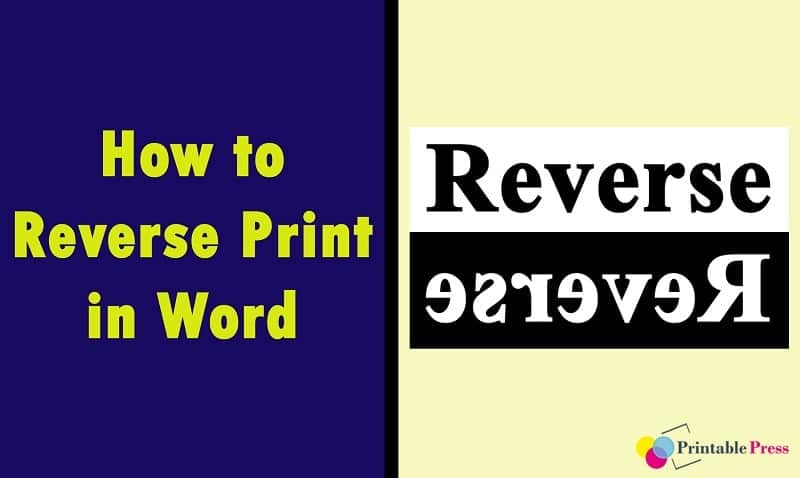
Reverse printing — also called mirror printing — means producing a horizontally flipped version of your design on paper. When you press that paper against fabric or another surface and peel it away, the image transfers in the correct reading direction.
Think of it like a rubber stamp. The text on the stamp reads backward, but the impression it leaves reads correctly. Transfer paper works the same way. Your ink sits on the coated side of the sheet. When you press it face-down against the fabric and apply heat, the ink migrates from the paper to the material. If your design reads correctly on the paper, it reads backward on the finished product. Mirror image reversal is a fundamental optical principle — and it applies to every heat transfer you make.
| Transfer Type | Mirror Required? | Why |
|---|---|---|
| Iron-on transfer paper (light fabric) | Yes | Design flips when pressed face-down |
| Iron-on transfer paper (dark fabric) | Yes | Same face-down transfer mechanic |
| Sublimation paper | Yes | Dye migrates in reverse through heat |
| Inkjet water-slide decal | Yes | Applied face-down to surface |
| Laser heat transfer | Yes | Applied face-down to fabric |
| Direct-to-garment (DTG) printing | No | Ink applied directly — no flip |
| Screen printing | No | Screen orientation is set correctly |
| Standard paper printing | No | No transfer step involved |
Why Word Works for This
Word's picture formatting tools include a horizontal flip option that works on any inserted image or text box. You don't need Photoshop or Illustrator. The method isn't as obvious as a dedicated design tool, but it's reliable and costs nothing extra. Here's the full process:
- Open a blank Word document and set your page size to match your transfer sheet.
- Insert your design as an image (Insert → Pictures) or type your text inside a text box (Insert → Text Box).
- Click the image or text box to select it.
- Go to the Picture Format tab (or Drawing Tools Format for text boxes).
- Click Rotate Objects — the curved arrow icon in the Arrange group.
- Select Flip Horizontal from the dropdown.
- Confirm your design reads backward on screen. That's exactly right.
- Load your transfer paper and print as normal.
If your design combines text and images, select all elements with Ctrl+A, right-click, and choose Group. Then flip the entire group as a single unit. This keeps every element aligned and ensures nothing gets left un-mirrored.
Projects That Require a Mirror Flip
T-Shirt Transfers and Garment Printing
Garment transfers are the most common reason people look up how to reverse print in Word. If you're printing on heat transfer paper for t-shirts, hoodies, or tote bags, you must flip your design before printing — no exceptions.
The same rule applies when you're printing on iron-on transfer paper for a t-shirt. Both light and dark fabric sheets require a mirrored image because the printed side goes face-down on the fabric.
Sublimation is another situation where flipping is mandatory. When you print sublimation transfers, the paper goes face-down on your substrate — mug, shirt, mousepad, or metal blank. The dye sublimates in reverse, so your Word file must be mirrored before it hits the printer.
Want to print a picture design on a shirt using Word? Same flip process applies. Insert your image, group all elements, flip horizontally, then print. Clean and repeatable.
Vinyl Stickers and Decal Work
Whether or not you flip for vinyl depends on how the final product is viewed:
- Printable vinyl (print-then-cut, applied face-up): No flip needed — you print on the face side.
- Inside-of-glass window clings or reverse-print vinyl: Flip required — the viewer sees through the material from the other side.
- Iron-on vinyl with a carrier sheet: Always check your product's specific instructions before printing.
When you're printing vinyl stickers that will be applied face-up on a surface, no flip is needed. But if that sticker goes on the inside of a window — visible from outside — you flip it. The rule is simple: if the viewer sees the design through the material, mirror it first.
Mistakes That Ruin Your Transfers
Skipping the Flip Entirely
This is the number one mistake — and it's completely preventable. You design something in Word, it looks perfect on screen, you print it, press it, and peel back to find everything backward. The wasted transfer paper stings. The wasted time stings more.
Use this quick mental check before every transfer print:
- Does my design contain any text? If yes — flip it.
- Does my design have a directional element (a person facing right, an arrow, a logo with an asymmetric shape)? If yes — flip it.
- Am I printing to regular paper for a document or test? If yes — do NOT flip.
Making this check a habit takes about five seconds and eliminates the most expensive mistake in the transfer printing workflow.
Flipping the Wrong Element
A subtler mistake happens when you flip only part of a multi-element design. Say you have a text box and a logo image in the same document. You flip the text but forget the logo — or the other way around. The result is a transfer where one element reads correctly and the other reads backward.
The fix is straightforward:
- Select all elements with Ctrl+A.
- Right-click and choose Group.
- Flip the group as a single unit using Flip Horizontal.
- Ungroup only if you need to make individual edits, then regroup before printing.
One more thing to watch: flipping a PNG with a transparent background sometimes causes Word to drop that transparency and replace it with white. After you flip, zoom in and confirm your image still looks exactly as expected before you commit to printing.
Reverse Printing Myths, Debunked
Myth: You Need Special Software
Many crafters assume you need Photoshop, Canva Pro, or dedicated transfer software to reverse print. You don't. Microsoft Word handles horizontal flipping natively through the Rotate Objects menu. No plugins, no subscriptions, no extra downloads. The built-in Flip Horizontal option does exactly what specialized tools do — it just takes a couple of extra clicks to find.
Myth: Printers Mirror Automatically
Some people assume their printer has a mirror mode that handles flipping automatically. A small number of printer driver menus do include a mirror print option — but most consumer inkjet and laser printers do not. If you rely on the printer to flip and it doesn't support that feature, you'll get a correctly oriented printout that transfers backward onto your material.
Always apply the flip inside Word before you print. Don't leave it to the printer driver unless you've confirmed that specific driver supports mirror printing and you've tested it on a scrap sheet first. Verify — don't assume.
Myth: Flipping Is the Same as Rotating
Rotating 180 degrees is not the same as flipping horizontally. Rotation spins the entire image — it doesn't mirror it. A rotated design still transfers backward and upside-down. In Word, you specifically want Flip Horizontal, not Rotate 90° Left, Rotate 90° Right, or Rotate 180°. The visual difference is obvious the moment you test it: flipped text reads backward left-to-right on screen; rotated text reads upside-down.
When to Flip — and When to Skip It
When You Must Reverse Print
Flip your design whenever the transfer process involves pressing a face-down sheet onto a surface. The definitive list:
- Light or dark iron-on transfer paper for fabric
- Sublimation paper pressed onto mugs, shirts, mousepads, metal blanks, or ceramic tiles
- Inkjet or laser heat transfer sheets
- Water-slide decals applied face-down
- Inside-facing window graphics viewed from outside
- Reverse-print vinyl applied to glass or acrylic
No exceptions in this category. If the printed surface touches the material face-down, the design must be mirrored before it leaves your printer.
When You Should Not Flip
Skip the mirror for these situations — applying a flip here actually breaks your result:
- Standard document printing (reports, flyers, labels, stationery)
- Direct-to-garment (DTG) printing — ink is deposited directly onto fabric, no flip step
- Screen printing — the screen is produced correctly at the start
- Printable vinyl or sticker paper applied face-up
- Regular photo paper prints intended for framing or display
If you're exploring how to print on t-shirts without a transfer sheet, those methods typically don't require mirroring either — the ink reaches the fabric in a direct path rather than transferring from a pressed sheet.
The rule is simple: face-down transfer means flip it; face-up application means leave it.
Building a Consistent Mirror Printing Habit
A Pre-Print Checklist
The best protection against wasted materials is a checklist you follow every single time — before you load a single sheet of transfer paper. Habits beat memory, especially when you're mid-project and moving fast.
- ☐ Design completed in Word and readable (not yet flipped)
- ☐ All elements selected and grouped with Ctrl+A → Group
- ☐ Group flipped horizontally — text and images read backward on screen
- ☐ Transfer paper loaded in the printer with the coated side in the correct orientation (check your paper's instructions)
- ☐ Print quality set to High or Best
- ☐ Test print done on regular paper first — hold it up to a window to verify the mirror is correct
- ☐ Transfer paper print only after test confirms the flip looks right
That window test is worth doing every time. Hold the regular paper printout up to light with the printed side facing away from you. Through the paper, you see the design as it will look after transfer. If it reads correctly through the paper, you're good to print on the real sheet.
Organizing Your Word Files for Repeatable Results
If you reuse designs — logos, names, recurring graphics — save two versions of every Word file:
- Original (unflipped): Your readable, fully editable master. Update this one when you need to change text or swap images.
- Print-ready (flipped): The mirrored version you send to the printer. Add "MIRROR" or "PRINT" to the filename so you never confuse the two.
Store both in the same project folder. That setup takes 30 extra seconds the first time and saves you from re-creating the flip every time you revisit a design. If your project also involves edge-to-edge coverage, check our guide on how to print to the edge of paper — bleed settings and flip settings need to work together from the start.
For high-volume work — batch t-shirt orders, craft fair prep, school event runs — build a Word template with your page dimensions, margins, and a grouped placeholder already in place. Open it, drop in the new design, flip the group, and print. Every project follows the same repeatable path, and you eliminate the chance of skipping a step.
Frequently Asked Questions
Do I need to reverse print every time I use transfer paper?
Yes, whenever your transfer process involves pressing the printed side face-down onto a surface — which covers iron-on paper, sublimation sheets, laser heat transfers, and water-slide decals. The only transfers that don't require mirroring are those where the printed side faces up, such as direct-apply printable vinyl.
Can I reverse print in Word on a Mac?
Yes. The process is identical on Mac. Select your image or grouped elements, go to the Picture Format tab, click Rotate, and choose Flip Horizontal. Word for Mac and Word for Windows share the same core formatting tools for this task.
What if my printer driver has a mirror print option — should I use that instead?
Only if you've confirmed it works correctly for your specific printer model and tested it on scrap paper first. Most consumer printers don't include a reliable mirror mode in the driver. Applying the flip inside Word is always the safer and more consistent approach.
How do I reverse print text-only designs in Word without inserting an image?
Type your text inside a text box (Insert → Text Box), then select the text box and use the Drawing Tools Format tab to access Rotate → Flip Horizontal. Plain paragraph text in a document body cannot be flipped this way — it must be inside a text box or WordArt object.
Does flipping the image in Word affect print quality?
No. The Flip Horizontal command is a geometric transformation — it doesn't resample, compress, or alter the image data itself. Your print quality stays exactly the same as it would be without the flip. Always print at the highest quality setting your printer and paper support.
Can I use this method for sublimation printing on mugs and hard substrates?
Yes. The Word flip method works for any sublimation project. The same principle applies — your sublimation paper goes face-down against the substrate during pressing, so the design must be mirrored in Word before printing. The physics of dye sublimation are identical to iron-on transfer paper in this respect.
What's the fastest way to check that I flipped correctly before printing on transfer paper?
Print on regular copy paper first. Hold that test sheet up to a window or light source with the printed side facing away from you. You'll see the design through the paper the way it will appear after transfer. If your text and images read correctly in that view, your flip is right and you're ready to print on the transfer sheet.
Does this same flip method work for other Microsoft Office programs?
Yes. PowerPoint and Publisher use the same Rotate → Flip Horizontal tool and work equally well for transfer designs. Many crafters prefer PowerPoint for transfer layouts because it handles image placement more flexibly than Word — but the flipping mechanism is identical across all three programs.
Final Thoughts
Knowing how to reverse print in Word is one of those skills that takes five minutes to learn and saves you from ruining projects indefinitely. The next time you sit down for a transfer job — whether it's a t-shirt, a mug, or a heat press decal — run through the pre-print checklist, do your window test on regular paper, and confirm that backward text on screen before you load your transfer sheet. Start your next project with that habit locked in, and you'll never waste another sheet of transfer paper on a backward design.
 |  |  |  |

About Karen Jones
Karen Jones spent seven years as an office manager at a mid-sized financial services firm in Atlanta, where she was responsible for a fleet of more than forty inkjet and laser printers spread across three floors, managed ink and toner procurement contracts, and handled first-line troubleshooting for connectivity failures, paper jams, and driver conflicts before escalating to IT. That daily exposure to printers from Canon, Epson, HP, and Brother under real office conditions gave her a practical command of setup, maintenance, and common failure modes that spec sheets never capture. At PrintablePress, she covers printer how-to guides, setup and troubleshooting tips, and practical advice for home and office printer users.


Get some FREE Gifts. Or latest free printing books here.
Disable Ad block to reveal all the secret. Once done, hit a button below
| | | |