Can I Use Sublimation Ink In A Normal Printer
by Anthony Clark · March 28, 2022
You can use sublimation ink in a normal printer — but only if that printer uses a piezoelectric printhead, not a thermal one. That single hardware difference decides everything. Most Canon and HP inkjet printers use thermal printheads that heat the ink to fire droplets, and sublimation ink will clog those heads fast. Understanding how sublimation ink normal printer compatibility works before spending money is how you avoid a costly mistake. For a full overview of the sublimation process from start to finish, explore the sublimation resource section here on PrintablePress.
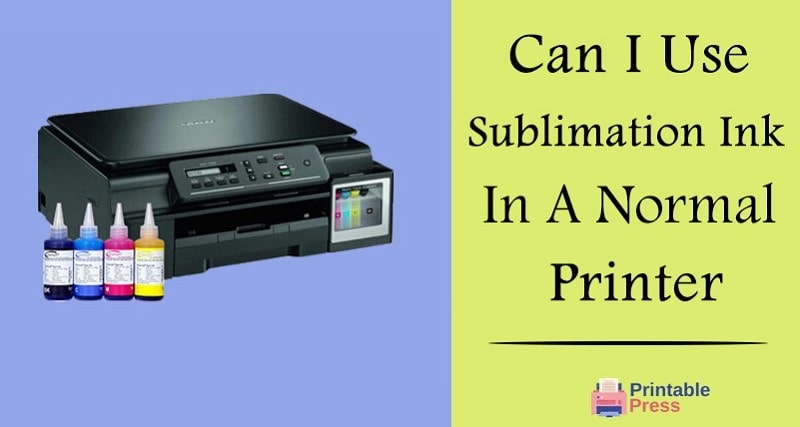
Epson EcoTank printers are the dominant choice for DIY sublimation conversion because they use piezo technology across their entire lineup. The tanks are refillable from the factory, so loading sublimation ink is straightforward — pour it in, run a few cleaning cycles, and the printer is ready for transfer paper. No cartridge adapters, no complicated continuous ink supply systems.
What you're doing in a conversion is turning a standard inkjet into a transfer printer. The sublimation ink deposits onto special paper, and when you press that paper onto polyester fabric or a polymer-coated surface with a heat press, the dye turns to gas and bonds permanently at the molecular level. The printer is just the delivery mechanism. Get the hardware right and the rest follows logically.
Contents
Choosing the Right Normal Printer for Sublimation Ink
Piezo vs. Thermal Printheads Explained
The entire compatibility question hinges on how your printer fires ink. Thermal printheads briefly heat the ink to create a vapor bubble that pushes a droplet through the nozzle. Sublimation ink is not designed for that process — the heat can cause it to partially activate inside the head, leading to clogs, inconsistent firing, and degraded output. Piezoelectric printheads use an electrical charge to flex a small crystal element that physically pushes the ink out. No heat involved. Sublimation ink flows cleanly through a piezo head because there's nothing inside the head activating the dye prematurely.
Epson built its consumer inkjet lineup entirely around piezo technology — a deliberate engineering choice the company has maintained for decades. Inkjet printing broadly divides into these two camps, and for sublimation crafters, Epson's side of that divide is the only viable starting point with consumer-grade machines.
Best Epson Models to Convert
EcoTank models are the practical favorites because the refillable tank system accepts sublimation ink without any modification. You don't need to hack cartridge chips or build a bypass system. The ET-2720, ET-2800, and ET-15000 are the most commonly converted models. The ET-15000 is worth serious consideration if you plan to print 13×19-inch transfers for large garments or oversized sublimation projects — its wider format opens up creative options that an 8.5-inch printer simply can't match.
| Printer Model | Max Print Width | Refillable Tanks | Best For |
|---|---|---|---|
| Epson ET-2720 | 8.5 inches | Yes | Mugs, ornaments, small crafts |
| Epson ET-2800 | 8.5 inches | Yes | Standard t-shirts, tiles, phone cases |
| Epson ET-4850 | 8.5 inches | Yes | Home office and sublimation hybrid use |
| Epson ET-15000 | 13 inches | Yes | Large garments, banners, full sheets |
| Epson ET-5850 | 8.5 inches | Yes | High-volume small-format production |
If you're weighing a converted Epson against a dedicated sublimation machine, the quality gap narrows considerably when you use quality ink and proper color profiles. Our guide to the best sublimation printers for t-shirts walks through how converted Epsons compare to Sawgrass and other purpose-built options — a useful read before you commit to either path.

What Real Sublimation Conversions Actually Produce
Results on Fabric
When you press a sublimation transfer onto a 100% polyester shirt using a properly converted Epson, the results hold up impressively. Colors are bright and vivid. Gradients are smooth. The image bonds at the fiber level — there's no surface layer to crack, peel, or fade. Wash after wash, the print stays intact. That's the central promise of sublimation, and a well-configured consumer printer delivers it consistently.
The polyester requirement is non-negotiable. Sublimation dye bonds only with synthetic fibers or polymer coatings. On a cotton shirt, the image transfers partially but fades within the first wash cycle. A 50/50 poly-cotton blend gives you muted, vintage-style results that can be intentional in some applications but disappointing if you expected sharp, photographic quality. For full-color reproduction, you're working with 100% polyester every time.
Results on Hard Substrates
Hard substrates — mugs, phone cases, aluminum photo panels, ceramic tiles — require a polymer coating to accept sublimation dye. Uncoated ceramic absorbs nothing useful. When the substrate has that coating and you apply heat and pressure correctly (typically 380–400°F for 60–90 seconds, depending on the item), the result is permanent and scratch-resistant. A sublimation-printed mug survives the dishwasher repeatedly without any image degradation.
The range of substrates you can work with using a converted printer is genuinely wide. Crafters regularly sublimate mouse pads, polyester tote bags, puzzles, ornaments, keychains, and metal photo panels. Each substrate has its own time-and-temperature profile, so keeping a reference chart posted at your heat press station saves you from guessing and ruining blanks.
Getting Sharp, Vibrant Transfers Quickly
Using ICC Profiles Correctly
The fastest improvement you can make to your output quality costs nothing: install the correct ICC profile for your ink brand and paper combination. An ICC profile tells your printer driver exactly how to translate on-screen colors into ink percentages that produce accurate results after heat pressing. Without one, colors often look correct on the transfer paper but shift dramatically once pressed. Reds become orange. Blues go flat. Skin tones turn muddy.
Most reputable sublimation ink brands provide free ICC profiles on their websites, matched to specific printer models. Download the right profile, install it through your operating system's color management settings, and select it in the print driver. The before-and-after difference is dramatic — profiled prints come out with accurate skin tones, clean whites, and true blues that unprofiled output simply can't match.
The ink brand you choose affects profile accuracy directly. For recommendations on which sublimation inks perform most consistently across a range of Epson printers, the best sublimation ink reviews guide covers the top options with real-world testing data and notes on which papers each ink pairs well with.
Print Settings and Paper Type
Set your print driver to the highest quality mode and select a paper type that maximizes ink saturation — "Ultra Premium Photo Paper Luster" or a similar glossy photo option works well in Epson drivers even when you're printing on sublimation transfer paper. This increases the ink volume deposited per pass, which translates directly to more vibrant color after pressing.
Always print on the coated side of your transfer paper — that's the side that holds the ink before transfer and releases it cleanly under heat. Printing on the wrong side produces a dull, incomplete transfer that looks washed out even after a perfect press. There's no recovering a bad print; just discard it and reprint.
- Always mirror your image before printing if your design contains text or asymmetric elements — sublimation transfers in reverse
- Set color mode to "Color" even for designs that appear mostly black — pure black sublimation ink can run warm; mixing all four colors produces a truer neutral
Diagnosing and Fixing Common Sublimation Problems
Clogged Heads and Banding
Clogged nozzles are the most frequent problem with converted sublimation printers. Sublimation ink dries in the printhead when the printer sits unused for more than a few days. The symptom is banding — horizontal white or color-shifted lines running through your print. Run the printer's built-in head cleaning utility, two to three cycles at most, then print a nozzle check pattern to confirm every nozzle is firing before you put transfer paper in the tray.
Prevention is straightforward: print something at least every two to three days. A simple full-color gradient on plain copy paper takes ten seconds and keeps the ink flowing through all channels. Skipping this routine for weeks leads to deeper clogs that require flush kits and far more time to resolve. Regular use is your best maintenance strategy.
Color Shift After Heat Press
If your pressed transfers look dramatically different from what you printed — more orange than expected, duller overall, or shifted toward green — the cause is almost always temperature variance, incorrect press time, or a missing ICC profile. Colors shift toward orange when the press runs too hot. They go muted when it's too cool or the press time is insufficient.
Verify your heat press with an infrared thermometer. Budget presses commonly show a 20–30°F gap between the displayed temperature and the actual platen surface temperature. That discrepancy alone is enough to throw off your color output significantly. Measure once, document the actual working temperature for each substrate you use, and you eliminate most color shift problems permanently.
Mistakes That Kill Your Sublimation Output
Pressing on the Wrong Substrate
The most common beginner mistake with a sublimation ink normal printer setup is pressing onto incompatible material. Cotton shirts, natural wood, uncoated ceramics, and glass simply do not work. The sublimation dye has nothing synthetic to bond with on natural materials. You'll get a faint ghost image that disappears in the first wash — or no visible transfer at all.
Always confirm the polyester content or polymer coating of your blank before pressing. Reputable blank suppliers label sublimation-compatible items explicitly. When you're working with a new substrate for the first time, test with a scrap piece before committing a full design to an expensive blank. A bad press is permanent — sublimation dye cannot be removed once it has bonded with the substrate.
Mixing Ink Brands
Mixing sublimation ink brands inside the same tank system is a reliable path to unpredictable color output. Different brands use different dye formulations, and when those formulations blend in your tanks or ink lines, the color profile becomes nearly impossible to calibrate accurately. You'll burn more time troubleshooting than you would have saved using the leftover ink.
When you switch brands, flush the system completely with a dedicated flush solution, refill with the new ink, and run several cleaning cycles before printing anything you intend to press. The same discipline applies when changing paper brands — switching paper without updating your ICC profile shifts your color output noticeably even with identical ink. Small variables compound in sublimation; precision in each step is what separates consistent results from frustrating ones.
Frequently Asked Questions
Can I convert any Epson printer to use sublimation ink?
Most Epson inkjets use piezoelectric printheads and can technically accept sublimation ink. EcoTank models are the most practical choice because the refillable tanks take sublimation ink directly with no cartridge modifications. Cartridge-based Epson models can be converted, but the ongoing ink costs are higher and the process requires chip resetters or compatible third-party cartridges.
Will using sublimation ink void my printer's warranty?
Yes, in virtually every case. Using third-party or non-OEM ink voids the manufacturer's warranty regardless of the ink type. This is why most crafters purchase a dedicated Epson EcoTank specifically for sublimation conversion and keep it completely separate from any printer used for everyday documents. The conversion is a deliberate, one-way commitment for that machine.
What happens if I accidentally use sublimation ink in a thermal inkjet printer?
The printhead will likely clog quickly and may be permanently damaged. Thermal printheads heat the ink to fire it, and sublimation dye is not formulated to withstand that process. Even if the printer outputs something initially, you'll see rapid quality degradation and nozzle failure. There is no workaround — sublimation ink requires a piezoelectric printer, period.
Pick the right printer, load the right ink, press onto the right substrate — get all three right and sublimation delivers permanent, professional-quality results that no other home printing method comes close to matching.
 |  |  |  |

About Anthony Clark
Anthony Clark spent nine years running a custom printing studio in Phoenix, Arizona, producing sublimation-printed drinkware, heat-pressed apparel, and branded merchandise for sports leagues, small businesses, and online retailers. That hands-on production background means he has calibrated hundreds of heat press cycles, sourced sublimation blanks from over a dozen suppliers, and troubleshot every coating and color-shift problem that shows up when dye meets polyester. He left the shop floor in 2019 to write full-time about the techniques and equipment he used daily. At PrintablePress, he covers sublimation printing and heat press methods.


Get some FREE Gifts. Or latest free printing books here.
Disable Ad block to reveal all the secret. Once done, hit a button below
| | | |