Reviews ›
Best ID Card Printers: Reviews, Buying Guide, and FAQs 2026
by Rachel Kim · April 04, 2022
More than 1 billion ID cards are issued globally each year — yet the average buyer spends fewer than 15 minutes selecting the printer that produces them. That mismatch matters. Your ID card printer determines print resolution, card durability, encoding capability, and long-term cost per card. A poor match between machine and workload generates ribbon waste, card reprints, and preventable downtime.
The 2026 market spans a wide range: single-sided vs. dual-sided output, direct-to-card vs. retransfer technology, entry-level desktop units for small offices, and high-throughput enterprise machines with built-in encoding and lamination modules. This guide cuts through the noise. Whether you manage employee badges for a 50-person company or a credentialing program across multiple campuses, the reviews and buying criteria below give you a clear framework for choosing the right machine.
Our editorial team evaluated seven leading models across price tiers and print technologies. Each review draws on manufacturer specifications, verified purchaser feedback, and real-world performance data. For additional printing comparisons and guides, visit our full product review library. If you work with dye-sublimation printing in other contexts, our guide to sublimation printing for beginners explains the core technology that powers most card printers today.

Contents
Our Top Picks for 2026
- #PreviewProductRating
- Bestseller No. 1
 Rating:

- Bestseller No. 2
 Rating:
- Bestseller No. 3
 Rating:
- Bestseller No. 4
 Rating:
 - Bestseller No. 5
 Rating:
- Bestseller No. 6
 Rating:
- Bestseller No. 7
 Rating:
Detailed Product Reviews
1. Zebra ZC300 Dual Sided ID Card Printer — Best for Versatile Encoding
The Zebra ZC300 is a mid-range workhorse designed for organizations that need both color and monochrome output from a single machine. Its dual-sided printing capability means you can print employee photos on the front and department codes or barcodes on the reverse — without a manual flip. The LED/LCD graphical interface is one of the clearest on the market, using icon-based animations and multi-language text prompts that any operator can follow without training.
Encoding flexibility is a primary selling point. The ZC300 supports magnetic stripe encoding for swipe-and-go access cards as well as contactless smart card encoding via its ZIP Pocket system. The new Software Development Kits (SDKs) allow integration with third-party contactless encoders, making this printer adaptable as your credential ecosystem evolves. This is not a printer you will outgrow quickly.
Build quality reflects Zebra's enterprise positioning. The chassis is compact but sturdy. Ribbon installation follows a guided process that reduces mis-loads. For organizations printing anywhere from 50 to several hundred cards per month, the ZC300 delivers consistent output without the overhead of a full enterprise system.
Pros:
- Dual-sided printing in color or monochrome — maximum flexibility
- Graphical LED/LCD interface with multi-language support
- Magnetic stripe and contactless smart card encoding options
- ZIP Pocket enables third-party encoder integration via SDK
- Compact footprint suitable for desk or counter deployment
Cons:
- Higher upfront cost than single-sided alternatives
- Software licensing for advanced encoding may add to total cost
- Ribbon consumption increases significantly with dual-sided color jobs
2. Zebra ZC100 Single Sided ID Card Printer — Best Entry-Level Zebra
If your badge program only requires single-sided output and you want Zebra's reliability without the ZC300's price tag, the ZC100 is the logical choice. It ships as a standalone printer package — no bundled software — which gives you the freedom to integrate it with your existing card design platform. Print speed of 24 seconds per full-color card positions it well for low-to-medium volume programs where throughput matters but does not dominate the buying decision.
The user interface is deliberately simplified. Step-by-step on-screen prompts guide operators through loading cards, installing ribbons, and clearing jams. For environments where the printer is shared among non-technical staff — a reception desk, a school office, a small HR department — this level of guided operation reduces errors and wasted cards. The ZC100 is not trying to be all things to all buyers. It focuses on doing one job cleanly.
The standalone configuration also means you avoid paying for features you will never use. If encoding, lamination, or dual-sided output are not in your requirements, the ZC100 eliminates those costs entirely. It is an honest, well-built single-purpose machine from a manufacturer with decades of credentialing expertise.
Pros:
- Reliable Zebra engineering at an accessible price point
- Simple step-by-step UI — minimal operator training required
- 24-second full-color print speed for low-to-medium volume
- Standalone package — integrates with your existing software
- Compact and easy to place in shared office environments
Cons:
- Single-sided only — not suitable for dual-sided badge programs
- No encoding options in the base configuration
- Software must be sourced and licensed separately
3. Evolis Primacy 2 Dual-Sided ID Card Printer & Supplies Bundle — Best Complete Bundle
The Evolis Primacy 2 is the updated successor to the widely-used Primacy 1, and it improves on every dimension that mattered to Primacy users. This bundle ships with a complete supplies package: a color ribbon, 100 blank PVC cards, and Card Imaging card design software. If you are setting up a badge program from scratch, you can begin printing within minutes of unboxing — no separate consumable orders required.
Print technology is direct-to-card dye sublimation, which delivers vivid color accuracy and smooth tonal gradients on photographic elements. Dual-sided capability means both faces of the card can carry information, whether that is a color photo on the front and a barcode on the reverse, or dual-color graphics for visual security. Evolis has long been a preferred brand among European enterprise buyers, and the Primacy 2 reflects that heritage in its build precision and ribbon system reliability.
Card Imaging software is intuitive enough for first-time users and capable enough for professional badge designers. The combination of hardware quality and bundled software removes the typical friction from the first day of operation. For medium-volume programs — schools, mid-size corporations, event credentialing — the Primacy 2 bundle represents strong value per card printed.
Pros:
- Complete bundle — ribbon, 100 cards, and design software included
- Dual-sided direct-to-card dye sublimation printing
- Successor to the proven Primacy 1 with meaningful improvements
- Evolis build quality — precision-engineered ribbon transport
- Suitable for medium-volume programs without additional investment
Cons:
- Higher price point than single-sided alternatives
- Replacement ribbons from Evolis carry a premium cost
- Direct-to-card technology offers less edge-to-edge coverage than retransfer
4. Fargo HDP5000 Dual Side High Definition ID Card Printer — Best for Security & Durability
The Fargo HDP5000 operates on a fundamentally different printing principle than the other machines on this list. Instead of printing directly onto the card surface, it uses High Definition Printing (HDP) retransfer technology: dye is first printed onto a clear film, which is then thermally bonded to the card face. The result is true edge-to-edge coverage — no white borders, no color drop-off at card edges — plus significantly enhanced card durability compared to direct-to-card output.
This bundle includes a YMCK color ribbon, transfer film, Card Imaging design software, and 100 PVC cards. The HDP film layer itself acts as a protective overlaminate, extending card life in environments where badges are handled frequently, exposed to moisture, or carried without protective holders. For government IDs, healthcare worker badges, or high-security access credentials, the additional durability and print quality of retransfer technology often justifies the higher per-card cost.
Dual-sided output covers both faces of the card with the same edge-to-edge precision. The print resolution is noticeably sharper than most direct-to-card competitors at equivalent price points — fine text, small barcodes, and photographic detail all render cleanly. If your credentialing program demands the highest possible visual quality and card longevity, the HDP5000 is the machine to evaluate.
Pros:
- Retransfer HDP technology — true edge-to-edge printing on both sides
- Enhanced card durability via integrated HDP film overlaminate
- Complete bundle with ribbon, film, software, and 100 cards
- Superior print sharpness — fine text and photo detail render precisely
- Suitable for high-security and government-grade credentials
Cons:
- Retransfer consumables (ribbon + film) are more expensive per card
- Slower throughput than direct-to-card machines at the same price tier
- Larger footprint — requires dedicated desk or cart space

5. Evolis Zenius 2 Single Sided ID Card Printer & Supplies Bundle — Best New-for-2026 Option
Released in 2026, the Evolis Zenius 2 replaces the original Zenius as Evolis's entry-level single-sided offering. It is a notable upgrade for buyers who found the original's ribbon capacity limiting. The included supplies bundle goes further than competing entry-level kits: you receive a 200-capacity color ribbon, 100 blank cards, and Card Imaging design software. That extended ribbon yield reduces the frequency of ribbon changes — a practical advantage for busy operations.
Print technology remains direct-to-card dye sublimation, consistent with the Evolis product family. Color accuracy and photographic reproduction quality are strong for this price tier. The Zenius 2 is positioned as a high-volume entry model — suited for offices, schools, and event operations that need reliable single-sided output without the investment of a dual-sided machine.
As a 2026 release, the Zenius 2 incorporates connectivity improvements over its predecessor. Setup and driver installation are streamlined for both Windows and macOS environments. For buyers who want Evolis build quality and the convenience of a fully bundled kit — without paying for dual-sided capability they will not use — the Zenius 2 makes a compelling case in 2026.
Pros:
- New-for-2026 model with improved specs over the original Zenius
- 200-capacity color ribbon included — fewer ribbon change interruptions
- Complete bundle: ribbon, 100 cards, and Card Imaging software
- Evolis dye-sublimation quality at an entry-level price point
- Straightforward setup for both Windows and macOS
Cons:
- Single-sided only — not suitable for dual-sided badge programs
- Direct-to-card output does not match retransfer edge coverage
- Limited encoding options compared to mid-range and enterprise machines
6. Matica MC310 Dual Sided ID Printer — Best High-Throughput Option
The Matica MC310 targets organizations where throughput is the primary constraint. With a rated speed of 180 cards per hour for single-sided color and up to 850 cards per hour in monochrome mode, the MC310 delivers production-level output from a desktop footprint. If you run quarterly ID renewal cycles for a large workforce or manage event credentialing for hundreds of attendees, this throughput capacity changes the economics of your operation significantly.
Encoding options on the MC310 are comprehensive. An optional in-line magnetic stripe encoder handles swipe access programs. Dual-interface encoders support both contact and contactless smart cards — the same hardware can serve access control, time-and-attendance, and payment applications without modification. The MC310's ribbon program is notably broad: the new Matica YMCScKO ribbon adds visual security elements (VSEs) that make credentials harder to counterfeit.
Optional lamination modules extend the MC310's capability further, enabling true enterprise-grade card security without requiring a separate machine. For organizations with serious volume requirements and multi-application credential programs, the MC310 is one of the most capable direct-to-card machines available at its price tier. The upfront investment is real, but the per-card economics at high volume are favorable.
Pros:
- 180 cards/hour color, 850 cards/hour monochrome — exceptional throughput
- Magnetic stripe, contact, and contactless smart card encoding options
- YMCScKO ribbon adds visual security elements for high-security programs
- Optional in-line lamination module available
- Suited for access control, time-and-attendance, and payment applications
Cons:
- Higher upfront cost — best justified by high-volume programs
- Optional modules (lamination, encoding) increase total system cost
- More complex setup than entry-level desktop printers
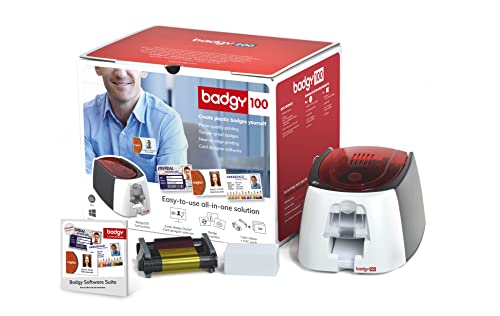
7. Badgy100 Plastic Card Printer with Badge Studio — Best for On-Demand Small Batches
The Badgy100 occupies a distinct niche: it is designed for single-print, on-demand badge production at the lowest possible entry cost. If you need to replace a lost card immediately, print a visitor badge for an unexpected guest, or produce short runs of custom credentials without contracting a print bureau, the Badgy100 eliminates the sub-contractor dependency entirely. Cards print in high resolution on standard CR80 PVC card stock.
Badge Studio software — included with the printer — provides an online template library with professional-looking designs. You do not need graphic design experience to produce polished-looking badges. The template selection covers corporate, academic, healthcare, and event use cases. For a small business owner or school administrator managing infrequent badge needs, Badge Studio significantly lowers the design barrier.
The Badgy100 is honest about what it is: a single-sided, low-volume printer for organizations that print fewer than 200 cards per year. It does not compete on throughput, encoding capability, or card durability with the machines above. What it does offer is instant in-house production and complete control over timing — no waiting for a third-party print order, no minimum order quantities. For the right use case, that independence is the product's core value proposition.
Pros:
- Lowest cost of entry on this list — accessible for small organizations
- Badge Studio software with professional online template library included
- Print on demand — replace lost or stolen cards immediately
- High-resolution output on standard PVC card stock
- No sub-contractor dependency for small-batch badge needs
Cons:
- Single-sided only — limited to front-face printing
- Low throughput — not suited for volumes above ~200 cards per year
- No encoding options in any configuration
- Card durability is lower than retransfer or laminated alternatives
How to Pick the Best ID Card Printer
Choosing an ID card printer involves more variables than most buyers anticipate. Before you evaluate specific models, work through the criteria below. They will narrow your shortlist quickly and prevent a costly mis-match between machine capability and operational need. You can also read about the best printers for heat transfer paper if your operation involves multiple printing types beyond card production.
Print Volume and Throughput Requirements
Volume is the single most important factor. Estimate your annual card output honestly before reading spec sheets.
- Under 500 cards/year: Entry-level single-sided printers (Badgy100, Zebra ZC100) are sufficient. Throughput specs are irrelevant at this scale.
- 500–5,000 cards/year: Mid-range direct-to-card machines (Evolis Zenius 2, Evolis Primacy 2, Zebra ZC300) handle this range with capacity to spare.
- 5,000+ cards/year or batch renewal cycles: High-throughput machines like the Matica MC310 become cost-effective. The per-card economics of faster printers improve significantly at this scale.
- Account for seasonal spikes — an annual employee onboarding cycle or semester start can double weekly volume temporarily.
Single-Sided vs. Dual-Sided Printing
Dual-sided printing costs more upfront and consumes more ribbon per card. Whether it is worth the premium depends entirely on your badge design requirements.
- Single-sided is sufficient when your badge carries only a photo, name, and title — all on one face.
- Dual-sided is necessary when you need barcodes, magnetic stripes, department codes, or access zone information on the card reverse.
- Dual-sided printers can operate in single-sided mode — you are not forced to use both sides on every job.
- Consider future requirements. A credential program that starts simple often expands. Dual-sided capability avoids a printer replacement cycle in 18–24 months.
Direct-to-Card vs. Retransfer Technology
This distinction matters for print quality, card durability, and cost per card. According to Wikipedia's overview of card printers, retransfer (also called reverse transfer or HDP) printing produces superior edge-to-edge coverage and longer-lasting cards than direct thermal transfer.
- Direct-to-card (DTC): Dye is transferred directly onto the card surface. Faster, lower consumable cost, but may show a thin white border at card edges. Adequate for most corporate badge programs.
- Retransfer (HDP): Dye is printed onto a clear film first, then bonded to the card. True edge-to-edge coverage, significantly higher card durability, better suited for high-security or frequently-handled credentials. Consumable cost is higher.
- If your credentials must withstand outdoor use, frequent scanning, or high-friction environments, retransfer technology is worth the premium.
Encoding, Security, and Software Integration
Many badge programs require more than a printed image. Evaluate encoding and security needs before finalizing your choice.
- Magnetic stripe encoding: Required for swipe-and-go door access, time-and-attendance readers, or payment applications. Available as a built-in or optional module on mid-range and enterprise printers.
- Smart card encoding: Contact (chip) and contactless (RFID/NFC) encoding enables modern access control and multi-application cards. The Zebra ZC300 and Matica MC310 both support these configurations.
- Visual security elements (VSEs): UV fluorescent ink panels, holographic overlaminates, and micro-text patterns deter counterfeiting. More relevant for government, healthcare, and high-security corporate programs.
- Software compatibility: Confirm the printer driver works with your existing HR or access control platform. Some printers require proprietary design software; others are broadly compatible. If you also work with other card-adjacent printing, our guide to sublimation vs. heat transfer explains print technology trade-offs that apply across multiple card and media types.
What People Ask
What is the difference between direct-to-card and retransfer ID card printing?
Direct-to-card (DTC) printing transfers dye directly onto the PVC card surface. It is faster and has lower consumable costs, but may leave a small white border at card edges. Retransfer printing — also called High Definition Printing (HDP) — applies dye to a clear film first, then thermally bonds the film to the card. The result is true edge-to-edge coverage and significantly better card durability. Retransfer is preferred for high-security credentials and cards subjected to heavy daily use.
How many cards per year do I need to print to justify buying my own ID card printer?
Most organizations find in-house printing cost-effective at approximately 200–300 cards per year or more. Below that threshold, outsourcing to a print bureau may be more economical when you account for printer amortization, ribbon, and card stock costs. However, in-house printing provides on-demand production speed and privacy benefits that have value beyond pure card economics — particularly for replacement cards and visitor credentials.
Do ID card printers require special PVC card stock?
Most ID card printers are designed for standard CR80 PVC cards (the same size as a credit card: 85.6 mm × 54 mm, 0.76 mm thick). Some printers also accept composite PVC cards (PVC/polyester blends) and PET cards, which offer higher durability. Always verify card thickness compatibility with your specific printer model. Using incorrect card stock causes feed errors, print defects, and can damage internal rollers.
What does a color ribbon (YMCKO) include and how many cards does it print?
A standard YMCKO ribbon contains five panels per card position: Yellow (Y), Magenta (M), Cyan (C), Black resin (K), and Overlay (O). Each panel set produces one full-color card. Ribbon yield varies by model — entry-level ribbons typically yield 100–200 cards, while high-volume ribbons for machines like the Matica MC310 yield 500 or more. The overlay (O) panel applies a clear protective coating that resists smudging and minor abrasion.
Can ID card printers encode smart cards and magnetic stripes simultaneously?
Yes — printers configured with both a magnetic stripe encoder and a smart card encoder module (contact and/or contactless) can encode multiple credential types in a single pass. The Zebra ZC300 and Matica MC310 both support this configuration. Combined encoding is common in enterprise programs where a single card serves access control, time-and-attendance, and building entry functions. Confirm the specific encoder module combination with your vendor before purchase.
How do I maintain an ID card printer to extend its service life?
Regular cleaning is the most important maintenance task. Most card printers ship with a cleaning kit including cleaning cards and adhesive cleaning rollers. Run a cleaning cycle after every ribbon replacement or approximately every 1,000 cards — whichever comes first. Store card stock in sealed packaging away from dust and humidity. Avoid touching card surfaces before loading, as skin oils cause print defects. Replace the cleaning roller when it loses tackiness. Following the manufacturer's cleaning schedule prevents the majority of printhead failures and ribbon-related jams.
Buy on Walmart
- Zebra ZC300 Dual Sided ID Card Printer — Walmart Link
- Zebra ZC100 Single Sided ID Card Printer — Walmart Link
- Evolis Primacy 2 Dual-Sided ID Card Printer & Supplies Bundl — Walmart Link
- Card Imaging Fargo HDP5000 Dual Side High Definition ID Card — Walmart Link
- Evolis Zenius 2 Single Sided ID Card Printer & Supplies Bund — Walmart Link
- Matica MC310 Dual Sided id Printer, Direct to Card Printer, — Walmart Link
- Badgy100 Plastic Card Printer with Badge Studio - ID Design — Walmart Link
Buy on eBay
- Zebra ZC300 Dual Sided ID Card Printer — eBay Link
- Zebra ZC100 Single Sided ID Card Printer — eBay Link
- Evolis Primacy 2 Dual-Sided ID Card Printer & Supplies Bundl — eBay Link
- Card Imaging Fargo HDP5000 Dual Side High Definition ID Card — eBay Link
- Evolis Zenius 2 Single Sided ID Card Printer & Supplies Bund — eBay Link
- Matica MC310 Dual Sided id Printer, Direct to Card Printer, — eBay Link
- Badgy100 Plastic Card Printer with Badge Studio - ID Design — eBay Link
Next Steps
- Estimate your annual card volume — count current staff, anticipated hires, replacement rates, and any visitor or event credentialing needs. This single number eliminates most irrelevant options immediately.
- Check current prices on Amazon for the two or three models that match your volume tier and feature requirements. Prices on ID card printers fluctuate, and bundle availability changes frequently.
- Verify software compatibility with your existing HR, access control, or visitor management platform before purchase. Contact the manufacturer's support line if your platform is not listed in the compatibility documentation.
- Order a ribbon and card stock sample from your shortlisted printer's manufacturer. Calculate your true cost per card — including ribbon yield and card stock price — before committing to the hardware.
- Review the full buying guide above against your security requirements. If your program requires encoding, lamination, or visual security elements, confirm these are available as factory or field-installed options on the model you select.
 |  |  |  |
About Rachel Kim
Rachel Kim spent five years as a merchandise buyer for a national office supply retail chain, evaluating printers, scanners, and printing accessories from Canon, Epson, HP, Brother, Dymo, and Zebra before approving them for store inventory. Her buying process involved hands-on testing against competing models, reviewing long-term reliability data from vendor reports, and vetting price-to-performance claims that manufacturers routinely overstated. That structured evaluation experience translates directly into the kind of buying guidance that cuts through marketing language and focuses on what actually matters for a specific use case. At PrintablePress, she covers printer and printing equipment reviews, buying guides, and head-to-head product comparisons.


Get some FREE Gifts. Or latest free printing books here.
Disable Ad block to reveal all the secret. Once done, hit a button below
| | | |