Reviews ›
10 Best Fabric Paint for Denim T-Shirts
by Rachel Kim · March 26, 2022
You're standing in the craft aisle — or scrolling through Amazon at midnight — trying to figure out which fabric paint will actually hold up on your favorite denim jacket after a few washes. The options feel endless, and the labels all promise permanent, flexible, vibrant color, so it's hard to know which ones are telling the truth. Whether you're decorating a plain t-shirt for a weekend project or adding custom lettering to a pair of jeans, choosing the right paint makes the difference between a design that lasts and one that cracks off by laundry day.
Fabric paint has come a long way from the stiff, plasticky formulas that used to turn soft cotton into something resembling a cardboard box. Today's best options stay flexible after washing, bond deeply into fabric fibers, and come in every finish imaginable — from flat matte to shimmering metallic. The fabric paint market in 2026 offers something for every skill level, whether you're a first-time crafter reaching for a brush or an experienced artist looking for professional-grade pigment saturation. And if you're planning your designs ahead of time, pairing paint with a solid design workflow — like the tips in this guide on how to create t-shirt designs — will help you get much better results on your finished piece.

In this guide, we've tested and researched seven of the most popular fabric paints available for denim and t-shirts in 2026. You'll find a detailed breakdown of each product — what it does well, where it falls short, and which type of project it suits best. We've also included a buying guide section at the end to help you understand the key differences between paint types, finishes, and application methods so you can make the most informed choice for your specific project. Think of this as the resource you wish you'd had before buying three different paints and ending up with only one that actually worked on dark denim.
Contents
- Top Rated Picks of 2026
- Detailed Product Reviews
- Tulip Soft Fabric Paint Rainbow 10 Pack — Best for Color Variety
- Jacquard Textile 8 Color Set — Best for Professional Durability
- Pebeo Setacolor Opaque Fabric Paint — Best for Dark Fabrics
- ARTEZA Metallic Fabric Paint Set — Best for Metallic Finishes
- FolkArt Brush-On Fabric Acrylic Paint — Best for Beginners
- Mont Marte Permanent Fabric Paint Set — Best for Multi-Surface Use
- Tulip ColorShot Instant Fabric Spray Paint — Best for Even Spray Coverage
- How to Pick the Best Fabric Paint for Denim
- Frequently Asked Questions
Top Rated Picks of 2026
- #PreviewProductRating
- Bestseller No. 1
 Rating:

- Bestseller No. 2
 Rating:
 - Bestseller No. 3
 Rating:
 - Bestseller No. 4
 Rating:
 - Bestseller No. 5
 Rating:
 - Bestseller No. 6
 Rating:
 - Bestseller No. 7
 Rating:
Detailed Product Reviews
1. Tulip Soft Fabric Paint Rainbow 10 Pack — Best for Color Variety
If you want a ready-to-go palette that covers every color in the spectrum without hunting down individual bottles, the Tulip Soft Fabric Paint Rainbow 10 Pack makes a strong case as the most convenient starter set available. Each 1-ounce bottle contains a pre-mixed, non-toxic formula that dries in roughly four hours to a soft matte finish, which means the painted area won't feel stiff or rubberized when you wear the garment. The rainbow set includes ten colors — Pink, True Red, Orange, Yellow, Leaf Green, Royal Blue, Purple, Brown, Black, and White — giving you warm and cool tones alongside neutrals that let you mix custom shades on a palette before applying them to fabric.
The paint works on both dark and light fabrics, which is a significant advantage because many brush-on fabric paints struggle to show true color over dark backgrounds without multiple coats. On denim specifically, the coverage is solid with two passes, and the matte finish blends naturally with the woven texture of the fabric rather than sitting on top like a plastic film. After the 72-hour cure window, the paint is machine washable, and colors hold up well through regular washing cycles without cracking or peeling, as long as you follow the heat-setting instructions — either tumble dry on medium or iron over a pressing cloth on the painted side.
One thing worth noting is that because these are 1-ounce bottles, you may find yourself running low on black or white faster than the other shades, especially if you're doing large fills or blending. The bottle tips are narrow enough for freehand painting, but if you're doing detailed line work, you'll likely want a fine-tip applicator brush rather than squeezing directly from the bottle. For stenciling, stamping, and general brush painting on shirts and denim, though, this set offers a well-rounded starting point that's genuinely difficult to beat at its price point.
Pros:
- Ten versatile colors cover warm tones, cool tones, and neutrals in one purchase
- Works effectively on both dark and light-colored fabrics including denim
- Non-toxic formula is safe for all skill levels, including crafting with kids nearby
- Matte finish stays flexible and soft after washing without cracking
Cons:
- 1-ounce bottles run out quickly when working on large design areas or fills
- Requires 72-hour cure time before machine washing, which takes planning ahead
2. Jacquard Textile 8 Color Primary/Secondary Set — Best for Professional Durability
Jacquard is one of those brands that professional fabric artists reach for when they need something that will genuinely last through repeated wear and washing without fading or compromising the drape of the garment. The Textile Color 8-Color Set includes primary and secondary hues in 2.25-ounce jars — noticeably more paint volume per jar than most competing sets at a similar price — and the formula has been engineered specifically to penetrate fabric fibers rather than sitting on the surface as a coating. This penetration is what prevents the paint from chipping, cracking, or peeling over time, and it's the core reason why Jacquard's reputation for longevity is so strong among crafters and designers who rely on their work holding up across dozens of wash cycles.
Setting the paint requires heat, either through ironing at a cotton setting or running the garment through a dryer on the hottest setting, and once set, the bond is impressively durable. What makes Jacquard stand out on denim in particular is how soft the fabric remains after application — you won't feel a stiff patch or a raised texture where the paint was applied, which is something cheaper formulas consistently struggle with. The paint also works across a wide range of materials beyond cotton, including synthetic fabrics, outdoor upholstery, shoes, and bags, so if you're buying a single brand to use across multiple project types, this set is a genuinely practical investment.
The 2.25-ounce jars make mixing custom colors easy, and the paint thins with water if you want a more transparent wash effect or need to thin the consistency for softer brush strokes on lighter-weight fabrics. If you're the kind of crafter who also enjoys screen printing by hand, you'll appreciate that Jacquard's consistency works reasonably well for simple screen-print-style techniques — and if that method interests you, the detailed walkthrough in this guide on how to screen print covers the process from start to finish. For anyone who wants professional-grade durability from a brush-on fabric paint, this set is one of the most reliable options currently available in 2026.
Pros:
- Paint penetrates fabric fibers rather than coating the surface, preventing chipping and cracking
- Fabric remains soft and natural-feeling after paint is applied and heat-set
- Larger 2.25-ounce jars offer more volume than most competing sets
- Works on natural, synthetic, stretchy, and porous surfaces including denim and shoes
Cons:
- Requires intentional heat-setting step — skipping it significantly reduces durability
- Jar format can make precise detail application more challenging without the right brush
3. Pebeo Setacolor Opaque Fabric Paint — Best for Dark Fabrics
Pebeo's Setacolor Opaque line is specifically designed for one of the most persistent challenges in fabric painting: achieving true, vibrant color on dark or black fabrics without multiple coats turning the surface stiff. The opaque formula contains a higher pigment concentration (pigment = the actual color particles that give paint its hue and opacity) than standard fabric paints, which allows a single deliberate pass to produce bold, visible color even on dark denim or black cotton t-shirts. Available in 40 colors with 15 shimmer options in the 45-milliliter size, the Setacolor Opaque range gives you genuine variety, and the fact that 24 colors scale up to 250-milliliter bottles means you can buy larger volumes of your most-used shades once you know what you need.

The air-dry time is approximately one hour, which is faster than many competing brands, and you have two fixing options once the paint is dry: iron the reverse side of the fabric at a cotton setting for five minutes, or place the item in an oven at 150°C (300°F) for five minutes. Both methods bond the paint to the fabric fiber permanently. The oven method sounds unusual but is actually quite effective for items that are awkward to iron flat, like shoes or oddly shaped fabric goods. On cotton, wool, velvet, and even leather, the paint performs consistently, though denim remains one of its strongest applications because the weave texture holds the opaque pigment well without requiring excessive paint buildup.
The Titanium White listing is the most popular individual color from this line because white fabric paint is genuinely difficult to get right — it has to be opaque enough to show clearly on dark fabric without going on so thick that it cracks when the fabric flexes. Pebeo's Titanium White handles this balance better than most competitors, making it a go-to for lettering, highlights, and stenciled designs on darker garments. If you work mostly on dark fabrics, this paint should be near the top of your shortlist, and you can mix it with other Setacolor shades to lighten colors or adjust opacity to suit your specific project requirements.
Pros:
- High-opacity formula covers dark and black fabrics effectively in fewer coats
- Two flexible fixing methods — iron or oven — suit different project types
- Works across cotton, wool, velvet, leather, and other fabric types
- Air-dry time of approximately one hour is faster than many competing brands
Cons:
- Sold in individual bottles or small sets, so building a full palette costs more than bundle sets
- The oven-fixing method may not suit everyone's workflow or kitchen setup
4. ARTEZA Metallic Fabric Paint Set of 14 — Best for Metallic Finishes
If you want that eye-catching shimmer on your denim jackets or t-shirts that regular matte or satin paints simply can't deliver, the ARTEZA Metallic Fabric Paint Set offers fourteen lustrous shades in a single purchase, including Gold, Silver, Sapphire Blue, Pearl Rose, and a range of other metallic tones that photograph beautifully under both natural and artificial light. The semi-transparent nature of these paints is actually an intentional design choice — when you apply metallic fabric paint over a lighter base, the shimmer interacts with the fabric's natural color, creating a depth and variation that opaque metallics can't replicate. This makes the set particularly interesting for denim, where the natural indigo-blue of the fabric shows through and blends with the metallic shimmer in a way that looks genuinely premium.
The quick-drying formula reduces waiting time between layers, and once you've applied your final coat, a pass with a warm iron sets the paint permanently so it can handle machine washing and tumble drying without cracking or peeling over time. ARTEZA designed this set to work across leather, cotton, linen, denim, canvas, and other fabric types, which means you're not buying a specialty product that only works on one material — you'll get use out of this set across a wide variety of projects and surfaces. The paint maintains the fabric's natural softness and drape after application, which is a common weak point with metallic paints that tend to leave a stiff, almost plastic-feeling surface.
For decorative projects like painted denim jackets, holiday-themed shirts, custom tote bags, or any design that benefits from a premium shimmery finish, this set delivers a level of visual impact that standard matte or satin paints simply can't match. The fourteen-color range covers enough variety that you're unlikely to need to purchase additional metallic shades for most projects, and the tubes provide a workable amount of paint per color for several sessions. One thing to keep in mind is that because these are semi-transparent metallics, they may require two passes over very dark base fabrics to achieve full shimmer visibility, so plan accordingly if you're working on black or very dark navy denim.
Pros:
- Fourteen metallic shades in one set cover a wide range of decorative applications
- Semi-transparent formula interacts beautifully with denim's natural color for a layered look
- Fabric stays soft after painting and heat-setting — no stiff or plasticky texture
- Durable through machine washing and tumble drying without cracking or peeling
Cons:
- Semi-transparent finish may require two coats on very dark fabrics for visible shimmer
- Metallic shades are specialized — this set won't replace a standard solid-color palette
5. FolkArt Brush-On Fabric Acrylic Paint Beginner Set — Best for Beginners
FolkArt's Brush-On Fabric Acrylic Paint Beginner Set is one of the most approachable entry points into fabric painting because the 2-ounce bottle format gives you a generous amount of paint per color without requiring a significant upfront investment, and the eight included colors — Wicker White, Licorice, Engine Red, Lemon Custard, Fresh Foliage, Magenta, Brilliant Blue, and Pure Orange — cover the core of the color wheel well enough to mix a wide range of secondary and tertiary shades. If you've worked with acrylic paint on canvas or paper before, the consistency and behavior of FolkArt Fabric paint will feel familiar and comfortable to use, which makes the learning curve genuinely short for anyone with prior painting experience.
Once dry, the paint is permanent on textiles and machine washable in cold water, which is exactly what you want from a fabric paint you're putting on frequently worn items like denim jeans or cotton t-shirts. The soft finish means the painted areas don't feel noticeably different from the surrounding fabric when you're wearing the garment, which is a consistent pain point with many beginner-oriented paints that tend to leave a thick, rubbery residue. Application is smooth across cotton, linen, denim, polyester, and blended fabric types, so you won't need to adjust your technique significantly between different garments in your wardrobe.
For anyone who's newer to customizing clothing and wants a forgiving, easy-to-control formula that produces reliable results across a range of basic techniques — brush painting, simple stenciling, stamping — this FolkArt set is a genuinely sensible starting point. The 2-ounce bottles also make it practical to use for larger fills without constantly running out mid-design, which is a frustration many crafters encounter with 1-ounce starter sets. And if you want to explore other methods of decorating fabric beyond paint — like vinyl applications — the guide on whether adhesive vinyl sticks to fabric is worth reading as a complement to your growing toolkit.
Pros:
- Generous 2-ounce bottles provide more paint per color than most beginner sets
- Familiar acrylic consistency is comfortable for anyone with prior painting experience
- Soft finish after drying maintains fabric feel without a stiff or rubberized texture
- Works across cotton, linen, denim, polyester, and blended fabrics
Cons:
- Eight colors cover basics but intermediate crafters may want a wider or more nuanced palette
- Cold-water-only washing instruction requires care and attention to laundry habits

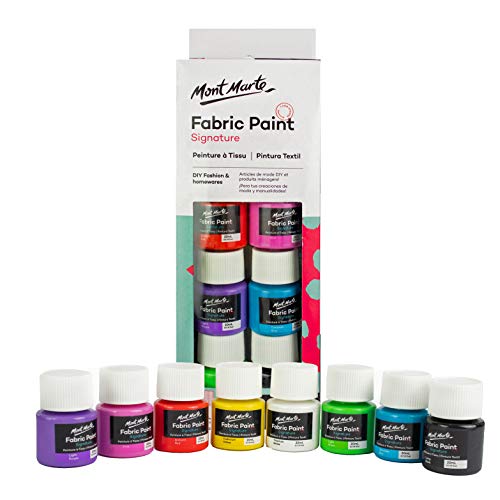
6. Mont Marte Permanent Fabric Paint Set 8 x 20ml — Best for Multi-Surface Use
Mont Marte's Permanent Fabric Paint Set stands out from the others on this list because it genuinely bridges the gap between dedicated fabric paint and multi-surface acrylic, giving you a product that performs well on fabric while also working on wood, ceramic, glass, and canvas without requiring you to switch to a different medium. The eight vibrant colors in 20-milliliter tubes have a creamy, smooth consistency that glides onto fabric surfaces without drag or pilling, and the high-pigment formula ensures good coverage per coat even on thicker woven materials like denim. The glossy finish is noticeably different from the matte finishes of most other products on this list, which gives designs a more polished, almost print-like appearance that works particularly well for graphic lettering and bold geometric shapes.
The lightfastness (resistance to color fading caused by light exposure) of Mont Marte's pigments is a genuine strength — garments painted with this set hold their color vibrancy well even after several months of regular wear and washing, and items stored in sunlit spaces don't show the gradual fading that cheaper paints tend to develop over time. The tube format makes it easy to squeeze out precise amounts without wasting paint, and the creamy consistency blends smoothly on a palette, so mixing custom shades is straightforward and predictable. For multi-media crafters who work across different surfaces in the same creative session, buying one reliable set that moves between fabric and hard surfaces is a practical efficiency that saves both money and shelf space.
The 20-milliliter tubes are smaller than many competing products, so heavy users working on large fills will want to stock up on multiple tubes of their most-used colors, particularly black and white. However, for detail work, decorative elements, lettering, and accent colors, the tube size is perfectly adequate for most projects. The glossy finish also means that designs on dark denim read as visibly shiny compared to the surrounding matte fabric surface, which is an aesthetic consideration worth thinking through before committing — some people love the contrast, while others prefer a matte finish that blends more naturally with the fabric.
Pros:
- Versatile formula works on fabric, wood, ceramic, glass, and canvas in one set
- High-pigment, creamy consistency provides strong coverage and easy blending
- Good lightfastness maintains color vibrancy through washing and light exposure
- Tube format allows precise dispensing without wasting paint
Cons:
- 20-milliliter tubes run out quickly on large projects or fills
- Glossy finish contrasts noticeably with matte fabric — not ideal for those preferring a seamless look
7. Tulip ColorShot Instant Fabric Spray Paint — Best for Even Spray Coverage
Spray-on fabric paint fills a very specific creative gap that brush-on formulas can't easily address: large areas of consistent, even color applied quickly and without brush marks or streaks showing in the finished result. The Tulip ColorShot Instant Fabric Spray delivers this with a smooth, flat matte finish that soaks into fabric fibers rather than sitting on top as a surface coat, which means the color looks woven into the garment rather than painted on. For anyone refreshing the color on faded black denim jeans, overdying a light fabric to a new shade, or creating ombre (gradient color effect) transitions that would be tedious and uneven with a brush, spray paint is genuinely the right tool for the job.
The formula bonds effectively to cotton, polyester, canvas, and denim, and the spray mechanism is designed to deliver even coverage without the dripping, splattering, or uneven patches that can make spray painting frustrating. Colors can also be blended directly on the fabric while they're still wet by layering adjacent spray passes from two or more cans, which opens up gradient and color-mixing possibilities that would be difficult to achieve with any other application method. For stenciled patterns, the clean, even spray gives crisp edges with minimal bleeding, particularly on tightly woven denim that doesn't absorb paint as aggressively as softer cotton fabrics.
The 3-ounce can covers a reasonable amount of fabric — enough for a solid single-layer application on a standard adult t-shirt — but for full garment overdyeing or multi-layer coverage on denim, you'll likely want two cans to ensure you don't run out partway through the project. Using spray fabric paint does require a well-ventilated workspace and some masking or protection for the surrounding area, since overspray is unavoidable with aerosol products. The black colorway reviewed here is particularly popular for darkening faded black denim back to its original depth, which is one of the most practical use cases for this product in 2026 when buying a new pair of jeans might feel like a less sensible option than refreshing what you already own.
Pros:
- Delivers even, drip-free spray coverage across large areas without brush marks
- Matte finish soaks into fabric fibers for a natural, woven-in appearance
- Colors can be blended wet-on-wet directly on fabric for gradient and ombre effects
- Works effectively on cotton, polyester, canvas, and denim
Cons:
- Aerosol format requires ventilated workspace and masking to protect surrounding areas
- 3-ounce can may not be sufficient for full garment coverage without purchasing a second can
How to Pick the Best Fabric Paint for Denim T-Shirts
With so many options in the market in 2026, the most useful thing you can do before buying is narrow down what your specific project actually needs. A professional artist producing custom denim jackets for sale has very different requirements from a parent helping a child decorate a plain shirt for a school event — and the same paint that excels in one context may be frustrating in the other. The four criteria below are the most important factors to weigh when making your decision.

Opacity and Coverage on Dark Fabrics
One of the most common disappointments in fabric painting happens when you apply what looks like a vibrant color on a white surface only to find it nearly invisible on dark denim or black cotton. Opacity — how well the paint covers the base fabric color underneath — varies significantly between products and even between colors within the same product line. According to textile printing principles, opaque formulas rely on a higher concentration of white pigment or titanium dioxide to block the underlying color, and this is exactly what products like the Pebeo Setacolor Opaque are designed to deliver. If you're working primarily on light-colored or white fabrics, most standard fabric paints will perform adequately. But if dark fabrics are your primary surface, look specifically for paints labeled opaque rather than transparent or semi-transparent, and be prepared to apply two coats even with the most opaque formulas for deeper, darker base colors.
Finish Type: Matte, Satin, Gloss, or Metallic
The finish you choose affects not just how the design looks but how the painted area feels when you wear the garment. Matte finishes, like those from Tulip Soft and Tulip ColorShot, blend most naturally with fabric texture and are generally the least noticeable to the touch, making them ideal for wearable items you'll be putting on regularly. Glossy finishes, like Mont Marte's, create a more deliberate contrast with the surrounding fabric and can look very sharp on graphic designs or lettering but may feel slightly different from the base fabric over larger painted areas. Metallic and shimmer finishes sit in their own category and are best used for accent work, highlighting, and decorative effects rather than large base color fills. Think about whether you want your design to look like part of the fabric or to sit distinctly on top of it — that question will guide your finish choice more reliably than any other single factor.
Application Method and Project Scale
How you plan to apply the paint is just as important as the paint formula itself. Brush-on paints offer the most control for detailed work, lettering, portraiture, and freehand designs, and they work well for both small accents and large fills as long as you use the right brush size for each application. Spray paints like the Tulip ColorShot are the right tool for large, even coverage across wide areas, allover color changes, and gradient effects — but they require more workspace preparation and offer less precision for fine detail work. Stenciling works with both brush-on and spray-on formats, though spray tends to produce slightly crisper edges on smooth stencils. If you're working on a series of garments rather than a single piece, you'll also want to factor in whether your chosen paint is available in larger volume containers so you don't run into consistency issues from mixing paint across different batches.
Durability and Washing Instructions
Permanent fabric paint is only as permanent as its heat-setting and washing instructions are followed correctly. Most brush-on fabric paints require a cure period of 24 to 72 hours before the first wash, and many need a heat-setting step — either ironing over a pressing cloth or running through a hot dryer — to chemically bond the pigment to the fabric fibers. Skipping this step is the most common reason fabric paint designs fade, crack, or peel within the first few washes. Once properly set, the best formulas on this list should survive 50 or more regular wash cycles without visible degradation. Look for machine-washable claims specifically rather than just "permanent," since "permanent" sometimes only refers to resistance to dry cleaning or hand washing. If you're decorating items that will be worn and washed frequently, prioritize products with clear, simple washing instructions you can actually follow consistently.
Frequently Asked Questions
Can you use regular acrylic paint on denim fabric?
You can use regular acrylic paint on denim, but it isn't ideal for garments you plan to wear and wash regularly. Standard acrylic paint (the kind designed for canvas or paper) lacks the fabric-specific binders that keep paint flexible after drying, so it tends to crack and peel when the fabric moves, stretches, or goes through a washing machine. Fabric-specific acrylic paints — like the FolkArt or Mont Marte options reviewed above — are formulated with additives that keep the dried paint flexible enough to move with the fabric without breaking down. If you do want to use regular acrylic paint on fabric, mixing it with a dedicated fabric medium (a textile additive sold at most craft stores) will improve flexibility and washability significantly.
Do I need to heat-set fabric paint on denim?
For most fabric paints, yes — heat-setting is strongly recommended to achieve permanent, wash-durable results. Heat-setting causes the polymer binders in the paint to cross-link with the fabric fibers, creating a bond that resists washing and friction. Without this step, even high-quality fabric paints may fade, peel, or wash out after repeated washing cycles. The method varies by product: some require ironing at a medium-high setting for three to five minutes on the reverse side of the painted area, while others can be heat-set in a clothes dryer on the hottest setting. Always check the specific instructions on your paint brand, and allow the full cure time before heat-setting to ensure the paint has dried completely first.
How long does fabric paint last on denim jeans or t-shirts?
When properly applied and heat-set, quality fabric paint on denim should last the life of the garment with minimal visible degradation. Most of the products reviewed in this guide claim washfastness across 50 or more wash cycles when instructions are followed correctly, and in practice, well-applied designs often remain vibrant for several years of regular wear. The factors that most affect longevity are: whether the paint was heat-set properly, whether you're washing in cold water as recommended, whether the garment is being dried on high heat regularly (which stresses the paint bond over time), and the quality of the original paint formulation. Lower-quality or improperly set paint may begin showing fading or cracking within 10 to 20 wash cycles.
What is the difference between transparent and opaque fabric paint?
Transparent fabric paint allows the underlying fabric color to show through, which creates a tinted or glazed effect rather than full color coverage — this type works best on white or very light fabrics where you want the paint color to interact with the fabric's base tone. Opaque fabric paint blocks the underlying color completely, delivering the paint's true color regardless of the base fabric shade, which makes it essential for any work on dark, colored, or patterned fabrics. Most beginner sets include opaque formulas by default since they're more predictable and forgiving on a wider range of fabric colors. Semi-transparent paints, like the ARTEZA Metallics, fall in the middle and are useful for layering effects where you want some interaction between the paint color and the fabric underneath.
Is fabric paint safe to use on children's clothing?
The fabric paints reviewed in this guide are all non-toxic and safe for use on children's clothing once they are fully dry and heat-set — the Tulip Soft Paint specifically notes its non-toxic formulation as a key feature. However, the application process itself is not suitable for very young children to perform unsupervised, as wet paint can irritate skin and should not be ingested. Once the paint is cured and the garment has been washed once, the paint bonds with the fabric and does not rub off or transfer under normal wear conditions. Always check the specific product label for any age-related warnings, and ensure the garment has gone through at least one wash cycle after heat-setting before a child wears it against their skin for extended periods.
Can I mix different brands of fabric paint together?
Mixing fabric paints from different brands is generally possible, but results can be unpredictable depending on the chemistry of each formula. Paints within the same product line — for example, mixing two Tulip colors or two Jacquard colors — will blend consistently because the base formula is identical. Cross-brand mixing can sometimes produce changes in drying time, finish, or wash durability because different brands use different binder chemistries that may not interact ideally. If you need to mix brands, test the blend on a scrap piece of fabric first and wash it to see how the result holds up before committing to your final project. A safer alternative is to use a single brand's full color range and mix your custom shades within that consistent formula.
Buy on Walmart
- Tulip Soft Fabric Paint, Permanent Fabric Paint for Clothes, — Walmart Link
- Jacquard Textile 8 Color Primary/Secondary Color Set - Perma — Walmart Link
- Pebeo 295-010 Setacolor Opaque Fabric Paint 45-Milliliter Bo — Walmart Link
- ARTEZA Metallic Fabric Paint, Set of 14, Permanent Paint, Te — Walmart Link
- FolkArt Brush on Fabric Acrylic Paint Beginner Set (2-Ounce) — Walmart Link
- Mont Marte Permanent Fabric Paint Set 8 x 20ml Vivid Colours — Walmart Link
- Tulip ColorShot Instant Fabric Spray Paint, Permanent Color — Walmart Link
Buy on eBay
- Tulip Soft Fabric Paint, Permanent Fabric Paint for Clothes, — eBay Link
- Jacquard Textile 8 Color Primary/Secondary Color Set - Perma — eBay Link
- Pebeo 295-010 Setacolor Opaque Fabric Paint 45-Milliliter Bo — eBay Link
- ARTEZA Metallic Fabric Paint, Set of 14, Permanent Paint, Te — eBay Link
- FolkArt Brush on Fabric Acrylic Paint Beginner Set (2-Ounce) — eBay Link
- Mont Marte Permanent Fabric Paint Set 8 x 20ml Vivid Colours — eBay Link
- Tulip ColorShot Instant Fabric Spray Paint, Permanent Color — eBay Link
The best fabric paint for your project is the one that matches your surface, your technique, and your willingness to follow the cure and heat-set steps — skip those, and no formula on earth will keep your design on the fabric.
 |  |  |  |
About Rachel Kim
Rachel Kim spent five years as a merchandise buyer for a national office supply retail chain, evaluating printers, scanners, and printing accessories from Canon, Epson, HP, Brother, Dymo, and Zebra before approving them for store inventory. Her buying process involved hands-on testing against competing models, reviewing long-term reliability data from vendor reports, and vetting price-to-performance claims that manufacturers routinely overstated. That structured evaluation experience translates directly into the kind of buying guidance that cuts through marketing language and focuses on what actually matters for a specific use case. At PrintablePress, she covers printer and printing equipment reviews, buying guides, and head-to-head product comparisons.


Get some FREE Gifts. Or latest free printing books here.
Disable Ad block to reveal all the secret. Once done, hit a button below
| | | |