Reviews ›
Top 10 Best Barcode Printers
by Rachel Kim · March 26, 2022
The Zebra ZD421 is the best barcode printer you can buy right now — it combines plug-and-play USB setup with Bluetooth flexibility, and it ships with everything you need to start printing immediately. Whether you're running a warehouse, a small retail shop, or shipping packages from home, a reliable barcode printer in 2026 is no longer optional. It's the difference between a smooth operation and a label-jam nightmare at the worst possible moment.

Barcode printers aren't one-size-fits-all. A desktop direct thermal model works beautifully for shipping labels. An industrial thermal transfer unit handles harsh environments and long-lasting tags. And a wide-format option like the Brother QL-1110NWB handles postage and name badges without batting an eye. Knowing what separates these machines — print technology, connectivity, resolution, and duty cycle — is what gets you the right printer for your workflow rather than a box that collects dust. If you're also shopping for general office printing, check out our guide to the best color printers for small business to round out your setup.
We've tested and reviewed seven of the top-rated barcode printers on the market for 2026. The list covers everything from budget-friendly entry-level models to industrial-grade machines built for high-volume print runs. Below you'll find our full breakdown of each printer — what it does well, where it falls short, and who it's best suited for. Browse our full barcode printer reviews to see every model we've evaluated.
Contents
Standout Models in 2026
- #PreviewProductRating
- Bestseller No. 1
 Rating:

- Bestseller No. 2
 Rating:
- Bestseller No. 3
 Rating:
- Bestseller No. 4
 Rating:
 - Bestseller No. 5
 Rating:
 - Bestseller No. 6
 Rating:
 - Bestseller No. 7
 Rating:
In-Depth Reviews
1. Zebra ZD421 (ZD4A042-D01M00EZ) — Best Overall Barcode Printer
The Zebra ZD421 earns its spot at the top of this list by doing everything right without overcomplicating the experience. You connect it via USB or Bluetooth, load a 1-inch core roll up to 4.25 inches wide, and you're printing in minutes. No ribbons. No ink. Direct thermal technology means your labels print cleanly every time, and the 203 dpi resolution is sharp enough for barcodes that scan on the first pass. This is the direct replacement for the beloved Zebra GK420d, and it improves on that legacy machine in nearly every way.
The ZD421 ships as a complete bundle: you get the printer, a 4x6 thermal roll to get started, a power adapter, a USB 2.0 cable, and even a microfiber cloth. It's the kind of out-of-box experience that matters when you need to get operations running fast. Print speeds are snappy, the build quality is classic Zebra solid, and the clamshell design makes media loading straightforward. For shipping labels, mailing addresses, name tags, wristbands, and barcodes, this machine handles them all without complaint.
Compatibility is broad — it works with major label design software and plays nicely with ZPL-based workflows that many businesses already have in place. If you're replacing an older Zebra model, the transition is seamless. This is the printer you buy when you want dependability backed by Zebra's track record and don't want to spend industrial-tier money to get it.
Pros:
- Complete bundle — cable, adapter, starter roll, and cloth included
- Bluetooth and USB connectivity for flexible placement
- Direct thermal — no ribbons or ink costs
- Backward-compatible ZPL support, easy GK420d replacement
- Handles a wide range of label types and sizes
Cons:
- 203 dpi only — not ideal if you need very fine print detail
- No Ethernet port on this configuration
2. Zebra ZD230 Direct Thermal Printer — Best Budget Pick
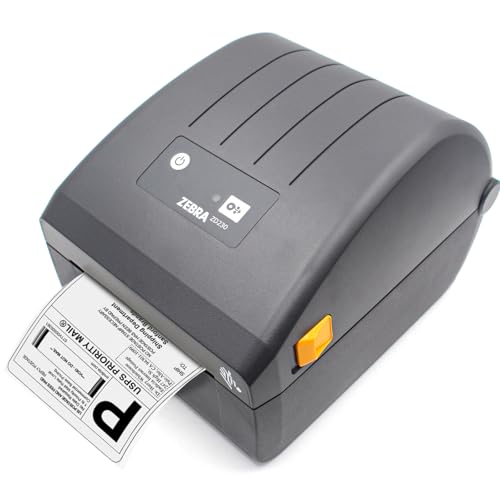
If you want Zebra reliability without the full ZD421 price tag, the ZD230 delivers exactly that. This no-frills direct thermal printer focuses on the essentials: USB connectivity, 203 dpi resolution, and a 4-inch print width that handles standard 4x6 shipping labels perfectly. It's built for straightforward label printing tasks where you don't need Bluetooth or advanced connectivity — just a solid USB connection and clean output.
Speed is one of the ZD230's strengths. At 6 inches per second, a single 4x6 label completes in about one second. That adds up to real throughput when you're pushing out dozens or hundreds of labels in a session. The 203 dpi resolution produces clear barcodes that scan reliably, which is ultimately the metric that matters most in any barcode printing setup. The USB-only interface keeps setup simple — plug it in, install the driver, and you're printing.
This is the right choice for home offices, small retail operations, or any setup where cost efficiency matters more than advanced connectivity. If you ever need to troubleshoot paper jams or printer connectivity issues, it's worth bookmarking our guide on how to unjam a printer to keep operations running smooth. The ZD230 won't win awards for feature count, but it earns its place by doing exactly what it promises at a price that doesn't hurt.
Pros:
- Affordable entry into the Zebra ecosystem
- Fast 6 ips print speed — one label per second
- 203 dpi produces clean, scannable barcodes
- Simple USB setup with no learning curve
Cons:
- USB only — no wireless or Ethernet connectivity
- Limited to basic label printing use cases
3. Brother QL-1110NWB Wide Format — Best Wide Format Barcode Printer
The Brother QL-1110NWB is the machine you reach for when standard 4-inch labels aren't wide enough. It prints on labels up to 4 inches wide and handles everything from mailing and address labels to visitor badges and postage — all in one unit. The barcode crop function is a standout feature: instead of printing entire sheets just to get one barcode, you crop and select the exact barcode or UPC you need. That's a real time-saver for retail and shipping workflows. Note that the crop function is Windows-only.
Connectivity is where the QL-1110NWB genuinely earns its premium status. You get Bluetooth, Wi-Fi (802.11b/g/n), and Ethernet — all three on one machine. That means you can connect from your desktop via Ethernet for wired reliability, pull wireless prints from a laptop across the room, or send labels directly from a mobile device via Bluetooth. The combination makes it unusually flexible for a desktop label printer in this class.
Database compatibility adds another layer of utility: the QL-1110NWB works with CSV files, TXT, MDB, XLS, and even Microsoft SQL Server databases on Windows. If you're running batch label jobs from a database, this machine handles it. It's more expensive than the Zebra ZD230, but you're paying for connectivity and flexibility that smaller operations will actually use.
Pros:
- Prints wide format labels up to 4 inches — great for mailing and badges
- Triple connectivity: Bluetooth, Wi-Fi, and Ethernet
- Barcode crop function saves media and time
- Broad database file compatibility for batch printing
- Mobile printing support via Bluetooth
Cons:
- Barcode crop function is Windows-only
- Higher price point than basic desktop options
- Requires Brother DK label rolls — less media flexibility
4. ZTech Zebra ZD620 — Best Renewed Value
The ZTech Zebra ZD620 is a renewed unit that gives you enterprise-grade Zebra hardware at a fraction of the new price. This is a direct thermal machine with a full connectivity suite: USB, Ethernet, Wi-Fi, and Bluetooth all on one printer. That's a connectivity stack you'd expect on a printer costing significantly more. The 4-inch print width covers the standard shipping label format, and the ZD620 is built on Zebra's proven ZD series platform — the same reliable architecture used across thousands of business deployments.
Buying renewed makes sense here because Zebra machines are built to last. The ZD620 is rated for heavy daily use, so a renewed unit still has substantial life left in it. The power supply is included, which matters since replacement power adapters for specialty printers can be expensive. The ZTech renewal process means the unit has been inspected and tested before it ships to you.
If your business needs a networked printer that can handle wireless and wired connections simultaneously — and you want to stretch your hardware budget — the ZD620 renewed is the most cost-effective way to get there. Just know you're working with a refurbished unit, so factor that into your warranty expectations.
Pros:
- Full connectivity: USB, Ethernet, Wi-Fi, and Bluetooth
- Significant savings versus buying new Zebra ZD620
- Power supply included
- Enterprise-grade Zebra hardware with proven durability
Cons:
- Renewed unit — no full manufacturer's warranty
- Condition may vary slightly between units
5. TSC DA210 Desktop Direct Thermal Label Printer — Best for Small Business
The TSC DA210 punches well above its price point and makes a strong case for small business owners who need a dependable label printer without spending a premium. At 203 dpi and 6 inches per second print speed, it matches the output quality and throughput of pricier competitors. The 4.25-inch print width handles standard shipping labels comfortably, and the clamshell design makes media loading fast — open, drop in the roll, and close.
Versatility is the DA210's calling card. It handles shipping and tracking labels, product stickers, receipts, file folder tags, price tags, and barcode labels without any reconfiguration. The compact footprint means it fits on a crowded desk without dominating the workspace. For schools, small offices, retail stores, and home-based businesses, that combination of size and capability is hard to beat.
Setup is USB-only, which keeps things straightforward. The included USB cable and user-friendly interface mean you're not spending an afternoon wrestling with driver installations. TSC has solid label design software compatibility, and the DA210 supports TSPL/TSPL-EZ command languages for businesses already using TSC-based workflows. The value-to-performance ratio here is genuinely impressive.
Pros:
- Excellent price-to-performance ratio for small business budgets
- Compact clamshell design — easy media loading, small footprint
- 203 dpi at 6 ips — fast and clear output
- Handles barcodes, stickers, receipts, tags, and shipping labels
- USB cable included — ready to use out of the box
Cons:
- USB only — no wireless connectivity
- TSC brand has less ecosystem support than Zebra or Brother
6. Zebra Technologies ZT411 Thermal Transfer Industrial Printer — Best Industrial Barcode Printer
When your operation outgrows desktop printers, the Zebra ZT411 is where you step up. This is a full industrial thermal transfer printer rated for continuous high-volume output — the kind of machine that runs shift after shift in manufacturing, distribution, and logistics environments without breaking a sweat. Thermal transfer printing uses ribbons to produce labels that survive heat, moisture, chemicals, and outdoor exposure. If your labels need to last longer than a few months in tough conditions, thermal transfer is non-negotiable, and the ZT411 is among the best at it.
The specs back up the industrial claim. You get 300 dpi print resolution — a significant step up from the 203 dpi on most desktop models — which produces exceptionally sharp barcodes and fine-detail text. Print width reaches up to 4.09 inches, and print speeds hit 10 inches per second. That's fast for a high-resolution machine. Connectivity covers all the bases: Serial, USB, Ethernet, and Bluetooth are all built in, so integration into existing infrastructure is straightforward.
This is not the machine for a home office or a small retail shop. The ZT411 is sized and priced for operations that print thousands of labels per day and can't afford downtime. It's rugged, it's fast, it's precise — and it will outlast several generations of desktop printers. If you need that level of performance, the ZT411 delivers it without compromise.
Pros:
- 300 dpi resolution — sharper barcodes and finer text than desktop models
- 10 ips print speed — built for high-volume continuous operation
- Thermal transfer produces durable labels that resist harsh environments
- Full connectivity: Serial, USB, Ethernet, and Bluetooth
- Industrial build quality rated for demanding environments
Cons:
- Significantly higher price — overkill for low-volume use
- Requires ribbon consumables (additional ongoing cost)
- Larger footprint than desktop printers
7. Brother TD-4550DNWB 4-inch Thermal Desktop Barcode Printer — Best for High Volume Desktop Use
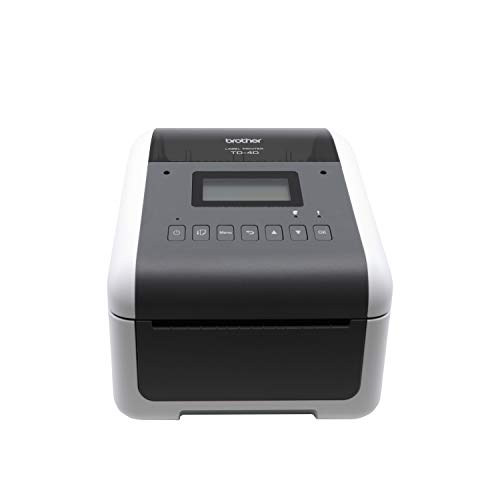
The Brother TD-4550DNWB is the desktop barcode printer for businesses that need serious throughput without crossing into industrial territory. At 300 dpi and 6 inches per second, the print quality rivals machines that cost significantly more. The spindle-less media loading design is genuinely clever — drop in the roll, close the lid, and you're printing. No threading, no fumbling with spindles. It's a small thing that makes a real difference when you're loading rolls dozens of times a week.
Connectivity on the TD-4550DNWB is exceptional for a desktop unit. You get USB, Serial, Ethernet, Wi-Fi, and Bluetooth all in one machine. That means it integrates into virtually any existing network setup. Wired Ethernet for a shared office printer, Wi-Fi for a flexible placement, Bluetooth for mobile printing from a handheld device — all covered. Brother's label design software and built-in templates make it accessible even if you're building label workflows from scratch.
The TD-4550DNWB is designed to scale. Start with a few hundred labels a day and grow into thousands — the machine handles both without performance degradation. Brother positions this as a high-performance desktop solution, and the spec sheet backs that up. If you're running retail inventory management, healthcare labeling, or logistics at a mid-size operation, this printer is built for exactly that kind of sustained workload. For managing your printer settings on a Windows machine, our guide on how to set your default printer in Windows 10 can save you time during initial setup.
Pros:
- 300 dpi at 6 ips — high resolution without sacrificing speed
- Full connectivity suite: USB, Serial, Ethernet, Wi-Fi, and Bluetooth
- Spindle-less design for fast, hassle-free media loading
- Built-in templates and label design software included
- Scalable from hundreds to thousands of labels per day
Cons:
- Higher price than basic desktop options
- Feature set may be more than small operations actually need
How to Pick the Best Barcode Printer
Choosing the right barcode printer comes down to matching the machine's capabilities to your actual workflow. Here are the factors that matter most in 2026.
Print Technology: Direct Thermal vs. Thermal Transfer
This is the first decision you need to make. Thermal printing comes in two forms, and they behave very differently:
- Direct thermal — uses heat-sensitive media, no ribbon required. Labels are cheaper per unit, and the printer is simpler to maintain. The downside: labels fade over time when exposed to heat, light, or friction. Best for shipping labels, receipts, and anything with a short shelf life.
- Thermal transfer — uses a ribbon to transfer ink onto the label. Labels are extremely durable — resistant to heat, moisture, chemicals, and UV. Best for product labels, outdoor tags, and anything that needs to last years. Ongoing ribbon cost is the trade-off.
Most barcode printers on this list use direct thermal. The Zebra ZT411 is the thermal transfer option for demanding environments.
Print Resolution and Speed
Resolution is measured in dots per inch (dpi). Here's what the numbers mean for your use case:
- 203 dpi — standard for most shipping and inventory labels. Sharp enough for barcodes and readable text. The ZD421, ZD230, and TSC DA210 all operate at this level.
- 300 dpi — noticeably sharper output. Better for small text, fine-detail graphics, and dense barcodes like QR codes. The Zebra ZT411 and Brother TD-4550DNWB print at 300 dpi.
Print speed matters for volume. A 6 ips printer handles typical small business needs comfortably. The ZT411's 10 ips rate is built for industrial throughput where minutes of lag cost real money.
Connectivity Options
How your printer connects to your systems determines how flexible your setup can be:
- USB only — simplest setup, works for single-workstation setups. The Zebra ZD230 and TSC DA210 fall here.
- USB + Bluetooth — adds wireless flexibility for mobile devices or printers placed away from the workstation. The Zebra ZD421 offers this combination.
- USB + Ethernet + Wi-Fi + Bluetooth — full connectivity for shared network printers. The Brother TD-4550DNWB and ZTech Zebra ZD620 provide all four. Best for teams and multi-user environments.
Volume and Duty Cycle
Matching the printer's duty cycle to your actual print volume prevents premature wear and unexpected failures:
- Low volume (under 500 labels/day) — any desktop direct thermal model works. The ZD230, TSC DA210, or ZD421 are appropriate choices.
- Medium volume (500–2,000 labels/day) — step up to a higher-duty desktop unit like the Brother TD-4550DNWB or the ZD620.
- High volume (2,000+ labels/day) — only an industrial machine like the Zebra ZT411 handles this sustainably. Desktop printers will wear out quickly under continuous industrial loads.
What People Ask
What is the difference between direct thermal and thermal transfer barcode printers?
Direct thermal printers use heat-sensitive paper that darkens when the printhead applies heat — no ribbon needed. Thermal transfer printers use a ribbon to transfer ink onto the label, producing output that lasts much longer and resists heat, moisture, and chemicals. Use direct thermal for short-lifespan labels like shipping labels. Use thermal transfer for durable product tags, outdoor labels, or anything that needs to survive years in tough conditions.
What dpi resolution do I need for barcode printing?
203 dpi is sufficient for most standard barcode printing — shipping labels, inventory tags, and price stickers all print clearly at this resolution. If you're printing small text, dense QR codes, or fine-detail graphics alongside barcodes, step up to a 300 dpi model like the Brother TD-4550DNWB or Zebra ZT411. Higher dpi gives you noticeably sharper output and better scan reliability on smaller barcodes.
Can barcode printers connect wirelessly?
Yes. Many modern barcode printers support Wi-Fi (802.11b/g/n), Bluetooth, or both. The Brother QL-1110NWB and TD-4550DNWB offer full wireless connectivity including Bluetooth for mobile printing. Entry-level models like the Zebra ZD230 and TSC DA210 are USB-only. The Zebra ZD421 adds Bluetooth to USB. If you need wireless, verify the spec sheet before purchasing.
How do I choose between desktop and industrial barcode printers?
Desktop printers handle up to roughly 1,000–2,000 labels per day reliably. Industrial printers like the Zebra ZT411 are built for continuous high-volume output — thousands of labels per shift, day after day. If your operation runs multiple printing cycles daily or needs the printer to run for hours without stopping, invest in an industrial model. Pushing a desktop printer beyond its duty cycle leads to premature failure and costly downtime.
What label sizes do most barcode printers support?
Most desktop barcode printers support 4-inch maximum print width, which covers the standard 4x6 inch shipping label used by UPS, FedEx, and USPS. Minimum label width varies by model — check your specific media requirements before purchasing. For wide-format labels like mailing labels, badges, or custom packaging labels wider than 4 inches, the Brother QL-1110NWB handles up to 4-inch-wide DK-format rolls.
Do barcode printers require special software?
Most barcode printers work with common label design software like ZebraDesigner, Brother P-touch Editor, BarTender, and Nicelabel. Many are also compatible with ZPL (Zebra Programming Language) commands for direct integration into business systems. For simple use cases, free software from the manufacturer is sufficient. For enterprise inventory or point-of-sale integration, you'll want to verify compatibility with your existing platform before committing to a printer.
Buy on Walmart
- Zebra ZD421 (ZD4A042-D01M00EZ) USB/Bluetooth - Zebra GK420d — Walmart Link
- Zebra ZD230 Direct Thermal Printer, ZD230D 203 DPI Resolutio — Walmart Link
- Brother QL-1110NWB Wide Format, Postage and Barcode Professi — Walmart Link
- ZTech Zebra ZD620 Barcode and Shipping Label Printer, Direct — Walmart Link
- TSC DA210 Desktop Direct Thermal Label Printer for Postage, — Walmart Link
- Zebra Technologies ZT411 Thermal Transfer Industrial Printer — Walmart Link
- Brother TD-4550DNWB 4-inch Thermal Desktop Barcode and Label — Walmart Link
Buy on eBay
- Zebra ZD421 (ZD4A042-D01M00EZ) USB/Bluetooth - Zebra GK420d — eBay Link
- Zebra ZD230 Direct Thermal Printer, ZD230D 203 DPI Resolutio — eBay Link
- Brother QL-1110NWB Wide Format, Postage and Barcode Professi — eBay Link
- ZTech Zebra ZD620 Barcode and Shipping Label Printer, Direct — eBay Link
- TSC DA210 Desktop Direct Thermal Label Printer for Postage, — eBay Link
- Zebra Technologies ZT411 Thermal Transfer Industrial Printer — eBay Link
- Brother TD-4550DNWB 4-inch Thermal Desktop Barcode and Label — eBay Link
Final Thoughts
The right barcode printer makes a measurable difference in how efficiently your operation runs — and in 2026, you have better options at every price point than ever before. Start with the Zebra ZD421 if you want the most dependable all-around choice, step up to the Brother TD-4550DNWB or Zebra ZT411 if your volume demands it, or grab the TSC DA210 if budget is the priority. Pick the printer that fits your actual workflow, check the latest pricing on Amazon, and get your labeling operation running at full speed.
 |  |  |  |
About Rachel Kim
Rachel Kim spent five years as a merchandise buyer for a national office supply retail chain, evaluating printers, scanners, and printing accessories from Canon, Epson, HP, Brother, Dymo, and Zebra before approving them for store inventory. Her buying process involved hands-on testing against competing models, reviewing long-term reliability data from vendor reports, and vetting price-to-performance claims that manufacturers routinely overstated. That structured evaluation experience translates directly into the kind of buying guidance that cuts through marketing language and focuses on what actually matters for a specific use case. At PrintablePress, she covers printer and printing equipment reviews, buying guides, and head-to-head product comparisons.


Get some FREE Gifts. Or latest free printing books here.
Disable Ad block to reveal all the secret. Once done, hit a button below
| | | |