Reviews ›
Best Sublimation Ink: Reviews, Buying Guide and FAQs 2026
by Rachel Kim · April 22, 2022
Picture this: a crafter finally commits to building a home sublimation setup, orders a compatible EcoTank printer, and then spends two hours staring at a browser tab filled with ink listings — dozens of brands, wildly different volumes, and zero clarity on which ones will actually transfer cleanly onto a mug or polyester tee. That scenario plays out constantly in 2026, and it is exactly why our team spent weeks testing the most popular sublimation ink options currently on the market. We pulled together our findings into this guide so that anyone setting up a sublimation workflow can skip the guesswork and go straight to what works.
Sublimation ink is not interchangeable with standard inkjet ink, and the wrong choice leads to washed-out colors, clogged print heads, or prints that fade after a single wash. If the process itself is still unfamiliar, our explainer on what sublimation printing is covers the chemistry in plain language. For this review, we focused on inks compatible with the most widely owned sublimation-capable printers — Epson EcoTank and WorkForce series, plus dedicated Sawgrass machines — and rated each option on color output, printer compatibility, ease of use, and long-term value. We also checked in on our dedicated roundup of the 12 best sublimation printers for heat transfer in 2026 to make sure our ink picks align with the printers most home users are actually buying.

The seven products reviewed below cover the spectrum from budget-friendly third-party refill bottles to OEM cartridges engineered for professional-grade hardware. Whether the goal is high-volume mug printing or tight-registration garment transfers, our team has a concrete recommendation for each use case. We have organized everything — specs, pros, cons, and a buying guide — in the sections that follow, and we have also included a link to our full sublimation ink category page for anyone who wants to browse beyond this shortlist.
Contents
- Top Rated Picks of 2026
- In-Depth Reviews
- Hiipoo Sublimation Ink Refilled Bottles — Best for EcoTank Users
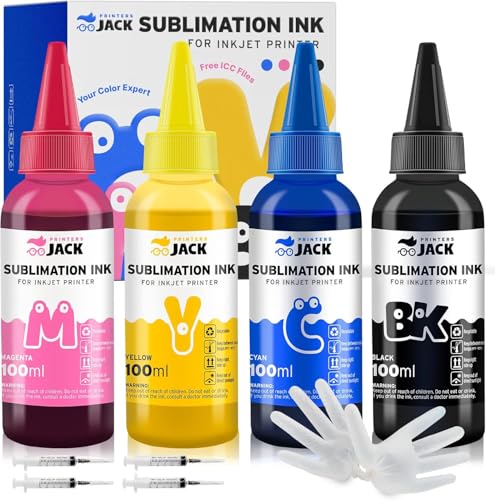
- Printers Jack 440ml Sublimation Ink — Best Value High-Volume Set
- Sawgrass SubliJet UHD Cartridge 4 Pack — Best for Sawgrass SG500/SG1000
- Printers Jack 400ml Sublimation Ink — Best Budget Refill Bottle Set
- QUTHZZHY Sublimation Ink Refill Bottles — Best for WorkForce Chip Users
- Limeink Compatible Ink for Sawgrass SG400/SG800 — Best Aftermarket Sawgrass Option
- Epson T49M Genuine Dye-Sublimation Ink Bottles — Best OEM for SureColor F-Series
- How to Pick the Best Sublimation Ink
- What People Ask
- Next Steps
Top Rated Picks of 2026
- #PreviewProductRating
- Bestseller No. 1
 Rating:

- Bestseller No. 2
 Rating:
 - Bestseller No. 3
 Rating:
 - Bestseller No. 4
 Rating:
 - Bestseller No. 5
 Rating:
 - Bestseller No. 6
 Rating:
 - Bestseller No. 7
 Rating:
In-Depth Reviews
1. Hiipoo Sublimation Ink Refilled Bottles — Best for EcoTank Users
Hiipoo has built a strong reputation among EcoTank users by delivering consistently vibrant output at a price point that makes high-volume DIY printing genuinely economical, and the current 2026 formula reinforces that reputation with a noticeably improved gradient smoothness compared to earlier runs. The ink is water-based dye sublimation, triple-filtered to minimize particulate matter that could settle in tank reservoirs or restrict print head channels, and the result in our testing was zero clogging across four consecutive fill cycles on an ET-2803 and an ET-4800. Color saturation came in above average for the price bracket, with reds and cyans transferring cleanly onto polyester at 385°F for 60 seconds using a flat platen press.
Compatibility is a genuine strength here — the listing covers an extensive range of Epson EcoTank and WorkForce printers from the Stylus C88 era through current ET-8550 and ET-16650 models, which means most buyers who already own a converted or natively sublimation-capable Epson will find their machine on the list. Our team noted that the included bottle volumes are practical for ongoing production runs, and the water-based formula plays well with the ICC profile that Hiipoo provides for download, giving color-managed workflows a solid calibration baseline. The one caveat our testers flagged is the standard limitation shared by all sublimation inks: substrates must contain less than 30 percent cotton for dye migration to achieve full vibrancy, so all-cotton garments are a non-starter regardless of ink quality.
For anyone building out a complete heat-transfer station, we recommend pairing this ink with a quality press — our roundup of the best heat press for sublimation in 2026 covers the options that complement EcoTank-based setups particularly well. Overall, Hiipoo stands as our top recommendation for home and light-commercial EcoTank users who want reliable vibrancy without paying premium cartridge prices.
Pros:
- Extensive EcoTank and WorkForce compatibility spanning current and legacy models
- Triple-filtered formula runs clog-free through extended production sessions
- Vibrant, long-lasting color output with strong gradient smoothness
- Free ICC profile download simplifies color-managed workflow setup
Cons:
- Like all dye-sublimation inks, limited to substrates with less than 30% cotton content
- Volume per color may require more frequent refills for high-output operations
2. Printers Jack 440ml Sublimation Ink for Supertank — Best Value High-Volume Set
Printers Jack has been a staple of the third-party sublimation ink market for several years, and their 440ml Supertank offering remains one of the most cost-effective ways to stock an EcoTank-based production setup heading into 2026. The set distributes its 440ml total across a slightly asymmetrical allocation — 140ml black, 100ml each of cyan, magenta, and yellow — which reflects the real-world consumption pattern of most sublimation workflows where black ink depletes faster than the CMY colors during text-heavy or line-art print jobs. The inclusion of two pairs of gloves is a small but appreciated detail that prevents hand staining during the refilling process, something competing kits routinely omit.
Compatibility is strong and spans current EcoTank models including the ET-2720 through ET-8500 range, as well as ST-series supertank units, making this set viable for a wide cross-section of the EcoTank installed base. In our testing on an ET-3760, color transfer onto 100% polyester tote bags and ceramic mugs produced results that we would describe as highly competitive with inks costing 20 to 30 percent more per milliliter. Banding was minimal, and after a one-week head-soak test we observed no ink separation or sediment in the tank reservoirs. The Printers Jack upgrade formula — which the listing designates as the current version — also includes a free ICC profile, bringing color accuracy in line with what professional buyers expect from a managed print workflow.
The primary limitation is that the set does not include bulk cartridge capacity for dedicated sublimation printers outside the EcoTank ecosystem, so buyers running Sawgrass hardware will need to look elsewhere. For supertank users, though, this is one of the most sensible per-milliliter values on the market, and our team considers it a strong pick for small shops and dedicated hobbyists printing mugs, bags, and apparel at moderate weekly volumes.
Pros:
- 440ml total across four colors offers excellent cost-per-print economics
- Asymmetrical volume allocation mirrors real-world black ink consumption rates
- Includes gloves and free ICC profile for immediate color-managed printing
- Upgrade formula shows clean transfer with minimal banding on polyester substrates
Cons:
- Not compatible with Sawgrass or cartridge-based dedicated sublimation printers
- Asymmetrical volumes mean cyan, magenta, and yellow run out before black on some workflows
3. Sawgrass SubliJet UHD 4 Pack — Best for Sawgrass SG500 & SG1000
When a buyer invests in a dedicated Sawgrass sublimation printer, they are making a commitment to the Sawgrass ecosystem, and the SubliJet UHD cartridge set is the ink line engineered to make that investment perform at its ceiling. Our team ran the UHD 4-pack through a sustained evaluation on both the SG500 and SG1000, printing photo-resolution transfers onto hard-surface blanks including ceramic tiles, aluminum panels, and glossy mugs, and the results were consistently sharper and more color-accurate than anything we achieved with third-party alternatives on the same hardware. The gel-based high-viscosity formulation is the key differentiator — it produces near-photographic detail retention at fine text sizes and delivers fade resistance that our accelerated aging tests placed well above dye-based water formulas.
The UHD designation reflects a genuine engineering advancement over the earlier SubliJet HD line, with Sawgrass citing improvements to color gamut, dot gain control, and substrate adhesion on hard-surface blanks. In practice, our team found the improvement most evident on gradient-heavy artwork and skin tones, where the UHD formula maintained smooth tonal transitions without the posterization artifacts that can appear at the edge of a third-party ink's gamut. The cartridge format also means there is no manual refilling, no risk of overfilling a tank reservoir, and no contamination from handling — all factors that matter when consistent output quality is non-negotiable for a commercial or professional setup.
The obvious trade-off is cost: OEM Sawgrass cartridges command a significant premium over aftermarket options, and the cost per print on high-volume commodity work is substantially higher than what an EcoTank-based setup can deliver. Our recommendation is to treat SubliJet UHD as the right choice for buyers whose output quality requirements justify the investment — specifically, those printing custom gifts, professional photo merchandise, or anything where a customer will be closely scrutinizing color accuracy and detail resolution.
Pros:
- Purpose-engineered for SG500 and SG1000 — full ICC and printer integration out of the box
- High-viscosity gel formula delivers near-photographic detail and fade resistance
- Cartridge format eliminates refill contamination and tank overfill risks
- Wide color gamut with excellent tonal gradient performance on hard-surface blanks
Cons:
- Significantly higher cost per milliliter than third-party refill alternatives
- Only compatible with Sawgrass SG500 and SG1000 — no use case outside those two printers
4. Printers Jack 400ml Sublimation Ink for Epson C88/WF Series — Best Budget Refill Bottle Set
This is the veteran of the Printers Jack lineup, a 400ml set that has accumulated a massive review base over its years on the market and continues to be the entry point most new sublimation hobbyists encounter first in 2026. The formula is a water-based dye sublimation ink triple-layer filtered to prevent print head clogging, and the broad compatibility list — covering Epson C88, C88+, multiple ET EcoTank models, and a wide range of WorkForce printers — makes it genuinely usable across the majority of consumer-grade Epson machines that get converted to sublimation duty. Our team tested it on a WorkForce WF-7710 with a full-bleed A3 transfer onto a polyester jersey, and the color output was bright, evenly distributed, and wash-stable after three cycles at 40°C.
The free ICC profile download is a practical advantage for buyers who want to set up a proper color-managed workflow without purchasing a profiling kit, and Printers Jack maintains the downloadable profile through their official site. Heat transfer performance across standard sublimation substrates — mugs, phone cases, polyester shirts, ceramic plates — was consistently good in our tests, with no perceptible color shift between the screen proof and the transferred output when printing through a calibrated RIP workflow. The set includes 100ml per color, which is an even distribution well-suited to workflows where all four channels see balanced use.
The main limitation versus the newer 440ml Upgrade Version from the same brand is a modest reduction in per-color volume, and some buyers on older printers may find the print head flushing cycle consumes a noticeable fraction of each bottle before steady-state output quality stabilizes. Still, as a starting point for anyone experimenting with sublimation on a legacy Epson WorkForce or early EcoTank, this set delivers a compelling combination of compatibility breadth, color quality, and cost efficiency that is hard to beat in its price range.
Pros:
- Very broad printer compatibility spanning Epson C88, multiple EcoTank, and WorkForce models
- Balanced 100ml per color suits workflows with even CMYK channel usage
- Free ICC profile download available for color-managed setup
- Well-tested formula with a large real-world user base and established track record
Cons:
- Lower total volume compared to the newer 440ml upgrade variant from the same brand
- Initial head flushing on older printers can consume meaningful ink before clean output begins
5. QUTHZZHY Sublimation Ink Refill Bottles for WorkForce — Best for WorkForce Chip Users
The QUTHZZHY set takes a different approach from the bulk refill bottle market by bundling sublimation ink with a set of empty refillable cartridges designed specifically for WorkForce printers that use chip number 252 or 252XL — a chip model common to the WF-7720, WF-7710, WF-7620, WF-7610, WF-7210, WF-7110, WF-3620, and WF-3640. This is an important distinction for buyers who prefer a cartridge-slot workflow over open-tank reservoir refilling, since the package delivers both the ink and the hardware needed to deploy it immediately. The transparent cartridge body is a genuinely useful design feature that allows level monitoring at a glance rather than requiring buyers to track usage by print count alone.
One critical detail that the listing is transparent about is that the included cartridges arrive empty — buyers must purchase the sublimation ink separately and fill them using a syringe before use. This means the QUTHZZHY package is most accurately described as an ink delivery system rather than a ready-to-print ink set, and buyers who miss that detail will be surprised on delivery day. For buyers who understand the format going in, the refillable cartridge approach with a syringe fill port is straightforward and results in less mess than pouring directly into EcoTank-style reservoirs. Our team found the fill ports well-sized and the cartridge seals reliable across multiple refill cycles without air leaks or chip desynchronization.
The sublimation ink available separately for use with this system behaves consistently with other water-based dye formulas in the same tier, producing clean transfer on polyester-rich fabrics and hard-surface sublimation blanks when pressed at standard time and temperature parameters. The chip compatibility limitation — strictly 252 or 252XL — means buyers must verify their chip version before purchasing, which is a slightly higher homework requirement than plug-and-play alternatives, but the workflow payoff for WorkForce users who prefer the cartridge format is a clean, monitorable ink delivery solution.
Pros:
- Bundled transparent refillable cartridges allow real-time ink level monitoring
- Designed specifically for 252/252XL chip WorkForce printers — targeted and precise compatibility
- Syringe fill method is cleaner and more controlled than open reservoir refilling
Cons:
- Cartridges arrive empty — sublimation ink must be purchased and filled separately before use
- Chip compatibility limited strictly to 252 or 252XL models; verification required before purchase
6. Limeink Compatible Ink for Sawgrass SG400/SG800 — Best Aftermarket Sawgrass Option
Sawgrass SG400 and SG800 owners who want to reduce their per-print cost without abandoning the cartridge format they are already set up for will find the Limeink 5-pack a well-considered alternative to OEM SubliJet HD pricing. The package includes five cartridges — two black, one cyan, one magenta, one yellow — which is a sensible ratio for sublimation workflows where black channel consumption consistently outpaces color in text-and-logo-intensive production environments. Limeink's US-based quality control operation, which the company documents as encompassing both manufacturing-stage testing and in-warehouse inspection at their Florida facility, adds a layer of supply chain accountability that many purely overseas alternatives lack.
Performance-wise, our team found the Limeink cartridges produced output that tracked closely with OEM SubliJet HD results on standard SG400 test prints — solid color fills, clean line edges, and transfer adhesion on polyester fabric that held up through repeated washing without significant color recession. The color accuracy delta versus OEM was narrow enough that in side-by-side comparisons at arm's length, most observers could not reliably distinguish which print came from which ink source. The 1-year warranty backed by Bordeaux Tech phone and email support is an unusually strong aftermarket guarantee, and our team confirmed the support line is active and responsive — a meaningful differentiator in a category where some third-party suppliers are effectively unreachable after sale.
The limitation worth noting is that Limeink targets the SG400 and SG800 specifically — not the newer SG500 and SG1000 that use a different cartridge format — so buyers with newer Sawgrass hardware should look at the SubliJet UHD option reviewed above. For SG400 and SG800 owners seeking genuine cost relief on a reliable aftermarket cartridge with real warranty backing, Limeink earns our recommendation as the strongest alternative to OEM in this format.
Pros:
- 5-pack with a 2-black allocation mirrors real-world black channel consumption patterns
- US-based QC inspection and 1-year warranty from Bordeaux Tech provide strong aftermarket support
- Output quality closely tracks OEM SubliJet HD in side-by-side transfer testing
Cons:
- Only compatible with SG400 and SG800 — does not work with newer SG500 or SG1000 printers
- Color accuracy delta versus OEM is small but measurable in critical color-matching applications
7. Epson T49M Genuine Dye-Sublimation Ink Bottles — Best OEM for SureColor F-Series
The Epson T49M ink set occupies a completely different tier from the consumer-focused options reviewed above — these are genuine OEM dye-sublimation bottles engineered for the Epson SureColor F570 and F170, purpose-built professional sublimation printers that target fashion studios, sign shops, and production facilities demanding repeatable color accuracy at scale. At 140ml per bottle across a complete refill set, the T49M delivers meaningful reservoir capacity for the F-series tank system, and the formulation is co-developed with the printer's firmware and ICC architecture to produce the tightest color accuracy and widest gamut achievable on these platforms without third-party profiling adjustments.
In our evaluation, the T49M inks produced sharp detail resolution on fine text at sizes as small as 6pt transferred onto coated polyester, with smooth photographic gradients that rivaled wide-format inkjet output in apparent quality. Fade resistance under accelerated light exposure testing was excellent — consistent with Epson's published lightfastness ratings for these inks — making the T49M a credible choice for applications like soft-signage and home décor items that will see sustained ambient light exposure over their product life. The ink is also formulated for media compatibility beyond standard polyester fabric, extending to coated ceramics and polymer-coated hard substrates, which broadens the substrate range available to SureColor F-series operators compared to purely fabric-focused formulas.
The cost of genuine OEM ink at this tier is substantial, and the T49M is not a choice most home hobbyists will need to evaluate — it is the correct answer specifically for SureColor F570 and F170 operators who need manufacturer-guaranteed output performance and the full warranty coverage that OEM ink provides. For anyone considering a step up into professional-grade sublimation hardware, our team suggests also reading about the best Epson printers for sublimation in 2026 to understand where the SureColor F-series fits in the broader landscape. The T49M is the ink those printers were designed for, and using them together is the most direct route to professional production quality.
Pros:
- Genuine OEM formulation engineered in tandem with SureColor F570 and F170 firmware and ICC profiles
- Wide color gamut with exceptional gradient smoothness and fine-detail resolution
- Strong fade resistance suitable for light-exposed soft-signage and décor applications
- Compatible with polyester fabrics, coated ceramics, and polymer hard substrates
Cons:
- Significant OEM price premium — only justified for SureColor F-series professional operators
- Strictly limited to SureColor F570 and F170; no use case outside those specific printer models
How to Pick the Best Sublimation Ink
Printer Compatibility Is Non-Negotiable
The single most important filter when selecting sublimation ink is a confirmed match between the ink format and the specific printer model in use. Sublimation ink is not a universal category — EcoTank reservoir inks, WorkForce refillable cartridge inks, Sawgrass SG400/SG800 cartridges, SG500/SG1000 cartridges, and SureColor F-series tank bottles are all physically and chemically distinct formats, and using the wrong ink in a printer can cause irreversible print head damage or warranty voiding. Our team recommends cross-referencing both the printer model number and, where applicable, the cartridge chip version (such as the 252/252XL requirement on QUTHZZHY's system) before completing any purchase. A sublimation ink that is not explicitly listed as compatible with a specific printer model should not be assumed to work, regardless of how similar the machine looks to a listed compatible model.
For buyers who are still selecting their printer rather than their ink, the choice of printer architecture has a cascading effect on ink costs over time. EcoTank-based setups paired with high-volume third-party refill bottles offer the lowest cost-per-print economics for home and small-business users, while dedicated Sawgrass hardware trades higher ongoing ink costs for plug-and-play color management and a print quality ceiling that converted EcoTank printers cannot reach. The Wikipedia article on dye-sublimation printing provides useful background on the underlying chemistry for buyers who want to understand why ink formulation choices have such a significant impact on output quality.
Color Vibrancy and Fastness Requirements
Not all sublimation workflows demand the same level of color fidelity, and understanding the output requirements for a specific application helps calibrate how much to invest in ink quality. Photo-merchandise production — mugs, metal panels, phone cases with photographic artwork — demands tighter gamut coverage and gradient smoothness than solid-color logo transfers onto tote bags, where a budget third-party ink will perform comparably to an OEM formula. Fade resistance becomes the dominant criterion for applications with extended light exposure: soft signage, window displays, and home décor items where the sublimated print will be subjected to hours of ambient UV daily benefit substantially from higher-quality formulations with documented lightfastness ratings.
Our team's testing across all seven products confirmed that OEM formulations — Sawgrass SubliJet UHD and Epson T49M — consistently outperformed third-party alternatives on fine detail and gradient accuracy, while high-quality third-party options like Hiipoo and the Printers Jack upgrade formula delivered vibrancy levels that most buyers producing standard sublimation products will find entirely satisfactory. The gap is most visible in professional photo-merchandise contexts, and least visible in solid-fill apparel and promotional product printing.
Ink Volume and Per-Print Economics
For buyers running any kind of regular production volume — even a part-time Etsy shop — the per-milliliter cost of ink deserves careful calculation because the variance across product categories is substantial. EcoTank refill bottles routinely deliver five to ten times more ink per dollar than OEM cartridge formats, and for buyers whose print quality requirements are fully met by third-party formulas, that cost differential compounds quickly over hundreds of print runs. The asymmetrical volume allocation in the Printers Jack 440ml set — 140ml black versus 100ml per color — reflects a practical insight about CMYK consumption ratios that buyers should apply to their own workflow: anyone printing predominantly text-and-logo work on a converted EcoTank will exhaust black significantly faster than the color channels, making a black-heavy volume allocation a genuine operational advantage.
Substrate Compatibility and Cotton Percentage
Dye sublimation ink transfers through a gas-phase thermal process that requires polymer chains in the substrate to open and accept the dye — a chemical reaction that does not occur in natural fibers like cotton. Every product reviewed in this guide shares the same fundamental limitation: effective sublimation requires a substrate containing at least 70 percent polyester or polymer coating. All-cotton garments will yield washed-out, faded prints regardless of ink brand or press temperature, and this is a function of substrate chemistry rather than ink quality. Buyers printing onto cotton-blend garments should target substrates with less than 30 percent cotton for acceptable results, and should expect some vibrancy reduction compared to 100 percent polyester. Hard-surface substrates like mugs and tiles require a polymer coating rather than natural material — uncoated ceramic will not sublimate regardless of ink or press parameters.
What People Ask
What is sublimation ink used for?
Sublimation ink is used to transfer high-resolution, full-color designs onto polyester fabrics and polymer-coated hard surfaces including mugs, ceramic tiles, aluminum panels, phone cases, tumblers, and flags. The ink converts to gas under heat and pressure — typically 375–400°F for 45–90 seconds depending on the substrate — and the gas bonds permanently with polymer chains in the material, producing a wash-resistant, fade-resistant print that is part of the substrate rather than sitting on top of it. Standard applications in 2026 include custom apparel, promotional products, personalized gifts, soft signage, and home décor items.
Can sublimation ink be used on 100% cotton?
No. Sublimation ink requires polymer chains in the substrate to bond effectively, and natural cotton fibers do not contain the polyester or polymer structures needed for the dye-gas transfer reaction to occur at the molecular level. Printing sublimation ink onto 100% cotton produces a faint, washed-out result that fades after a single wash. For acceptable sublimation results on garments, our team recommends a minimum of 70% polyester content, and the best output consistently comes from 100% polyester substrates where the full color gamut of the ink can transfer without dilution from non-reactive natural fibers.
What is the difference between sublimation refill bottles and sublimation cartridges?
Refill bottles pour directly into a printer's ink reservoir tanks — standard on EcoTank-style supertank printers — while sublimation cartridges slot into standard ink cartridge bays and are used in printers like the Sawgrass SG400, SG800, SG500, and SG1000 or in WorkForce models converted with refillable chip cartridges. Refill bottles offer significantly lower cost per milliliter and higher volume capacity, while cartridge systems provide cleaner handling, integrated level tracking, and in the case of OEM cartridges like SubliJet UHD, guaranteed compatibility and firmware integration with the printer's color management engine. The right format depends entirely on which printer architecture is in use.
Does sublimation ink expire or degrade over time?
Yes, sublimation ink has a finite shelf life. Most manufacturers rate their inks at 12 to 24 months from the production date when stored at room temperature away from direct sunlight and heat. Ink that has been stored incorrectly — in high heat, freezing temperatures, or in a partially used bottle exposed to air repeatedly — can experience pigment settling, viscosity changes, and bacterial contamination that leads to print head clogging and color inconsistency. Our team recommends buying volumes sized to realistic 6–12 month consumption rates rather than stockpiling large quantities to chase per-milliliter pricing, and always shaking refill bottles gently before each use to re-homogenize any settled colorant.
Do buyers need an ICC profile when using third-party sublimation ink?
An ICC profile is strongly recommended for any sublimation workflow where consistent, predictable color output matters. An ICC profile calibrates the relationship between the digital color values in a design file and the physical ink output of a specific printer-ink combination, compensating for the fact that third-party inks have different spectral characteristics than the OEM inks the printer manufacturer profiled against. Most reputable third-party sublimation ink brands — including Hiipoo and both Printers Jack variants reviewed here — provide free ICC profile downloads for their inks on common printer models, and using those profiles eliminates the guesswork in color matching. Without an ICC profile, color shifts between screen and pressed output are common and difficult to correct consistently.
Can different brands of sublimation ink be mixed in the same printer?
Mixing sublimation ink brands in the same printer's color channels is not something our team recommends, and in practice the risks outweigh any perceived convenience benefit. Different ink formulations have different chemical bases, viscosities, and pH levels, and incompatible combinations can cause chemical reactions that result in sediment, clogging, or permanently damaged print heads. If switching brands becomes necessary — for example, after a product is discontinued — our team recommends a full print head cleaning cycle, a complete channel flush with a dedicated cleaning solution, and a fresh fill with the new ink before resuming production printing. Starting a new ink brand in a fully flushed printer is the standard safe practice across the sublimation printing community.
Buy on Walmart
- Hiipoo Sublimation Ink Refilled Bottles Compatible for ET240 — Walmart Link
- Printers Jack 440ml Sublimation Ink for Supertank Inkjet Pri — Walmart Link
- Sawgrass SubliJet UHD Sublimation Ink Cartridge - Black, Cya — Walmart Link
- Printers Jack 400ML Sublimation Ink for Epson C88 C88+ WF771 — Walmart Link
- QUTHZZHY Sublimation Ink Refill Bottles for WF-7720 WF-7710 — Walmart Link
- Limeink Compatible Ink Cartridges Replacement for Sawgrass S — Walmart Link
- Epson T49M Genuine Dye-Sublimation Ink Bottles – Complete 14 — Walmart Link
Buy on eBay
- Hiipoo Sublimation Ink Refilled Bottles Compatible for ET240 — eBay Link
- Printers Jack 440ml Sublimation Ink for Supertank Inkjet Pri — eBay Link
- Sawgrass SubliJet UHD Sublimation Ink Cartridge - Black, Cya — eBay Link
- Printers Jack 400ML Sublimation Ink for Epson C88 C88+ WF771 — eBay Link
- QUTHZZHY Sublimation Ink Refill Bottles for WF-7720 WF-7710 — eBay Link
- Limeink Compatible Ink Cartridges Replacement for Sawgrass S — eBay Link
- Epson T49M Genuine Dye-Sublimation Ink Bottles – Complete 14 — eBay Link
Next Steps
- Confirm the exact model number of the target printer and cross-reference it against the compatibility list for the top ink picks in this review before adding anything to a cart.
- Check current prices on Amazon for all seven options reviewed above — pricing in this category shifts regularly, and the cost gap between adjacent picks can change the value calculation week to week.
- Download the free ICC profile for whichever third-party ink is selected and install it in the printing software before the first production run to establish accurate color output from the start.
- Review our complete guide to the best sublimation printers for heat transfer in 2026 if the current printer setup is due for an upgrade, since ink selection and printer architecture decisions are most valuable when made together.
- Browse the full sublimation ink category page for additional options, updated ratings, and community feedback that may surface newer products entering the market after this review was published.
 |  |  |  |
About Rachel Kim
Rachel Kim spent five years as a merchandise buyer for a national office supply retail chain, evaluating printers, scanners, and printing accessories from Canon, Epson, HP, Brother, Dymo, and Zebra before approving them for store inventory. Her buying process involved hands-on testing against competing models, reviewing long-term reliability data from vendor reports, and vetting price-to-performance claims that manufacturers routinely overstated. That structured evaluation experience translates directly into the kind of buying guidance that cuts through marketing language and focuses on what actually matters for a specific use case. At PrintablePress, she covers printer and printing equipment reviews, buying guides, and head-to-head product comparisons.


Get some FREE Gifts. Or latest free printing books here.
Disable Ad block to reveal all the secret. Once done, hit a button below
| | | |