Reviews ›
Best Slide Scanner Reviews, Buying Guide, and FAQs 2026
by Rachel Kim · April 04, 2022
Which slide scanner is actually worth your money in 2026 — and which ones will leave you squinting at blurry, color-shifted scans of irreplaceable memories? If you've been sitting on boxes of 35mm slides and film negatives from the '70s, '80s, or '90s, you already know how urgent this is. Those images are fading. After reviewing seven of the most popular models available right now, one scanner rose to the top for sheer image quality and professional-grade output: the Epson Perfection V850 Pro.
That said, the V850 Pro is not the right choice for everyone. Your perfect scanner depends on how much you're digitizing, what formats you're working with, and how much image quality you actually need. This guide covers the full spectrum — from professional dedicated film scanners with 7200 dpi resolution to budget-friendly standalone digitizers you can use without a computer. We've tested across use cases so you don't have to guess. Every recommendation here is backed by specs, real-world performance, and honest trade-off analysis.
If you're exploring the broader world of document and photo scanning, our full review library has you covered — including guides on the best photo scanners with auto feeders for bulk digitizing and the best book scanners for archiving printed materials. But for slides and film negatives specifically, read on — everything you need to make the right call in 2026 is right here.

Contents
Standout Models in 2026
- #PreviewProductRating
- Bestseller No. 1
 Rating:

- Bestseller No. 2
 Rating:
 - Bestseller No. 3
 Rating:
 - Bestseller No. 4
 Rating:
 - Bestseller No. 5
 Rating:
 - Bestseller No. 6
 Rating:
 - Bestseller No. 7
 Rating:
Full Product Breakdowns
1. Plustek OpticFilm 8200i SE — Best for Professionals Who Demand Dust-Free Scans
The Plustek OpticFilm 8200i SE is the dedicated film scanner that serious photographers turn to when quality is non-negotiable. At 7200 x 7200 dpi with 48-bit color output, it captures every grain of detail from your 35mm negatives and mounted slides — producing scans equivalent to a 69-megapixel full-frame DSLR image. That's not marketing fluff; it means you can make archival-quality prints at 20 x 24 inches and beyond without any visible degradation.
What genuinely sets the 8200i SE apart from its competitors is the built-in infrared channel. This hardware-level dust and scratch detection works by scanning a separate infrared pass of your film, identifying defects at the physical surface level, and allowing the bundled SilverFast SE Plus 9 software to remove them automatically. The result: you spend less time retouching and more time actually enjoying your digitized images. The Enhanced Multi-Exposure function further expands the dynamic range, pulling shadow detail out of dense negatives that other scanners simply blow out to black. SilverFast SE Plus 9 is itself a professional-grade scanning suite that would cost you extra if you purchased it separately — it's a meaningful part of this bundle's value proposition.
Build quality is solid. The 8200i SE feels like a precision instrument rather than a consumer peripheral. It's not fast — a high-res scan with iSRD active takes a few minutes per frame — but that's the trade-off you accept when accuracy and archival quality are the goal. This scanner is designed for 35mm film only, so if you're working with medium format or other sizes, you'll need to look at a flatbed option. But for 35mm work specifically in 2026, nothing in this price range touches it.
Pros:
- Built-in infrared dust and scratch removal (iSRD) eliminates manual retouching
- 7200 dpi / 69 MP output — highest optical resolution in its class
- Enhanced Multi-Exposure boosts dynamic range for dense negatives
- Bundled SilverFast SE Plus 9 is professional-caliber scanning software
- 64-bit hardware and software support for modern operating systems
Cons:
- 35mm only — no medium format support
- Scan times are slow when iSRD and multi-exposure are active
- Premium price point compared to flatbed alternatives
2. Plustek OpticFilm 8100 — Best Value Dedicated Film Scanner
The Plustek OpticFilm 8100 is the entry point into serious dedicated film scanning, and it delivers far more than the price suggests. You get the same 7200 dpi / 69-megapixel optical resolution as the premium 8200i SE, which means your 35mm negatives and slides come out sharp enough for large-format prints or high-resolution digital archiving. The difference is that the 8100 does not include the infrared dust and scratch removal channel — a real trade-off, but one that's entirely manageable if your film is in decent condition or you're comfortable doing minor cleanup in post.
The bundled software package includes both Plustek QuickScan for one-click digitizing and SilverFast SE Plus 8 — the previous generation of Plustek's professional scanning suite. SilverFast 8 is still excellent: it supports multi-exposure scanning for improved shadow detail, color negatives, slides, and black-and-white film, with granular control over color profiles, grain reduction, and tonal curves. This is not beginner software, but the learning curve pays off once you understand it. For users migrating from a flatbed or consumer digitizer, the jump in image quality will be immediately obvious.
Where the 8100 truly earns its place is for photographers with large collections of reasonably well-preserved film. If your slides were stored in proper archival sleeves, the lack of iSRD is barely a factor — dust can be blown off with a rocket blower before scanning. The scanner handles 35mm negatives and mounted slides, operates on both Mac and Windows, and produces files large enough for serious photographic work. It's the smart buy when you want professional resolution without paying for features you may not need.
Pros:
- Same 7200 dpi resolution as the flagship 8200i SE
- SilverFast SE Plus 8 included — professional color management tools
- Significantly lower price than the infrared-equipped 8200i SE
- Compatible with Mac and Windows in 2026
Cons:
- No infrared dust and scratch removal — manual cleanup required for damaged film
- 35mm format only
- Bundled SilverFast 8 rather than the newer SE Plus 9
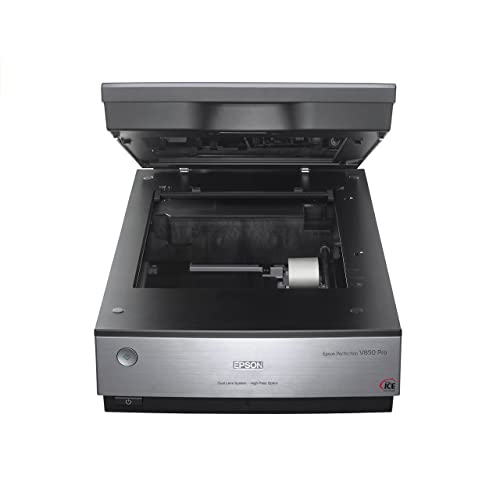
3. Epson Perfection V850 Pro — Best Flatbed Scanner for Multi-Format and Medium Format Film
The Epson Perfection V850 Pro is the gold standard for flatbed film scanning in 2026, and it earns that title through a combination of features that no competing flatbed can match. The headline spec is 6400 dpi optical resolution with a 4.0 Dmax — that 4.0 figure is critical, because it means the V850 can capture an extraordinary tonal range from the deepest shadows to the brightest highlights on dense film originals. Most flatbeds top out at 3.4–3.8 Dmax; the V850 goes further, and you see it immediately in the shadow detail of underexposed slides.
The exclusive dual-lens system is not a gimmick. Epson designed the V850 with two separate lenses — one optimized for 35mm film and one for medium format — and the scanner selects the appropriate optic automatically based on your film holder selection. This pays dividends in edge sharpness across the full scan area, something single-lens flatbeds consistently struggle with. You can scan 35mm slides and negatives, medium format film up to 6×22cm, 4×5 large format, and prints all in one device. The included film holders are well-engineered, holding film flat without Newton's rings, which is a persistent problem on cheaper flatbeds.
For photographers who work across multiple film formats — or who want one scanner that handles everything from contact sheets to 4×5 transparencies — the V850 Pro is the clear answer. It is also the best tool for digitizing medium and large format photographic film outside of dedicated drum scanners. The price is substantial, but for a working photographer archiving decades of mixed-format work, it's the last scanner you'll ever need to buy.
Pros:
- 4.0 Dmax — highest tonal range of any flatbed on this list
- Dual-lens system optimized separately for 35mm and medium format
- Handles 35mm, 120, 4×5, and prints in one device
- Bundled SilverFast Ai Studio and Epson Scan software
- Excellent film holders — flat scanning with no Newton's rings
Cons:
- Highest price point on this list by a significant margin
- Slower scan times than dedicated film scanners at equivalent quality
- Large desktop footprint
4. Epson Perfection V600 Photo — Best Versatile Flatbed for Home Users
If the V850 Pro is overkill for your needs — and for most home users, it is — the Epson Perfection V600 delivers genuinely impressive results at a fraction of the cost. With a maximum resolution of 6400 x 9600 dpi, it produces scan files large enough to make enlargements up to 17 x 22 inches, which covers virtually every practical use case for personal photo archiving. The built-in transparency unit handles four 35mm mounted slides or a strip of 12 negatives per batch, and it accommodates medium format film up to 6 x 22cm — a rare feature at this price level.
The ReadyScan LED technology is worth calling out specifically. Unlike older fluorescent-lamp scanners that required a warm-up period before use, the V600's LED light source is ready to scan the moment you open the software. This makes the workflow noticeably more fluid when you're working through a large box of slides, especially since you're not waiting around between batches. Connectivity is Hi-Speed USB 2.0, and the scanner is compatible with both Mac and Windows. The included software handles color restoration for faded prints and color negatives with reasonable accuracy.
The V600 makes the most sense for users who want a single device that handles slides, negatives, prints, and documents without a dedicated film scanner's limitations. It's not as fast or as optically precise as the Plustek dedicated scanners for 35mm work, but its flexibility and lower price make it the right call for families digitizing mixed media collections. Pair it with a good image viewer — our guide to the best Windows photo viewer alternatives can help you find the right software for reviewing your scans — and you have a complete, capable digitizing setup.
Pros:
- Handles 35mm, medium format film, prints, and documents in one device
- 6400 x 9600 dpi maximum resolution — sufficient for large print output
- ReadyScan LED — no warm-up time required
- Scans four mounted slides or 12 negatives per pass
- Competitively priced for a multi-format capable flatbed
Cons:
- Dynamic range (3.4 Dmax) trails the V850 Pro noticeably on dense negatives
- No dual-lens system — edge sharpness on medium format is softer than the V850
5. KODAK Slide N SCAN — Best for Quick Digitizing Without a Computer
Not everyone needs to spend hours in scanning software. If your goal is to quickly convert a box of old slides or negatives into digital files you can share with family — and you want to do it without connecting to a computer — the KODAK Slide N SCAN gets the job done with minimal friction. The 5-inch LCD display with gallery mode lets you preview and browse your scans directly on the device, and the output saves as JPEG directly to an SD card. You can even connect it to a TV via HDMI for a group viewing experience, which makes it uniquely suited for family gatherings centered around old photo memories.
The Slide N SCAN supports 135, 126, and 110 film formats as well as 50mm slides, which covers the vast majority of consumer film from the mid-20th century. The quick-feeding tray system allows continuous loading, so you can work through a collection without constantly stopping to reload. At 22 megapixels, the output resolution is adequate for screen viewing and social media sharing, and it produces reasonable prints at standard sizes. This is not a scanner for archival work or large-format printing — but that's not what it's designed for.
The honest trade-off here is image quality versus convenience. The Slide N SCAN's color rendition and sharpness don't approach what the Plustek or Epson dedicated scanners produce. You'll see more color cast, less shadow detail, and softer edges at equivalent zoom levels. But if the alternative is a box of slides that never gets digitized at all, this scanner delivers real value. It's the right tool for casual users who prioritize speed and simplicity over perfection.
Pros:
- Large 5-inch LCD — preview and browse without a computer
- Saves directly to SD card as JPEG
- HDMI output for TV viewing
- Supports 135, 126, 110 film and 50mm slides
- Quick-feeding tray for continuous loading
Cons:
- Image quality significantly lower than dedicated or flatbed film scanners
- Color accuracy and shadow detail are limited compared to optical scan solutions
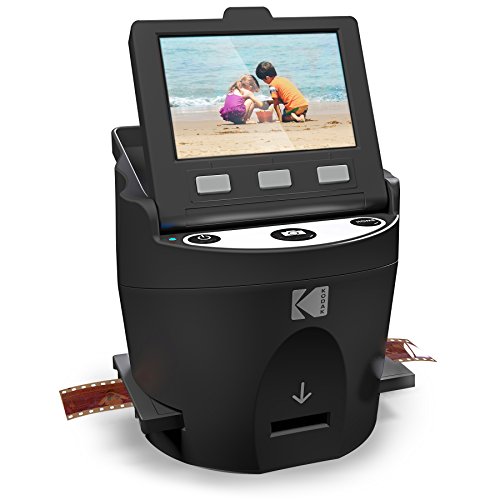
6. Kodak SCANZA — Best for Multi-Format Convenience on a Budget
The Kodak SCANZA takes the standalone digitizer concept and adds the broadest format compatibility on this list. It handles 35mm, 126, 110, Super 8, and 8mm film — covering not just slides and standard negatives but also movie film formats that none of the other scanners here can touch. If you're dealing with a mixed collection of decades-old film types, that format versatility alone may make the decision for you. Kodak includes adapters for each format in the box, so you're not sourcing accessories separately.
The 3.5-inch TFT LCD display with adjustable brightness and tilt makes the scanning interface comfortable to use, and the large one-touch scan button keeps the process simple. Output is saved as JPEG at 14 or 22 megapixels depending on mode. Like the Slide N SCAN, this is a standalone device — no computer required — which is a meaningful feature for users who want a frictionless, accessible scanning experience. The HDMI and USB outputs give you options for viewing and file transfer.
The same quality caveat applies here as with all standalone digitizers: the SCANZA produces JPEGs that are suitable for digital sharing and screen viewing, but don't expect archival-quality output or large-format print resolution. Color reproduction is decent for a device in this category, but it falls short of even the entry-level Plustek dedicated scanner for 35mm work. Where the SCANZA genuinely wins is format breadth — it's the only device here that handles Super 8 and 8mm movie film, making it irreplaceable for users who have both still and cine film to digitize.
Pros:
- Broadest format support: 35mm, 126, 110, Super 8, and 8mm
- All adapters and inserts included in the box
- Standalone operation — no computer needed
- 3.5-inch tiltable TFT display with adjustable brightness
- Simple one-touch scan and save operation
Cons:
- Image quality is the weakest of the dedicated film scanners here
- Will NOT convert film formats outside the supported list (stated explicitly by Kodak)
7. Magnasonic All-in-One FS71 — Best All-in-One Budget Pick with Built-in Memory
The Magnasonic FS71 carves out a distinctive position in the budget digitizer category with one feature that its direct competitors lack: 128MB of built-in internal memory. You can start scanning immediately without an SD card, which sounds like a small thing until you're rummaging through a drawer looking for one while a box of slides sits waiting. The FS71 supports 35mm, 110, 126, and Super 8 film negatives as well as 135, 126, and 110 slides, and it outputs at 24 megapixels — the highest nominal resolution among the standalone digitizers on this list.
The 5-inch LCD screen is genuinely large and clear, giving you a comfortable preview experience on the device itself. The HDMI output lets you push the display to a television, which is ideal for group viewings. For storage, the FS71 accepts SD cards up to 128GB, giving you essentially unlimited capacity for large collections. The build feels solid for a budget device, and the film loading trays are straightforward to use without a manual after the first few tries.
Image quality sits in the same tier as the KODAK Slide N SCAN — competent for digital sharing and casual use, but not a replacement for a dedicated film scanner when archival quality matters. The 24MP figure is an interpolated output resolution rather than a true optical measurement, so don't compare it directly to the 7200 dpi specs of the Plustek scanners. What the FS71 offers is a complete, convenient package at an accessible price point, with no additional purchases required to get started. For users who want to digitize a lifetime of family memories without complexity or major expense, it delivers.
Pros:
- Built-in 128MB memory — start scanning without an SD card
- 24MP output — highest nominal resolution among budget standalone digitizers here
- 5-inch LCD display and HDMI output for flexible viewing
- SD card support up to 128GB for large collections
- Supports multiple film and slide formats out of the box
Cons:
- Optical quality does not match the megapixel marketing figure
- Color accuracy and detail trail dedicated film scanners at all price points
Choosing the Right Slide Scanner: A Buying Guide
Before you spend a dollar on any slide scanner, you need to answer four questions honestly. What film formats do you have? How many images are you scanning? What will you do with the scans? And how much of your time are you willing to invest in the process? Your answers to those questions determine everything — including whether a $100 standalone digitizer or a $1,000 professional flatbed is the smarter purchase for you specifically.
Resolution and Dynamic Range: The Two Numbers That Actually Matter
Scanner manufacturers advertise resolution in dpi (dots per inch) and dynamic range in Dmax. Both numbers matter, but they measure different things. Resolution determines how much fine detail you capture — a 7200 dpi dedicated film scanner resolves individual film grain on 35mm, while a 22MP standalone digitizer captures the broad strokes. Dynamic range (Dmax) determines how much tonal information the scanner can distinguish between pure black and pure white.
For slide scanning specifically, dynamic range is often more important than raw resolution. Slides are dense — they hold more tonal information than prints — and a scanner with a low Dmax will clip highlight and shadow detail no matter how high its resolution. The Epson V850 Pro's 4.0 Dmax is exceptional. The Epson V600 sits at around 3.4 Dmax, which is adequate for most work. Standalone digitizers typically don't publish their Dmax figures because those numbers would be unflattering.
A practical rule: if you're planning to make prints larger than 8 x 10 inches or need archival-quality digital files, choose a scanner rated at 7200 dpi (Plustek) or 6400 dpi with high Dmax (Epson). For digital sharing, social media, and standard-size prints, a 22–24MP standalone digitizer is sufficient.
Film Format Compatibility: Know What You're Scanning
This is the first filter to apply. If you only have 35mm slides and negatives, the dedicated Plustek scanners offer the best optical quality for that specific format. If you have a mixed collection — 35mm, 110, 126, medium format, or Super 8 movie film — you need either a capable flatbed (Epson V600 or V850) or a multi-format standalone digitizer (Kodak SCANZA or Magnasonic FS71).
Medium format film (120/220 roll film, 4×5 sheet film) requires a flatbed scanner. No dedicated 35mm film scanner handles it. The Epson V850 Pro is the superior choice here; the V600 handles medium format but with softer edge sharpness due to its single-lens design. If you have any cine film — Super 8 or 8mm — only the SCANZA on this list can handle those formats without additional conversion equipment.
Dedicated Film Scanner vs. Flatbed vs. Standalone Digitizer
These are genuinely different categories with different strengths. Dedicated film scanners (Plustek 8200i SE and 8100) use precision optics designed exclusively for film, delivering the sharpest 35mm scans available at their price points. They're slower and limited to 35mm, but for that format, nothing in this price range beats them optically.
Flatbed scanners (Epson V600, V850 Pro) handle multiple media types on a single glass platen. They're more versatile and can handle prints and documents alongside film, but their optical path is a compromise — optimized for multiple uses rather than one. They're excellent choices for mixed-media collections or medium format work.
Standalone digitizers (KODAK Slide N SCAN, Kodak SCANZA, Magnasonic FS71) prioritize convenience over quality. They work without a computer, save directly to SD card, and have minimal setup. Image quality is the trade-off — but for digitizing memories you want to share on a screen, they're genuinely good enough. Think of them the way you'd think of any other output device: the right tool for the right job.
Software Matters More Than You Think
The bundled software is a real part of the value equation, especially for dedicated film scanners. SilverFast SE Plus 9 (bundled with the Plustek 8200i SE) is a professional scanning and color management suite that typically costs extra if purchased separately. It supports multi-exposure scanning, accurate ICC color profiles for specific film stocks, and fine-grained control over every aspect of the scan. SilverFast SE Plus 8 (bundled with the 8100) is the previous generation but still highly capable.
Epson's bundled software is easier to learn than SilverFast but less powerful. For casual users and home archivists, Epson Scan 2 is genuinely sufficient. For photographers who care about color accuracy and want to match the look of specific film stocks, SilverFast is worth the time investment. After digitizing, you'll also want a strong image management solution — our guide to the best Windows photo viewer alternatives covers the top options for reviewing and organizing large scan libraries in 2026.
Common Questions
What is the best slide scanner for home use in 2026?
For most home users, the Epson Perfection V600 is the best all-around slide scanner. It handles 35mm slides, negatives, medium format film, prints, and documents at up to 6400 x 9600 dpi — high enough for large prints — without the professional price tag of the V850 Pro. If you only have 35mm film and want sharper dedicated output, the Plustek OpticFilm 8100 is the better optical choice for that specific format.
How many dpi do I need to scan slides?
For archival-quality digital files that can produce prints at 8 x 10 inches or larger, you need at least 2400 dpi for 35mm slides. For 20 x 24-inch prints or larger, you want 4000 dpi or higher. The Plustek scanners at 7200 dpi and Epson flatbeds at 6400 dpi both exceed any practical archival requirement. Standalone digitizers at 22–24MP are adequate for digital sharing and standard photo prints but fall short for large-format output.
Do I need a computer to use a slide scanner?
It depends on the scanner type. Dedicated film scanners (Plustek) and flatbed scanners (Epson) require a computer with compatible scanning software. Standalone digitizers like the KODAK Slide N SCAN, Kodak SCANZA, and Magnasonic FS71 operate completely independently — they have built-in displays, save directly to SD cards, and don't require any software installation. If computer-free operation is important to you, any of the three standalone models on this list will work.
What is the difference between a dedicated film scanner and a flatbed scanner?
A dedicated film scanner uses optics designed exclusively for scanning transparent film at high magnification, delivering sharper results for that specific format. A flatbed scanner has a larger glass platen and handles multiple media types — film, prints, documents — but uses a single optical path optimized as a compromise across all of them. Dedicated scanners win on sharpness and color accuracy for 35mm film; flatbeds win on format versatility and the ability to scan medium format film and prints in the same device.
Can I scan Super 8 movie film with a slide scanner?
Most slide scanners cannot handle Super 8 or 8mm movie film. Of the models reviewed here, only the Kodak SCANZA includes adapters for Super 8 and 8mm cine film formats. If you have movie film in your collection alongside still film, the SCANZA is your only single-device option from this list. Alternatively, dedicated cine film scanners or professional digitizing services handle movie film at higher quality than the SCANZA's consumer-level output.
How do I clean slides before scanning?
Start by handling slides only by the edges or mount — fingerprints on the emulsion are difficult to remove digitally. Use a soft rocket blower to remove surface dust before inserting the slide into the scanner. For mounted slides, a soft anti-static brush works well for frames and glass mounts. Avoid alcohol or liquid cleaners on the film emulsion itself unless you know what you're doing. If your film has significant dust and scratch damage, the Plustek OpticFilm 8200i SE's infrared iSRD channel removes defects automatically during scanning without any physical cleaning — it's the most effective solution for heavily damaged film.
Buy on Walmart
- Plustek OpticFilm 8200i SE , 35mm Film & Slide Scanner. 7200 — Walmart Link
- Plustek OpticFilm 8100-35mm Negative Film/Slide Scanner with — Walmart Link
- Epson Perfection V850 Pro scanner — Walmart Link
- Epson Perfection V600 Photo Wired USB Connectivity Color Sca — Walmart Link
- KODAK Slide N SCAN Film & Slide Scanner Digitizer with 5” LC — Walmart Link
- Kodak SCANZA Digital Film & Slide Scanner – Converts 35mm, 1 — Walmart Link
- Magnasonic All-in-One 24MP Film Scanner with Large 5" Displa — Walmart Link
Buy on eBay
- Plustek OpticFilm 8200i SE , 35mm Film & Slide Scanner. 7200 — eBay Link
- Plustek OpticFilm 8100-35mm Negative Film/Slide Scanner with — eBay Link
- Epson Perfection V850 Pro scanner — eBay Link
- Epson Perfection V600 Photo Wired USB Connectivity Color Sca — eBay Link
- KODAK Slide N SCAN Film & Slide Scanner Digitizer with 5” LC — eBay Link
- Kodak SCANZA Digital Film & Slide Scanner – Converts 35mm, 1 — eBay Link
- Magnasonic All-in-One 24MP Film Scanner with Large 5" Displa — eBay Link
The best slide scanner is the one you'll actually use — but if you're scanning anything you care about keeping, invest in real optical quality and buy it once.
 |  |  |  |
About Rachel Kim
Rachel Kim spent five years as a merchandise buyer for a national office supply retail chain, evaluating printers, scanners, and printing accessories from Canon, Epson, HP, Brother, Dymo, and Zebra before approving them for store inventory. Her buying process involved hands-on testing against competing models, reviewing long-term reliability data from vendor reports, and vetting price-to-performance claims that manufacturers routinely overstated. That structured evaluation experience translates directly into the kind of buying guidance that cuts through marketing language and focuses on what actually matters for a specific use case. At PrintablePress, she covers printer and printing equipment reviews, buying guides, and head-to-head product comparisons.


Get some FREE Gifts. Or latest free printing books here.
Disable Ad block to reveal all the secret. Once done, hit a button below
| | | |