Reviews ›
Top 10 Best PETG Filaments for 3D Printing
by Rachel Kim · March 27, 2022
Which PETG filament is actually worth your money in 2026? There's no shortage of options on Amazon, but not all of them print clean, hold tight tolerances, or survive real-world conditions. After testing and researching the top contenders, one filament keeps rising to the top: the Prusament PETG Jet Black. It offers the tightest tolerance of the group at ±0.02 mm and delivers the kind of layer adhesion that functional parts demand. But it's not the right pick for everyone — so read on before you click buy.

PETG — short for polyethylene terephthalate glycol — sits in a sweet spot between the brittle simplicity of PLA and the temperamental strength of ABS. It's tougher than PLA, far easier to print than ABS, and naturally resistant to moisture and mild chemicals. That combination makes it the go-to material for functional parts: brackets, enclosures, tool holders, outdoor fixtures, and anything that needs to survive more than a week on a desk. If you're also exploring complementary maker tools, check out our roundup of the best laser engraving machines — pairing a laser engraver with a solid PETG setup opens up serious fabrication possibilities.
This guide covers seven of the best PETG filaments available right now, from budget-friendly spools to glass-fiber-reinforced engineering options. Whether you're running a Bambu Lab, Prusa MK4, Creality Ender, or any other FDM machine, you'll find a filament here that fits your printer, your workflow, and your budget. Browse more of our top picks across the making and printing space over at our product reviews hub.
Contents
Editor's Recommendation: Top Picks of 2026
- #PreviewProductRating
- Bestseller No. 1
 Rating:

- Bestseller No. 2
 Rating:
 - Bestseller No. 3
 Rating:
 - Bestseller No. 4
 Rating:
 - Bestseller No. 5
 Rating:
 - Bestseller No. 6
 Rating:
 - Bestseller No. 7
 Rating:
Product Reviews
1. HATCHBOX PETG 3D Printer Filament — Best for Beginners & Everyday Prints
HATCHBOX has been one of the most trusted names in desktop 3D printing for years, and their PETG filament is a big reason why. This 1.75 mm black spool delivers a dimensional accuracy of ±0.03 mm — tight enough for the vast majority of hobby and light-functional prints. The recommended extrusion temperature runs from 230°C to 260°C, which sits comfortably within the range of nearly every FDM printer on the market. You won't need to fight with exotic settings to get this filament to cooperate.
What makes HATCHBOX PETG genuinely compelling for beginners is how forgiving it is. PETG has a reputation for being slightly finicky — prone to stringing and oozing if your retraction settings aren't dialed in — but HATCHBOX's consistency minimizes those headaches. It extrudes cleanly, bonds between layers reliably, and produces parts that are both flexible under stress and highly impact resistant. You're not going to shatter a HATCHBOX PETG print by dropping it. The material is also odorless during printing, which matters if your printer is in a living space rather than a dedicated workshop.
The filament is available in a solid range of colors and even a transparent variant, so you're not stuck with just black. For seasoned users, the consistent purity of the filament means you can push retraction, speed, and temperature tuning without worrying about batch-to-batch variation causing unexpected failures. This is the spool you hand to someone who just unboxed their first 3D printer — and it's also the spool you keep loaded for workhorse prints when you don't want any surprises.
Pros:
- Consistent diameter with ±0.03 mm tolerance — reliable for everyday prints
- Odorless during printing, great for indoor use
- Wide temperature range accommodates virtually any FDM printer
- Very beginner-friendly with minimal stringing out of the box
Cons:
- Tolerance is slightly looser than premium competitors at ±0.03 mm vs. ±0.02 mm
- Not ideal for high-speed printing setups above 150mm/s
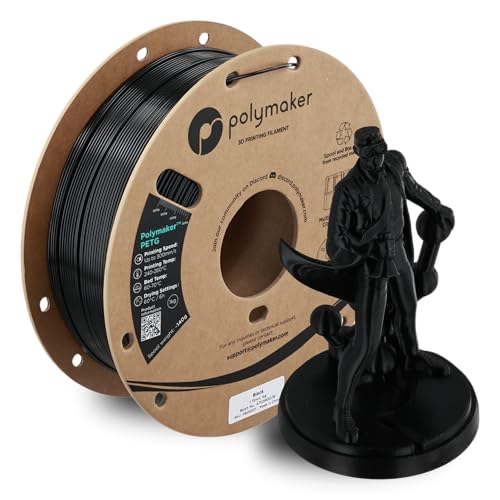
2. Polymaker PETG Black — Best for High-Speed Printing
Polymaker's new-generation PETG is built for a different era of 3D printing. With high-speed printers like the Bambu Lab X1C, Prusa MK4, and various Voron builds now capable of printing at 300 mm/s and beyond, most legacy PETG formulations simply can't keep up. They under-extrude, skip layers, or produce weak interlayer bonds at speed. Polymaker's updated formula is specifically engineered to handle the thermal and flow demands of high-velocity printing — up to 300 mm/s — without sacrificing the mechanical properties you expect from PETG.
The enhanced interlayer bonding formula is the real standout here. At high speeds, the material needs to fuse quickly and completely — any hesitation in adhesion shows up as delamination under stress. Polymaker's new PETG resists both cracking and delamination even when you're pushing the printer hard. It also prints warp-free, which means you don't need an enclosure to get reliable results. The heat resistance spec comes in at 80°C — solid for most functional applications, though you won't want to leave it in a hot car in July.
This is Polymaker's successor to the long-popular PolyLite PETG, and it's a meaningful upgrade. The surface finish is smooth, the color is rich and consistent, and it's fully compatible with multi-material systems like Bambu's AMS. If you've invested in a fast printer and you're still running older filament stock, you're leaving real performance on the table. Polymaker PETG is the upgrade that makes high-speed printing actually deliver on its promise.
Pros:
- Designed for up to 300 mm/s — perfect for fast printers
- Excellent interlayer adhesion even at high speeds
- Warp-free printing without requiring an enclosure
- Compatible with AMS and multi-material systems
Cons:
- Overkill if you're printing at standard speeds on a budget machine
- 80°C heat resistance is decent but not class-leading
3. Prusament PETG Jet Black — Best Premium Option
Prusament is Prusa Research's in-house filament brand, and they treat it with the same obsessive quality control they apply to their printers. The tolerance on this spool is ±0.02 mm — that's the tightest of any standard PETG on this list, and it's not just a marketing number. Prusament spools are individually measured and the data is published online. You can look up your specific spool and see the actual diameter readings taken throughout production. That level of transparency is unheard of in the filament industry, and it reflects a genuine commitment to consistency that matters when you're printing critical parts.
Functionally, Prusament PETG excels at exactly the things PETG is supposed to do. Mechanical parts, brackets, clamps, tool holders, enclosures — this filament handles all of them with excellent layer adhesion and strong impact resistance. The low shrinkage characteristic of PETG is particularly well-managed here, making it an excellent choice for larger prints where dimensional accuracy across the full build matters. You won't see the warping or corner-lifting that plagues ABS in large-format prints. Low stringing is another strong point — you'll spend less time post-processing and more time using your parts.
The premium price is real, and it's the honest trade-off you make for Prusament. If you're printing decorative objects or non-critical prototypes, you probably don't need this level of precision. But if you're printing functional components — anything that interfaces with other parts, handles mechanical load, or needs consistent wall thickness — Prusament PETG is simply the most reliable choice on the market in 2026. This is our top pick overall, and it deserves that position.
Pros:
- Tightest dimensional tolerance on this list at ±0.02 mm
- Per-spool quality data published online — full transparency
- Outstanding layer adhesion for functional and mechanical parts
- Low shrinkage enables large, warp-free prints
- Minimal stringing reduces post-processing time
Cons:
- Higher price per kg than most competitors
- Premium specs are wasted on non-critical decorative prints
4. eSUN PETG Filament 1.75mm — Best Budget Pick
eSUN is one of the most established budget filament manufacturers in the world, and their PETG delivers a solid experience at a price that's hard to argue with. The dimensional accuracy spec here is ±0.05 mm, which is the loosest of the group — but in practice, eSUN's production consistency is better than that number suggests. The real-world performance on most printers is smooth, with good layer bonding, minimal stringing, and a glossy surface finish that gives prints a polished look without any post-processing.
The filament checks every core PETG box: waterproof, chemically resistant, UV-stable, flexible without being floppy, and tough enough to take an impact without shattering. The spool itself is wound well — eSUN specifies a total length of 350–355 meters per kilogram, and the winding quality prevents tangles and overlapping that can cause mid-print feed failures. The filament melts smoothly, feeds through the extruder consistently, and doesn't clog the nozzle — which is honestly the minimum bar for any filament, but not every budget option clears it reliably.
If you're getting into PETG for the first time and don't want to spend premium pricing while you're still dialing in your settings, eSUN is the smart starting point. It's also a solid workhorse spool for high-volume printing where cost per kilogram matters more than sub-millimeter precision. Just know that you're trading some dimensional consistency for the lower price — for functional parts where tolerances are critical, step up to Prusament or OVERTURE. For everything else, eSUN absolutely holds its own. If you're a small shop printing labels or components to complement your physical products, also check out our picks for the best barcode printers — they pair well with a reliable PETG workflow.
Pros:
- Competitive price per kilogram — excellent for high-volume printing
- Good layer bonding and clean surface finish
- Tangle-free spool with well-managed winding
- Solid chemical, water, and UV resistance
Cons:
- Looser tolerance spec at ±0.05 mm compared to premium options
- Not suited for tight-tolerance functional assemblies
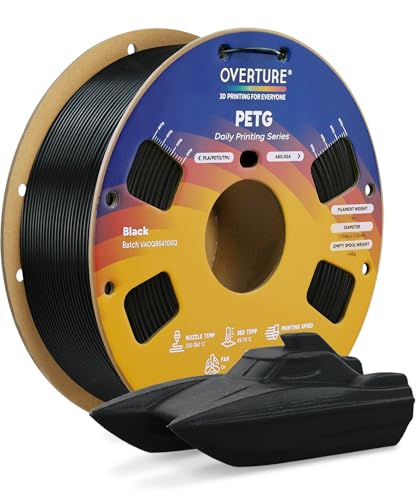
5. OVERTURE PETG 3D Printer Filament 1.75mm — Best Overall Value
OVERTURE hits a precision tier that you don't usually find at mid-range prices: ±0.02 mm dimensional accuracy, matching Prusament without the premium cost. That puts OVERTURE in a genuinely competitive position — you get near-premium tolerance in a spool that's priced for regular use. For anyone running functional parts regularly and watching their material budget, this is the filament that makes sense. The company's positioning — stronger than PLA, easier than ABS — is accurate and not just marketing copy.
The real-world printing experience with OVERTURE PETG is dependable. It handles heat and moisture well, layers bond solidly, and the low-shrinkage formulation keeps larger prints flat and true. Impact strength is a genuine strong suit — these prints take abuse. Outdoor applications work well thanks to the chemical and UV stability inherent to PETG chemistry. The precision-wound spool is a detail worth mentioning: sloppy winding causes feed irregularities and mid-print tangles, and OVERTURE has genuinely solved this problem. You get smooth, uninterrupted filament delivery from the first layer to the last.
If you're torn between OVERTURE and Prusament, here's the honest take: for most users printing most things, you won't feel a meaningful difference in the final part. Prusament's per-spool quality documentation gives engineers and professionals an extra layer of confidence, but OVERTURE's consistency in practice is excellent. Buy OVERTURE when you want precision at a reasonable price. Buy Prusament when the application is critical and the cost premium is justified by the stakes. For everyone in between, OVERTURE is the best value pick on this list.
Pros:
- ±0.02 mm tolerance matches premium filaments at a lower price
- Excellent layer adhesion and impact resistance for functional parts
- Precision-wound spool eliminates tangles and feed failures
- Suitable for outdoor, moisture-exposed, and load-bearing applications
Cons:
- No per-spool quality documentation like Prusament offers
- Color selection smaller than some competitors
6. iSANMATE 16KG PETG Filament Bundle — Best Color Variety
The iSANMATE 16KG bundle is a different kind of buy. You're not just getting one spool — you're getting 16 spools across 16 colors, covering everything from black, white, and gray through red, green, yellow, orange, blue, beige, army green, dark blue, brown, transparent, pink, purple, and sky blue. That's a full spectrum in a single purchase. For makers who want to keep a range of colors on hand without ordering individual spools repeatedly, this bundle is a genuinely efficient solution, especially for studios, schools, or anyone running a high-output print operation in 2026.
The dimensional accuracy comes in at ±0.02 mm — the same tight spec as OVERTURE and Prusament — which is impressive for a bulk value bundle. Recommended printing settings are nozzle temperature 240–260°C, bed temperature 70–80°C, and speeds from 30 to 300 mm/s, giving you plenty of flexibility across different printer configurations. PETG's inherent UV resistance and water resistance make these spools solid choices for outdoor applications: planters, bird feeders, automotive parts, outdoor fixtures, and toys that need to handle sun exposure and occasional drops.
The trade-off with any large bundle is consistency across individual spools. iSANMATE's specs look solid on paper, and the reviews are generally positive, but you're placing more trust in a newer brand than you would with Prusament or HATCHBOX. If any individual spool is problematic, you deal with it spool by spool. That said, at the price per kilogram when you factor in the bundle, this is a compelling deal for color-forward makers. Just make sure you have the storage space — 16 one-kilogram spools take up real shelf real estate. If you're also invested in other craft machines to complement your 3D printing setup, our guide to the best Silhouette machines is worth a read.
Pros:
- 16 colors in a single purchase — comprehensive color coverage
- ±0.02 mm tolerance spec competitive with premium single spools
- Supports speeds up to 300 mm/s for fast printers
- Excellent weather and UV resistance for outdoor prints
Cons:
- Consistency across all 16 spools is harder to guarantee than with a single-brand spool
- Requires significant storage space for 16 spools
- Less brand track record than established players like Prusament or HATCHBOX
7. ELEGOO Glass Fiber PETG Filament 1.75mm — Best for Engineering Parts
ELEGOO's Glass Fiber PETG (PETG-GF) is a specialty material, and it's worth being clear about who it's for. Regular PETG is flexible under stress — that's part of its appeal. But flexibility is also a limitation when you need stiff, rigid components that hold their shape under sustained mechanical load. Glass fiber reinforcement changes the equation. PETG-GF is significantly stiffer than standard PETG, offers excellent creep resistance for long-term load-bearing parts, and maintains the core chemical and thermal properties that make PETG worth using in the first place.
The electrical insulation performance is a standout feature for electronics enclosures, switchboxes, terminal covers, and any housing where consistent non-conductivity matters. PETG-GF delivers reliable insulation properties without requiring post-processing. The surface finish is another genuine differentiator: the added glass fibers produce a premium matte appearance with less visible layer lines than you'd get from standard PETG. If aesthetics matter alongside function — and they often do in professional contexts — PETG-GF gives you a cleaner look without sanding. The 0.5 kg spool size makes this an accessible entry point for trying the material without committing to a full kilogram.
The practical considerations are important: glass fiber is abrasive. You will wear through brass nozzles faster than with standard filament. A hardened steel nozzle (0.4 mm or larger) is not optional — it's required if you want consistent results and don't want to replace your nozzle every few prints. The filament also tends to be less forgiving on retraction settings. Get your slicer profile dialed in on a small test print before you commit to a large job. Done right, the results are excellent — rigid, professional-looking parts that outperform standard PETG in load-bearing scenarios.
Pros:
- Glass fiber reinforcement provides superior stiffness versus standard PETG
- Excellent creep resistance for sustained load-bearing applications
- Strong electrical insulation for electronics housings and components
- Premium matte finish with reduced visible layer lines
- 0.5 kg spool is a low-commitment entry point for the material
Cons:
- Abrasive to brass nozzles — requires a hardened steel nozzle
- Less forgiving on retraction settings; requires slicer tuning
- 0.5 kg spool means more frequent reorders for high-volume users
What to Look For When Buying PETG Filament
Dimensional Tolerance: The Number That Actually Matters
Tolerance is the single most important spec on a filament spool, and most buyers overlook it completely. Dimensional tolerance tells you how much the filament diameter varies from its stated size across the length of the spool. A ±0.02 mm tolerance means the filament stays very close to 1.75 mm throughout — your extruder sees consistent pressure, your flow rate stays predictable, and your prints come out dimensionally accurate. A ±0.05 mm tolerance introduces more variability, which shows up as inconsistent extrusion, under-fill, or over-fill in layers.
For casual printing — decorative items, figurines, non-critical enclosures — the difference between ±0.02 mm and ±0.05 mm is barely visible. For functional parts — gears, brackets, mating assemblies, anything with specified clearances — it's the difference between a part that fits and one that doesn't. If you're printing functional components, don't compromise on tolerance. Prusament and OVERTURE both hit ±0.02 mm; HATCHBOX delivers ±0.03 mm; eSUN comes in at ±0.05 mm. Know what you're printing before you pick your spool.
Printing Temperature and Printer Compatibility
PETG generally prints at nozzle temperatures between 230°C and 260°C, with a bed temperature of 70–80°C. That's higher than PLA but lower than ABS, which keeps it accessible to most printers without requiring an all-metal hotend. That said, the specific recommended range varies by brand and formulation. HATCHBOX runs 230–260°C; iSANMATE recommends 240–260°C. These ranges overlap enough that a single slicer profile typically works across brands with minor tweaks.
Where it gets more complicated is with high-speed formulations like Polymaker PETG, which can run up to 300 mm/s but requires a hotend capable of maintaining temperature at that flow rate. If you're on an older Bowden extruder setup at standard speeds, this distinction won't matter to you. But if you're on a Bambu Lab, Prusa MK4S, or a CoreXY machine pushing speed, choosing a filament rated for high-speed printing makes a measurable difference in layer adhesion quality at those velocities.
Spool Quality and Wind Consistency
A great filament on a poorly wound spool is a frustrating experience. Loose winding allows tangles to develop mid-print — the filament crosses over itself, binds, and the extruder loses its grip. You come back to a print that stopped hours in with a blob of plastic at the failure point. Quality spool winding means the filament lays in consistent, non-overlapping layers from the outside to the hub. OVERTURE and HATCHBOX are both specifically noted for their winding quality. eSUN documents their spool length (350–355 meters) and winding consistency. These details aren't accidental — they reflect manufacturing discipline.
Also consider whether the spool material itself is moisture-resistant or comes with a resealable bag. PETG is less hygroscopic than nylon, but it does absorb moisture over time in humid environments. Wet filament produces bubbling, popping sounds during printing, and significantly weaker layer adhesion. Store your PETG with desiccant if you're not printing from it immediately.
Specialty Variants: When Standard PETG Isn't Enough
Standard PETG covers the vast majority of use cases. But if your application demands more, specialty PETG variants exist for a reason. Glass fiber PETG (like the ELEGOO PETG-GF) delivers stiffness and creep resistance that standard PETG can't match — critical for sustained load-bearing parts. Carbon fiber PETG (not covered in this roundup but worth knowing about) pushes stiffness even further at the cost of brittleness and significant nozzle abrasion. High-speed PETG formulations, like Polymaker's updated formula, are engineered for fast printers that standard materials can't feed cleanly at speed.
The rule is simple: use standard PETG until your application gives you a specific reason not to. When a part fails because it creeps under load, is too flexible, or delaminates at high print speeds — that's when you step up to a specialty variant. Don't over-engineer your material selection if a solid standard PETG will do the job.
Frequently Asked Questions
Is PETG better than PLA for functional parts?
For most functional applications, yes. PETG is tougher, more impact-resistant, and more heat-tolerant than PLA. It's also waterproof and more chemically resistant. PLA is easier to print and produces slightly sharper details, but it becomes brittle at relatively low temperatures and will deform in a hot car or direct sunlight. If you're printing anything that needs to survive real-world conditions — mechanical stress, moisture, temperature swings — PETG is the better choice.
Do I need an enclosure to print PETG?
Generally, no. Unlike ABS, PETG has low enough shrinkage that it prints reliably without an enclosure on most printers. Warping is rare with proper bed adhesion. However, if you're printing very large objects or working in a cold, drafty environment, an enclosure helps maintain temperature stability and improve layer adhesion. High-speed PETG formulations like Polymaker's are specifically formulated to print warp-free without an enclosure.
Why does my PETG print string so much?
Stringing in PETG is usually caused by too-high printing temperature, insufficient retraction, or too-slow travel speed. Start by lowering your nozzle temperature by 5°C increments. Increase retraction distance slightly (2–5 mm for Bowden setups, 0.5–2 mm for direct drive). Raise travel speed if your machine allows it. Also make sure your filament is dry — moisture-loaded PETG strings more aggressively than properly stored filament. Each brand prints slightly differently, so dialing in a calibration tower before your main print saves time.
What bed surface works best with PETG?
PEI (polyetherimide) spring steel sheets are the most popular choice for PETG — the filament adheres well when the bed is warm and releases cleanly once it cools. Glass beds with a thin layer of glue stick also work reliably. Avoid printing PETG directly onto bare glass without a release agent, as it can bond too aggressively and damage the bed. Textured PEI surfaces give parts a nice matte bottom texture and release even more reliably than smooth PEI. Set your bed temperature between 70–80°C for consistent first-layer adhesion.
Can PETG be used for outdoor applications?
Yes — PETG is one of the better standard filaments for outdoor use. It resists UV degradation better than PLA (which becomes brittle and discolored outdoors within months), handles moisture without degrading, and is chemically resistant to mild solvents and oils. It won't match the UV resistance of ASA or PETG blended with UV stabilizers for extreme long-term outdoor exposure, but for most outdoor applications — planters, fixtures, enclosures, automotive trim — standard PETG performs well. The iSANMATE bundle specifically targets outdoor applications for this reason.
What is the shelf life of PETG filament?
Unopened and stored properly — in a dry, sealed environment with desiccant — PETG filament can last several years without significant degradation. Once opened, exposure to ambient humidity slowly introduces moisture into the filament. In humid climates, an opened spool may need drying after a few weeks. Signs of moisture absorption include popping or crackling sounds during printing, visible steam or bubbling in the extrusion, weaker layer adhesion, and rough surface finish. A filament dryer or an oven at 65°C for 4–6 hours restores most moisture-affected PETG to printable condition.
Buy on Walmart
- HATCHBOX PETG 3D Printer Filament, Dimensional Accuracy +/- — Walmart Link
- Polymaker PETG Black 3D Printer Filament 1.75mm 1kg, High Sp — Walmart Link
- Prusament 3D Printer Premium Filament PETG Jet Black 1.75mm — Walmart Link
- eSUN PETG Filament 1.75mm, 3D Printer Filament PETG, Dimensi — Walmart Link
- OVERTURE PETG 3D Printer Filament 1.75mm, Neatly Wound Durab — Walmart Link
- iSANMATE 16KG PETG Filament Bundle 1.75mm 3D Printer Filamen — Walmart Link
- ELEGOO Glass Fiber PETG Filament 1.75mm Black 0.5KG, PETG-GF — Walmart Link
Buy on eBay
- HATCHBOX PETG 3D Printer Filament, Dimensional Accuracy +/- — eBay Link
- Polymaker PETG Black 3D Printer Filament 1.75mm 1kg, High Sp — eBay Link
- Prusament 3D Printer Premium Filament PETG Jet Black 1.75mm — eBay Link
- eSUN PETG Filament 1.75mm, 3D Printer Filament PETG, Dimensi — eBay Link
- OVERTURE PETG 3D Printer Filament 1.75mm, Neatly Wound Durab — eBay Link
- iSANMATE 16KG PETG Filament Bundle 1.75mm 3D Printer Filamen — eBay Link
- ELEGOO Glass Fiber PETG Filament 1.75mm Black 0.5KG, PETG-GF — eBay Link
Key Takeaways
- Prusament PETG is the top pick overall in 2026 — its ±0.02 mm tolerance, verified per-spool quality data, and exceptional layer adhesion make it the gold standard for functional parts.
- OVERTURE PETG matches Prusament's tolerance spec at a lower price point, making it the best value choice for users who print functional parts regularly without needing per-spool documentation.
- Polymaker PETG is the right call if you're running a high-speed printer at 200–300 mm/s — its updated formula is specifically engineered for fast-printer demands that older PETG formulations can't reliably meet.
- ELEGOO Glass Fiber PETG is the specialty pick for rigid, load-bearing, or electrically insulating components — just budget for a hardened steel nozzle before you start your first spool.
 |  |  |  |
About Rachel Kim
Rachel Kim spent five years as a merchandise buyer for a national office supply retail chain, evaluating printers, scanners, and printing accessories from Canon, Epson, HP, Brother, Dymo, and Zebra before approving them for store inventory. Her buying process involved hands-on testing against competing models, reviewing long-term reliability data from vendor reports, and vetting price-to-performance claims that manufacturers routinely overstated. That structured evaluation experience translates directly into the kind of buying guidance that cuts through marketing language and focuses on what actually matters for a specific use case. At PrintablePress, she covers printer and printing equipment reviews, buying guides, and head-to-head product comparisons.


Get some FREE Gifts. Or latest free printing books here.
Disable Ad block to reveal all the secret. Once done, hit a button below
| | | |