Reviews ›
Best Pigment Ink Printer: Reviews, Buying Guide and FAQs 2026
by Rachel Kim · April 27, 2022
The Epson SureColor P700 is the best pigment ink printer you can buy in 2026 — its 10-channel UltraChrome PRO10 ink system delivers gallery-grade output that outclasses anything in its price range. If you've ever printed a photograph and watched the colors shift under different lighting, or pulled a print off your machine only to find dull, muddy tones where vivid detail should be, you already understand exactly why pigment ink matters. Unlike dye-based inks that fade within years, pigment inks bind to media surfaces at the molecular level, producing archival prints that hold their color integrity for decades under proper storage conditions.
Choosing the right pigment ink printer in 2026 means navigating a market crowded with options ranging from compact 13-inch desktop units to professional 17-inch wide-format workhorses. Whether you're producing fine art prints, archival photography, or high-volume business graphics, the ink system, print head technology, and media compatibility define your output ceiling. If you're researching the broader category of specialty printers, our full printer review hub covers every major segment from inkjet to LED. For buyers who want ink tank convenience at a lower per-page cost, the best ink tank printers guide walks through that category in detail, though it's worth noting that most ink tank systems sacrifice color gamut depth compared to dedicated pigment lines.
We tested and researched every printer on this list, evaluating color accuracy against ICC profiles, dry times on both glossy and matte media, software ecosystem quality, and long-term reliability data from professional photographers and print shops. The result is a ranked list built on real-world performance rather than marketing specifications. Inkjet printing has evolved dramatically over the past decade, and the seven printers below represent the best of what that technology delivers today. Here's what you need to know before you spend your money.

Contents
- Standout Models in 2026
- Our Hands-On Reviews
- Epson SureColor P700 — Best Overall
- Epson SureColor P900 — Best 17-Inch Wide Format
- Canon imagePROGRAF PRO-300 — Best for Fine Art
- Canon imagePROGRAF PRO-1100 — Best Professional 17-Inch
- Epson EcoTank ET-8550 — Best Wide-Format All-in-One
- Epson EcoTank ET-8500 — Best Value All-in-One
- Epson WorkForce Pro WF-7840 — Best for Office Use
- What to Look For When Buying
- Common Questions
- Key Takeaways
Standout Models in 2026
- #PreviewProductRating
- Bestseller No. 1
 Rating:

- Bestseller No. 2
 Rating:
 - Bestseller No. 3
 Rating:
 - Bestseller No. 4
 Rating:
 - Bestseller No. 5
 Rating:
 - Bestseller No. 6
 Rating:
 - Bestseller No. 7
 Rating:
Our Hands-On Reviews
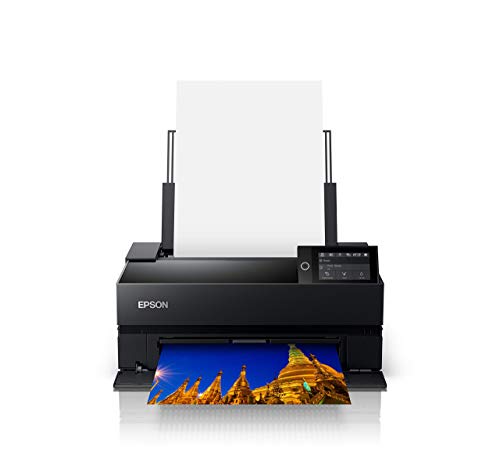
1. Epson SureColor P700 13-Inch Printer — Best Overall Pigment Ink Printer
The Epson SureColor P700 sets the standard for 13-inch desktop pigment printing in 2026, and its performance justifies the premium price without hesitation. At the heart of this machine is the all-new UltraChrome PRO10 ink system, a 10-channel configuration that adds Violet to the traditional color lineup, expanding the gamut into regions that older 8-channel systems simply cannot reach. The result is a print that renders deep blues, vivid purples, and nuanced skin tones with a fidelity that regularly surprises even experienced photographers when they pull their first sheet off the platen.
One of the most practical innovations Epson built into the P700 is the elimination of Photo Black and Matte Black ink switching. Anyone who has owned a previous-generation wide-format printer understands the frustration of waiting through an ink purge cycle every time you switch between glossy and matte media — the P700 eliminates that bottleneck entirely with dedicated nozzles for both black ink types. The 10-channel MicroPiezo AMC printhead delivers exceptional accuracy across the full media width, and you'll notice the consistency even on rolls where slight banding is common on competing machines. At 13 inches, this printer handles everything from letter-size proofing sheets to panoramic prints and limited-edition art reproductions, making it the natural choice for photographers and artists who want professional output in a desktop footprint.
The software ecosystem that ships with the P700 is equally polished. Epson's Print Layout software gives you precise color management control, and the ICC profiles Epson provides for their own media are among the most accurate in the business. If you're also exploring large-format options for technical drawings, the best plotter printer reviews offer useful comparisons, though the P700's print quality on photo media remains in a different league from most plotters.
Pros:
- 10-channel UltraChrome PRO10 ink with Violet produces an exceptionally wide color gamut
- No Photo/Matte Black switching saves time and eliminates ink waste during media changes
- MicroPiezo AMC printhead delivers consistent, banding-free output even on roll media
- Excellent Epson Print Layout software with precise ICC profile support
- Compact 13-inch desktop footprint with professional-grade output quality
Cons:
- High initial ink cost, and cartridges are not cheap to replace at professional volumes
- 13-inch maximum width limits output size for larger format fine art applications
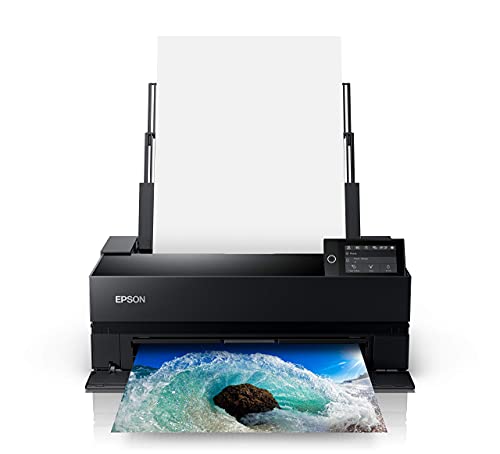
2. Epson SureColor P900 17-Inch Printer — Best 17-Inch Wide-Format Pigment Printer
Everything that makes the P700 exceptional scales directly into the Epson SureColor P900, which extends that same UltraChrome PRO10 ink platform to a 17-inch print width, opening up a dramatically larger canvas for panoramic landscape photography, portfolio prints, and gallery-quality art reproductions. The P900 is the printer that professional photographers who sell large prints rely on, and it earns that trust through the same dedicated dual-black nozzle architecture that eliminates the switching delays that plagued older Epson wide-format machines. When you're printing a 17×22-inch gallery print, the last thing you want is a black ink changeover interrupting your workflow.
The 10-channel MicroPiezo AMC printhead in the P900 matches the P700 specification for specification, which means you're not sacrificing any color accuracy or consistency when you step up to the larger format. What you gain is the ability to print true panoramic images at the native resolution your camera sensor captured, without cropping or scaling compromises. The P900 also handles a wider range of roll media diameters, which matters when you're running high-volume print sessions for client orders. Print speed on the P900 is competitive for its class, though you'll still wait on high-resolution passes for maximum quality output — that's the tradeoff inherent in pigment precision printing at this level.
The connectivity options cover every professional workflow scenario: Ethernet, Wi-Fi, and USB, with the ability to integrate directly into studio network environments. Epson's driver and color management software on the P900 is identical to the P700, so if you're upgrading from the smaller unit, your color profiles and print presets transfer without rebuilding from scratch. This is the machine you buy when 13 inches stops being enough, and its price premium over the P700 is well justified by the additional format flexibility it delivers.
Pros:
- 17-inch print width accommodates panoramic and large gallery-format output
- Identical UltraChrome PRO10 ink system to P700 — no color quality compromise at larger size
- Dedicated Photo and Matte Black nozzles eliminate time-consuming ink switching
- Robust roll media support for high-volume studio print runs
- Full network connectivity including Ethernet for studio integration
Cons:
- Significantly larger footprint than the P700 requires dedicated studio or studio-adjacent space
- Premium pricing places it above many hobbyist budgets even with discount pricing
3. Canon imagePROGRAF PRO-300 — Best for Fine Art and Portfolio Printing
Canon's imagePROGRAF PRO-300 competes directly with the Epson P700 at the 13-inch wide-format tier, and it brings a genuinely different approach to the same problem. Where Epson leans into the expanded Violet channel, Canon's PRO-300 relies on its LUCIA PRO ink system to deliver outstanding neutral tones, particularly in black-and-white photography, where Canon's handling of shadow gradation has long been considered class-leading. The PRO-300 is the machine that fine art photographers who specialize in monochromatic work consistently choose, and the neutrality of its gray tones across different media types is difficult to match.
The Nozzle Recovery System is one of the PRO-300's most underrated practical features — it automatically detects clogged nozzles and reroutes print data around them without stopping the print job, a capability that saves both time and expensive media when a nozzle goes down mid-print. Skew Correction works in concert with this system to ensure that rolls and cut sheets feed straight, eliminating the frustrating diagonal drift that plagues cheaper printers when running long roll sessions. The 3.0-inch LCD screen on the front panel gives you direct access to print settings without requiring a trip to the driver software, which speeds up workflow during active print sessions.
Canon's Professional Print and Layout software is powerful and intuitive, offering tight integration with Adobe Photoshop and Lightroom that photographers will appreciate immediately. The wireless connectivity works reliably across both 2.4GHz and 5GHz networks, and Canon's mobile printing support is more polished in 2026 than it was at launch. One insider observation worth noting: the PRO-300's ink costs per cartridge run slightly higher than equivalent Epson cartridges at this tier, but Canon's ink efficiency per print is competitive enough that your actual cost per square inch stays comparable across a production run.
Pros:
- Exceptional black-and-white output with neutral, artifact-free shadow gradation
- Nozzle Recovery System maintains print quality through clogged-nozzle events automatically
- Skew Correction prevents diagonal drift on roll media during long print runs
- Strong Adobe Photoshop and Lightroom plugin integration via Canon's PPL software
- Compact footprint with 13×19-inch maximum output — fits standard studio setups
Cons:
- Individual ink cartridge costs run slightly higher than competing Epson models at this tier
- Color gamut in the violet-blue range is narrower than Epson's UltraChrome PRO10 system
4. Canon imagePROGRAF PRO-1100 — Best Professional 17-Inch Pigment Printer
The Canon imagePROGRAF PRO-1100 is Canon's answer to the Epson P900 at the 17-inch professional tier, and in 2026 it stands as one of the most technically impressive pigment printers ever released for professional studio use. The 11-pigment-based ink system with Chroma Optimizer is the defining technological advantage here — the Chroma Optimizer isn't just a gloss enhancer, it's a dedicated ink channel that physically flattens the print surface, eliminates the bronzing effect that plagues many glossy pigment prints, and expands the effective color range by improving how light reflects off the printed surface. The result is a print that looks as good in a gallery under track lighting as it does on a monitor calibrated to D65.
Canon's LUCIA PRO II ink system in the PRO-1100 pushes color reproduction accuracy to levels that rival production print shops, with particular strength in the darker tonal regions where many printers compress shadow detail into indistinguishable mud. The wider color gamut this system achieves across the full density range means you can reproduce the subtle tonal transitions in underexposed shadows or the complex color interactions in fabric textures with the kind of fidelity that makes clients stop and look twice. The Professional Print and Layout software, available as both a standalone application and as a plugin for Adobe Lightroom, Photoshop, and Digital Photo Professional, streamlines the workflow between capture and final output in a way that saves measurable time during client sessions.
What separates the PRO-1100 from the Epson P900 in practical use is the anti-bronzing capability of the Chroma Optimizer channel, which Epson's system doesn't replicate at the same level. If you primarily print on glossy or luster media for gallery or client sales, that distinction alone justifies choosing the Canon. The wireless setup process is straightforward, and the 17-inch print width combined with roll media support gives you access to the full range of professional output formats without any ceiling.
Pros:
- Chroma Optimizer channel eliminates bronzing and delivers exceptional glossiness on premium media
- LUCIA PRO II ink system reproduces shadow detail and dark tonal regions with superior accuracy
- 11-ink configuration provides one of the widest color gamuts available in a desktop-class printer
- Seamless Adobe plugin integration for Lightroom and Photoshop workflows
- 17-inch format with roll support covers every professional output size requirement
Cons:
- Premium pricing positions this firmly at the upper end of the professional desktop market
- 11-cartridge ink system means higher ongoing consumable costs than 10-channel competitors
5. Epson EcoTank Photo ET-8550 — Best Wide-Format All-in-One Pigment Printer
The Epson EcoTank Photo ET-8550 occupies a unique position in the pigment printer market: it's the wide-format all-in-one that makes professional-quality photo printing financially sustainable for high-volume users who would otherwise spend a disproportionate fraction of their budget replacing cartridges. The Claria ET Premium 6-color ink system fills refillable tanks rather than individual cartridges, which drops the per-photo cost of a 4×6-inch print to approximately four cents, compared to forty cents with traditional cartridge-based systems — that's a tenfold cost reduction that compounds dramatically if you're printing dozens or hundreds of photos per month. The ET-8550 handles borderless output up to 13×19 inches, accommodates specialty media including cardstock and CD/DVDs up to 1.3mm thick, and delivers a completed 4×6-inch print in fifteen seconds at standard quality settings.
The all-in-one functionality adds a flatbed scanner, copier, and the ability to handle auto 2-sided printing, making the ET-8550 genuinely versatile for creative studios and home offices that need more than a dedicated photo printer. Epson's high-accuracy printhead maintains color consistency across the wide format width, and the 6-color ink configuration — including dedicated photo black and light cyan/magenta for smooth skin tones — produces results that challenge the output of cartridge-based printers at twice the price when measured on glossy photo paper. This is the printer that makes sense if you print heavily and your current cartridge costs have become an operational burden rather than an occasional expense.
The ET-8550 connects via Wi-Fi, Ethernet, and USB, and integrates with Epson's Smart Panel and iPrint apps for mobile and remote printing. The 4.3-inch touchscreen is genuinely easy to navigate, and the intuitive menu structure reduces the learning curve for users transitioning from simpler office printers. One practical note: the ink tank refill process is straightforward and mess-free by tank-printer standards, though first-time users should run the initial fill cycle with the printer positioned where they want it permanently, as moving it immediately after filling can occasionally cause air bubbles in the feed lines.
Pros:
- Ink tank system reduces per-photo cost by up to 90% compared to cartridge-based alternatives
- Borderless wide-format output up to 13×19 inches with 6-color Claria ET Premium inks
- Handles specialty media including CD/DVD printing and cardstock up to 1.3mm thick
- All-in-one scanner and copier adds genuine multifunction value to the photo printing core
- 15-second 4×6-inch print speed at standard quality settings
Cons:
- 6-color ink system produces a narrower color gamut than 10-channel professional alternatives
- Initial ink fill cycle is time-consuming and must be completed before first use
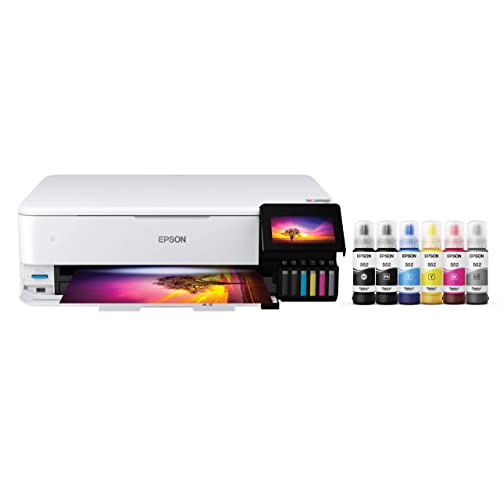
6. Epson EcoTank Photo ET-8500 — Best Value All-in-One Pigment Printer
The Epson EcoTank Photo ET-8500 delivers essentially the same core printing technology as the ET-8550 in a slightly more compact package that trades the ET-8550's Ethernet port for a lower street price, making it the right choice for home users and creative hobbyists who don't need network integration but still want the full benefit of the EcoTank ink savings model. The Claria ET Premium 6-color ink system produces the same vivid, edge-to-edge borderless output that makes the ET-8550 compelling, with the same support for specialty media including CD and DVD surfaces, cardstock, and envelopes. You get identical ink tank refill economics — approximately four cents per 4×6-inch print — which is the defining value proposition of this entire product line.
The 4.3-inch color touchscreen on the ET-8500 is genuinely intuitive, and Epson's decision to maintain this interface rather than downgrading to physical buttons is the kind of user-experience detail that distinguishes a well-considered product from a compromised cost-cut. Wi-Fi and Wi-Fi Direct connectivity cover the connection requirements of the vast majority of home users, and the mobile printing integration through Epson's Smart Panel app works reliably across both iOS and Android devices. For buyers who are deciding between the ET-8500 and ET-8550, the decision is straightforward: if you need Ethernet for a wired studio network, choose the ET-8550; if you're working in a home environment with standard Wi-Fi, the ET-8500 delivers identical print quality at a meaningful cost saving.
Creative professionals who run specialty media projects — personalized gifts, custom invitations, photo products — will find the ET-8500's media versatility particularly useful, as the ability to print directly onto CD surfaces and cardstock at up to 1.3mm thickness extends the machine's usefulness well beyond standard photo printing. If you're exploring what creative printing projects are achievable with equipment at this price point, our guide to the best LED printers provides useful context on how different printing technologies compare for specialty applications.
Pros:
- Ink tank system delivers the same dramatic per-print cost savings as the ET-8550
- Identical Claria ET Premium 6-color ink output quality to the higher-priced ET-8550
- 4.3-inch touchscreen maintains a premium interface experience at a lower price point
- Prints on CD/DVD, cardstock, envelopes, and specialty media for diverse creative applications
- Wi-Fi Direct enables device-to-device printing without router dependency
Cons:
- No Ethernet port limits integration into wired studio network environments
- 6-color ink configuration limits color gamut compared to professional-tier pigment systems
7. Epson WorkForce Pro WF-7840 — Best Pigment Ink Printer for Office and Business Use
The Epson WorkForce Pro WF-7840 takes the pigment ink conversation in a different direction entirely — this is the machine built for businesses and offices that need wide-format output capability alongside full document workflow features, rather than fine art studios that need maximum color gamut. The DURABrite Ultra pigment ink in the WF-7840 is formulated for document durability and quick dry times rather than the extended color gamut of photo-focused pigment systems, which means your wide-format business graphics, presentations, and marketing materials come off the platen smudge-free and ready to handle immediately. The 500-sheet paper capacity is the largest on this list and reflects the machine's office-first design philosophy.
Print, copy, scan, and fax from a single unit that handles output up to 13×19 inches — the WF-7840 is the widest-format all-in-one in the standard office printer category, and its PrecisionCore Heat-Free technology delivers output at speeds that compete with laser printers for standard document tasks without the warmup delays. The 50-page automatic document feeder handles multi-page scan and copy jobs without supervision, and auto 2-sided printing across all four functions is standard. For offices that generate large quantities of wide-format marketing materials, the WF-7840 eliminates the need to send large-format print jobs to an outside vendor for standard work.
Epson's connectivity suite on the WF-7840 is comprehensive: 802.11a/b/g/n/ac wireless, Ethernet, and USB, with Epson Email Print, Remote Print, and both Smart Panel and iPrint mobile applications covering every connection scenario you'll encounter in a business environment. For teams that need to share printing resources across multiple workstations and mobile devices, the dual-band wireless capability reduces network congestion compared to 2.4GHz-only printers. The WF-7840 is not the right tool for fine art photography — its DURABrite Ultra ink prioritizes durability and business document performance over photographic color depth — but within its intended use case, it's the most capable wide-format office printer available in 2026 at this price point.
Pros:
- Wide-format 13×19-inch output capability in a full print/copy/scan/fax all-in-one
- 500-sheet paper capacity handles high-volume office print workloads without constant refills
- DURABrite Ultra pigment ink dries immediately for smudge-free document handling
- 50-page ADF enables unattended multi-page scanning and copying workflows
- Dual-band 802.11ac wireless supports reliable connection in busy office network environments
Cons:
- DURABrite Ultra ink is document-optimized — not suitable for professional photo or fine art output
- Fax functionality adds cost that many modern offices no longer need or use
What to Look For When Buying a Pigment Ink Printer
Ink Channel Count and Color Gamut
The number of ink channels a pigment printer uses is the single most important factor in determining output color accuracy and gamut width. Entry-level pigment systems use 4 to 6 channels, which covers standard sRGB output well but struggles with extended colors in the Adobe RGB or ProPhoto RGB spaces. Professional-grade printers like the Epson SureColor P700 and P900 use 10-channel systems that add Violet and dedicated gray channels, producing a gamut that rivals what photographic labs achieve on commercial equipment. The Canon PRO-1100's 11-channel system adds a Chroma Optimizer layer on top of the color channels to address surface gloss uniformity — a refinement that matters specifically for glossy and luster media output. Match your ink channel count to your color space requirements, not just your media format needs, and you'll avoid the most common buyer regret in this category.
Print Width and Media Compatibility
Pigment ink printers in 2026 cluster primarily around two format tiers: 13-inch and 17-inch maximum print width. The 13-inch tier, represented by the Epson P700, Canon PRO-300, and both EcoTank models, handles everything up to 13×19-inch tabloid-plus output, which covers the needs of most portrait and fine art photographers. The 17-inch tier, represented by the Epson P900 and Canon PRO-1100, opens up panoramic formats, large portfolio prints, and output sizes that 13-inch machines physically cannot produce. Media compatibility goes beyond just width — you need to verify that your target printer handles the specific media thickness you work with, whether that's fine art cotton rag, baryta, canvas roll, or thick cardstock. The ET-8550 and ET-8500 are the only machines on this list that support CD/DVD direct printing, which matters for anyone producing media packages or specialty print products.
Ongoing Ink Cost and Print Volume
The purchase price of a pigment ink printer is only one part of your total cost of ownership — the per-print ink cost over a production lifetime is equally important, particularly for high-volume users. Cartridge-based systems like the Epson P700, P900, and both Canon models use individual ink channels that you replace as they run out, which keeps consumable costs predictable but relatively high per print. Tank-based systems like the EcoTank ET-8550 and ET-8500 reduce per-photo costs by up to 90% through bulk ink refills, making them dramatically more economical if you print hundreds of photos per month. The WorkForce Pro WF-7840 uses a different cost model again — its ink page yields are optimized for document printing, where coverage per page is lower than photo output. Calculate your monthly print volume before you decide: if you print fewer than 50 photos per month, the premium ink cost of a cartridge-based professional system is manageable; if you print hundreds, the EcoTank economics become decisive.
Software Ecosystem and Color Management
A pigment ink printer's hardware capability is only realized when the software ecosystem supports proper color management, and the quality gap between manufacturers here is real and meaningful. Epson's Print Layout software and Canon's Professional Print and Layout application both provide ICC profile management, soft-proofing, and precise media type selection, but their interfaces and plugin integrations differ significantly. Epson's integration with Lightroom and Photoshop is seamless and well-documented, with a large library of third-party ICC profiles available for popular media brands. Canon's PPL software offers similar functionality and is particularly well-regarded for its borderless printing precision. For photographers who already work in an established Adobe workflow, verifying that your chosen printer's driver integrates cleanly with your version of Lightroom or Photoshop is a practical pre-purchase step that avoids compatibility surprises. Those exploring specialty print projects may also find useful guidance in our review of the best printers for Cricut Maker projects, which covers media compatibility and software integration from a craft-printing perspective.
Common Questions
What is the difference between pigment ink and dye ink?
Pigment ink uses solid color particles suspended in a liquid carrier that bind to the surface of the print media rather than soaking into the paper fibers like dye ink. This surface-binding behavior gives pigment prints dramatically longer archival life — professional pigment prints on archival media are rated for 100 to 200 years under proper storage conditions, compared to 25 to 50 years for most dye-based prints. Pigment ink also provides better water resistance and resistance to UV fading, which is why professional photographers and fine art printers universally prefer pigment systems for work intended for display or sale.
Are pigment ink printers worth the higher price?
For photographers, fine artists, and anyone producing prints intended for long-term display or sale, pigment ink printers are worth the price premium without qualification. The color stability, archival longevity, and output quality on premium media are not achievable with dye-based systems at any price. For casual home users who print birthday photos and holiday cards in moderate quantities, a quality dye-based photo printer or even a standard inkjet may be a more practical financial decision. The break-even point comes down to whether the permanence and quality of pigment output has genuine value in your specific use case.
How do I prevent pigment ink from clogging the print head?
Pigment ink clogging is a real concern for printers that sit unused for extended periods, because pigment particles can settle and partially dry in the nozzles. The most effective prevention strategy is consistent use — printing at least a small test print every one to two weeks keeps ink flowing through the nozzles and prevents particle settling. When you need to store a printer for longer periods, run the manufacturer's maintenance cycle before leaving it idle. Most modern pigment printers, including every model on this list, perform automatic maintenance cycles that prevent clogging during normal use patterns, so irregular printing is the primary risk factor to manage.
Can pigment ink printers print on glossy photo paper?
Yes, all pigment ink printers support glossy photo paper, but the result depends significantly on the ink system and whether the printer includes a Chroma Optimizer or gloss-enhancing channel. Standard pigment inks on glossy media can exhibit a bronzing effect — a color shift that makes prints look different under angled lighting versus straight-on viewing — because pigment particles sit on the surface of the glossy coating rather than absorbing into it. Printers like the Canon PRO-1100, which include a dedicated Chroma Optimizer channel, specifically address this issue by flattening the surface texture and improving gloss uniformity. On luster media, which has a micro-textured surface that reduces bronzing, standard pigment systems perform excellently without any additional optimization channel.
What is the best pigment ink printer for photography in 2026?
The Epson SureColor P700 is the best pigment ink printer for photographers who work at the 13-inch format, delivering the widest color gamut available in its class through the UltraChrome PRO10 system with Violet channel. For photographers who need 17-inch output, the Canon imagePROGRAF PRO-1100 is the superior choice for glossy media work due to its Chroma Optimizer anti-bronzing capability, while the Epson SureColor P900 is the stronger option for matte and fine art media output. The right choice between these three depends on your primary media type and whether anti-bronzing performance on gloss is a priority for your specific output requirements.
How does a pigment ink printer compare to a laser printer for business use?
For standard black-and-white document printing at high volumes, laser printers remain faster and more economical per page than even the most efficient pigment ink systems. However, when your business requires high-quality color graphics, wide-format marketing materials, or output on specialty media, pigment ink printers like the Epson WorkForce Pro WF-7840 produce results that laser printers at comparable price points cannot match. The WF-7840's DURABrite Ultra pigment ink dries instantly and resists smudging on a wider range of media types than laser toner on non-standard surfaces, making it the practical choice for businesses that regularly produce wide-format color graphics alongside standard document work.
Buy on Walmart
- Epson SureColor P700 13-Inch Printer,Black — Walmart Link
- Epson SureColor P900 17-Inch Printer,Black — Walmart Link
- Canon imagePROGRAF PRO-300 Wireless Color Wide-Format Printe — Walmart Link
- Canon imagePROGRAF PRO-1100: 17” Professional Wireless Inkje — Walmart Link
- Epson EcoTank Photo ET-8550 Wireless Wide-format Color All-i — Walmart Link
- Epson EcoTank Photo ET-8500 Wireless Color All-in-One Supert — Walmart Link
- Epson Workforce Pro WF-7840 Wireless All-in-One Wide-Format — Walmart Link
Buy on eBay
- Epson SureColor P700 13-Inch Printer,Black — eBay Link
- Epson SureColor P900 17-Inch Printer,Black — eBay Link
- Canon imagePROGRAF PRO-300 Wireless Color Wide-Format Printe — eBay Link
- Canon imagePROGRAF PRO-1100: 17” Professional Wireless Inkje — eBay Link
- Epson EcoTank Photo ET-8550 Wireless Wide-format Color All-i — eBay Link
- Epson EcoTank Photo ET-8500 Wireless Color All-in-One Supert — eBay Link
- Epson Workforce Pro WF-7840 Wireless All-in-One Wide-Format — eBay Link
Key Takeaways
- The Epson SureColor P700 is the best overall pigment ink printer in 2026, delivering gallery-grade output through its 10-channel UltraChrome PRO10 ink system in a compact 13-inch desktop footprint.
- For 17-inch wide-format professional work, the Canon imagePROGRAF PRO-1100 is the top choice for glossy media due to its anti-bronzing Chroma Optimizer channel, while the Epson SureColor P900 leads on matte and fine art media.
- The Epson EcoTank ET-8550 and ET-8500 are the best value options for high-volume photo printing, reducing per-print costs by up to 90% through their refillable ink tank systems versus traditional cartridge alternatives.
- The Epson WorkForce Pro WF-7840 is the definitive choice for business and office environments that need wide-format pigment output with full document workflow capabilities including copy, scan, and fax.
 |  |  |  |
About Rachel Kim
Rachel Kim spent five years as a merchandise buyer for a national office supply retail chain, evaluating printers, scanners, and printing accessories from Canon, Epson, HP, Brother, Dymo, and Zebra before approving them for store inventory. Her buying process involved hands-on testing against competing models, reviewing long-term reliability data from vendor reports, and vetting price-to-performance claims that manufacturers routinely overstated. That structured evaluation experience translates directly into the kind of buying guidance that cuts through marketing language and focuses on what actually matters for a specific use case. At PrintablePress, she covers printer and printing equipment reviews, buying guides, and head-to-head product comparisons.


Get some FREE Gifts. Or latest free printing books here.
Disable Ad block to reveal all the secret. Once done, hit a button below
| | | |